Tether wants different miners to speak one language: what MDK could change
Source report: 2026-10-24 · Editorial analysis published: 2026-10-24
Tether says 15 industry participants will build and maintain MDK integrations. The practical goal is shared monitoring and control across different systems, not a promised increase in Bitcoin rewards.
One application, fewer separate dashboards
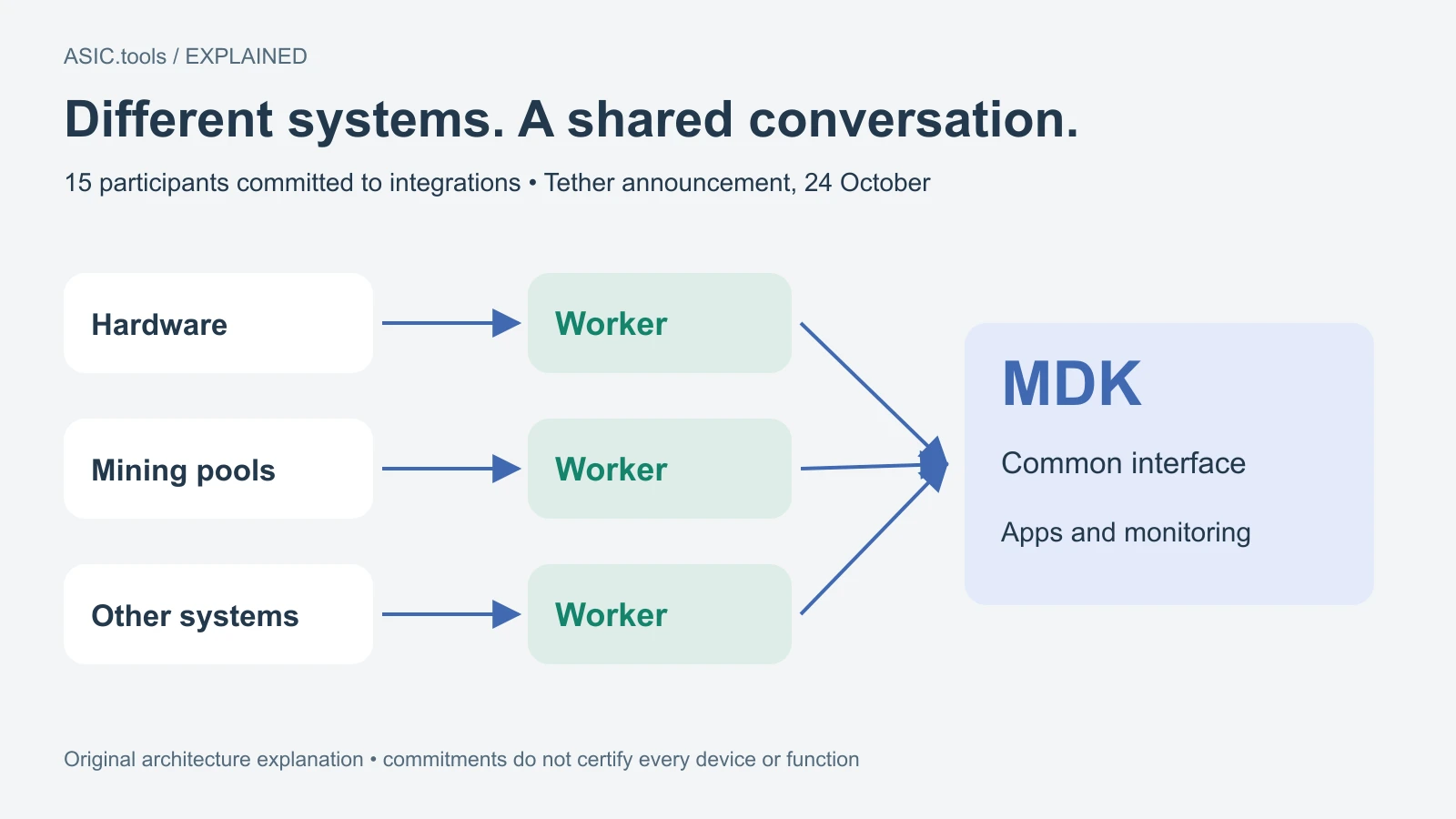
Tether announced on October 24 that 15 mining-industry participants have committed to building and maintaining integrations with its Mining Development Kit, or MDK. The practical idea is to make different machines, mining pools and management systems accessible through a shared software layer. For an operator with equipment from several brands, that could mean less time jumping between incompatible tools.
The list includes BITMAIN, MicroBT, Canaan, Bitdeer, Heatbit, Proto, Foundry, F2Pool, OCEAN and other participants. It spans equipment, operators, pools and the Stratum V2 ecosystem; it should not be read as 15 newly released miners. This is a commitment to integration work, not independent evidence that every model and function already works through MDK.
The underlying problem is ordinary: two devices can perform the same kind of mining while reporting their temperature, power or state in different ways. A dashboard built for one interface may not understand another. The proposed common layer is intended to reduce that repeated translation work rather than replace the physical machines.
A Worker is the translator
Tether calls each integration an MDK Worker. It is software that connects a participant’s existing hardware, pool or system to MDK. Think of it as an interpreter at a meeting: the participants keep their own language, but the application has a common way to ask questions and interpret the replies.
The release says each company chooses which functions it exposes and maintains its own Worker. That distinction matters. Sharing an interface does not mean every product has identical features, that manufacturers abandon their own software or that all models gain the same settings. Compatibility still has to be established for the actual combination being used.
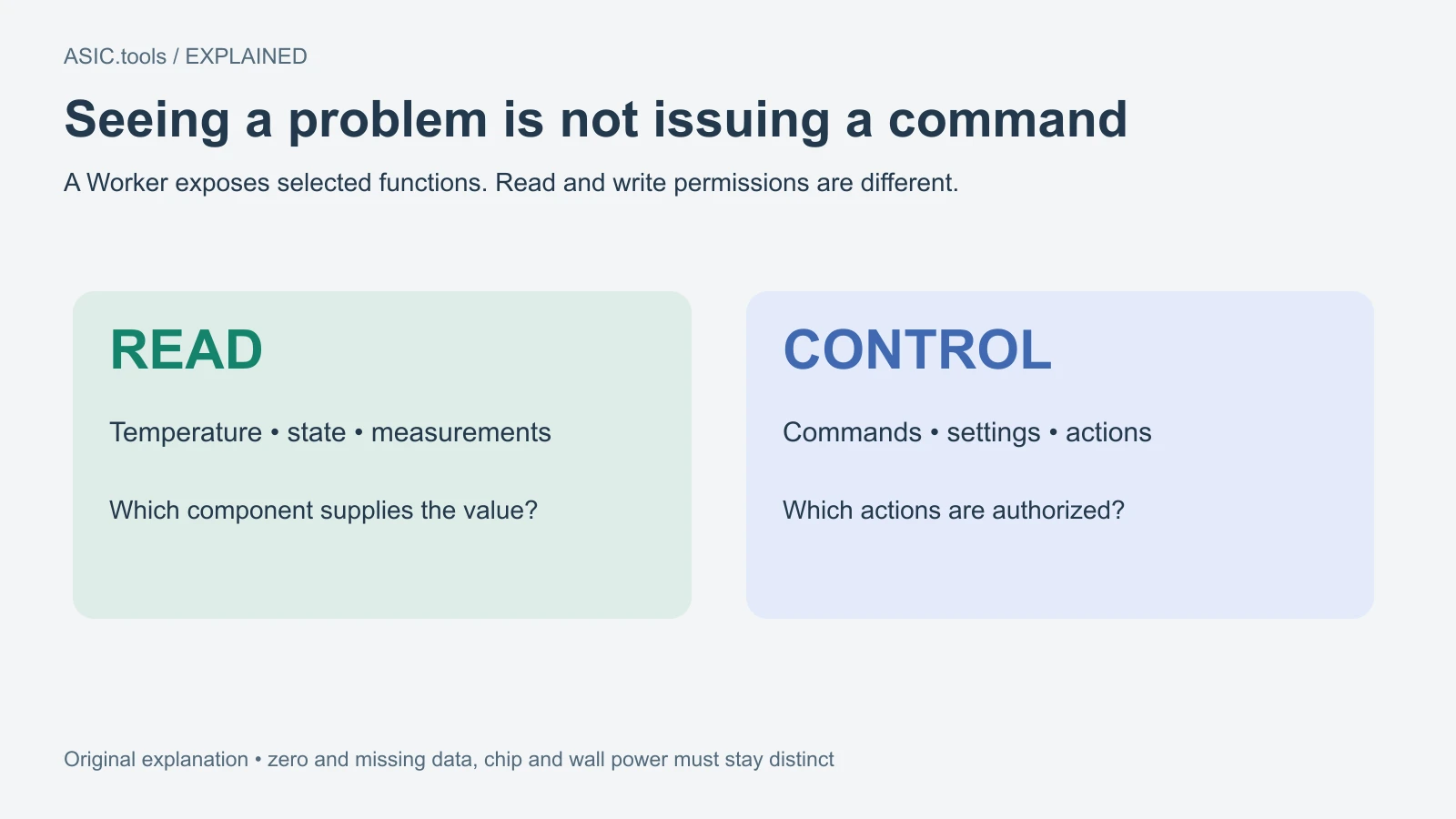
Monitoring and control are also different. Reading a temperature is not the same permission as changing a setting that affects a running machine. An operator evaluating an integration needs to know what it can read, what it can change and which component supplies each measurement. A common format helps organize that information; it does not make these decisions disappear.
Where the benefit could appear
For a mixed fleet, a shared interface could make it easier to compare device state, spot a problem and reuse one monitoring application across more equipment. The advantage is in managing the operation. It is not a claim that translating software messages increases a chip’s hashrate, lowers the electricity tariff or changes Bitcoin’s block reward.
Hashrate is the amount of hashing work attempted each second. An automation system may help an operator react to conditions, but the outcome still depends on the machine, the settings, uptime, electricity costs and network competition. Tether has not supplied a universal percentage gain that readers can safely insert into a profitability calculation.
Start a comparison with an equipment list and the functions actually supported, rather than with a claim of compatibility across an entire brand. Preserve the distinction between a real zero measurement and a missing reading. Likewise, a chip-power value and whole-device wall power cannot become directly comparable simply because they appear in the same dashboard.
AI is an application on top
Tether says its QVAC mining agent already operates on MDK as an early demonstration. The proposed direction is software that can monitor infrastructure, recognize problems and eventually take action. That statement describes Tether’s demonstration and development aim, not our independent test of an autonomous mining farm.
The shared layer is useful to more than AI. A conventional monitoring program can also use an integration. Open-source means the code is available for developers to inspect and build on; it does not mean an ordinary user receives a finished universal consumer app or that every possible installation has been audited.
The sensible boundary is what a particular application is authorized to do with a particular integration. Before relying on automation, an operator still needs to understand its scope and the difference between observing a problem and issuing a command. Neither the letters AI nor a shared interface establishes a guaranteed financial result.
What is available and what is planned
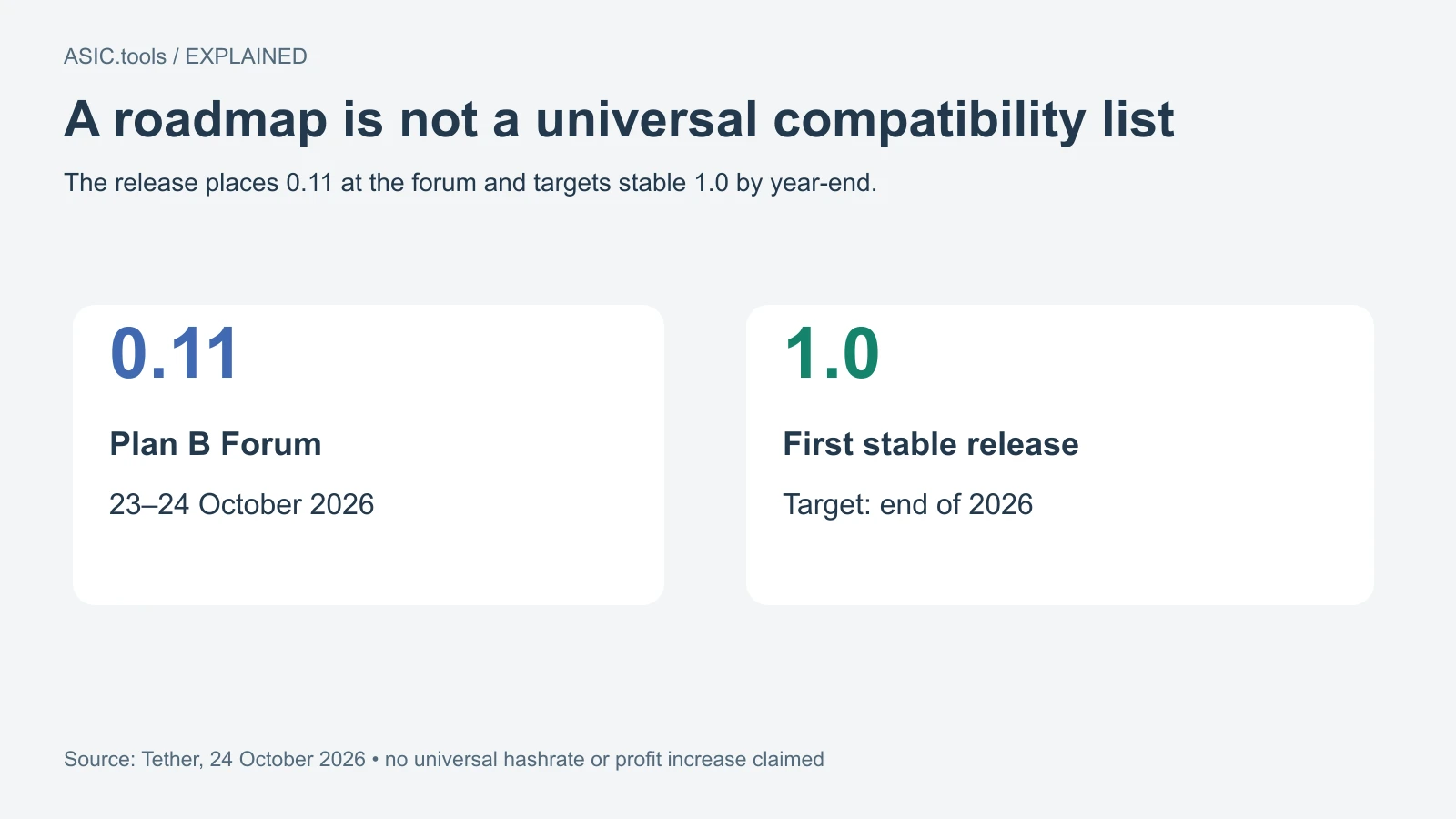
The announcement places version 0.11 at the October 23–24 Plan ₿ Forum and targets the first stable 1.0 release for the end of 2026. The end-of-year date is a target, not proof that stable 1.0 has shipped. Tether says developers can already begin testing and building integrations using the open project and documentation.
For readers, the useful next development is a maintained integration with clearly identified supported equipment and functions. The headline commitment matters because it could make future tools easier to reuse, but actual compatibility and operational results remain things to verify. MDK is management infrastructure, not a firmware image to install indiscriminately on any ASIC.
For now, keep mining estimates tied to the equipment and conditions you can establish. A shared management layer can simplify work without changing the basic economics by itself. That is the everyday significance of the announcement: fewer separate software conversations may eventually make a mixed group of miners easier to operate.
Source: Tether ↗
Mining calculator ↗