CKPool’s new solo block allocates 3.07689054 BTC after its service fee
Source report: 2026-10-27 · Editorial analysis published: 2026-10-28
Block 973413 was found October 27 at 15:11 UTC. Its coinbase divides 3.13968422 BTC between the winning address and a roughly 2% service share; public worker statistics do not identify the device.
A different block, with a visible service deduction
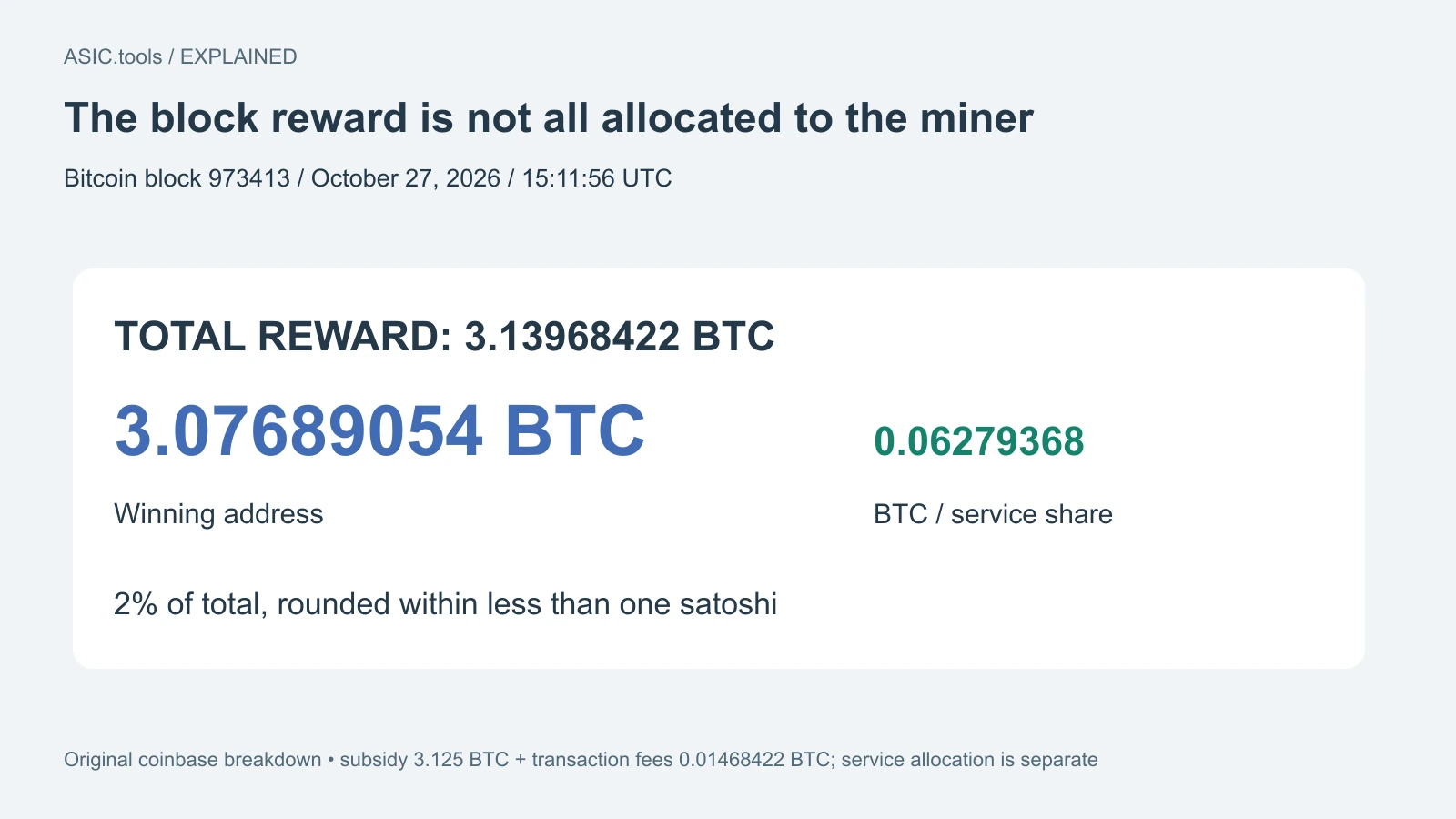
Solo CKPool found Bitcoin block 973413 on October 27, with a header timestamp of 15:11:56 UTC. Its reward transaction allocates 3.07689054 BTC to the winning address and 0.06279368 BTC to the service address. The total reward is 3.13968422 BTC. This is a new event after the FutureBit-tagged block reported earlier, not another account of that October 26 find.
The important detail for someone trying solo mining is that keeping an individual block’s reward does not necessarily mean using a free service. CKPool openly advertises a 2% fee. The two value-bearing outputs in this block are consistent with that arrangement. We checked matching block records from mempool.space and Blockstream and compared the reward transaction’s protocol fields through both explorers.
The block contained 1,465 transactions and has the full hash linked in the primary source. Those fixed identifiers distinguish this report from a changing pool homepage or a rounded social-media screenshot. They let a reader verify the allocation later without needing to know the miner’s name. Public block data and public receiving addresses do not reveal a recovery phrase or certify ownership of private keys.
The reward has two sources and two destinations
The block’s 3.13968422 BTC consists of the fixed 3.125 BTC subsidy and 0.01468422 BTC in transaction fees. A satoshi is one hundred-millionth of a bitcoin: the total is 313,968,422 satoshis. Of that, 307,689,054 go to the winning address and 6,279,368 to the service address. A third output has zero value and carries a protocol commitment, not another monetary payment.
Two percent of the total is 6,279,368.44 satoshis, so the service output differs from exact percentage arithmetic by less than one satoshi. This explains the rounding without inventing another charge. Transaction fees paid by Bitcoin users are part of the block reward; CKPool’s service fee is a deduction from that reward. Calling both simply “fees” can obscure why the miner’s allocated amount is lower than the headline total.
What the public worker data actually shows
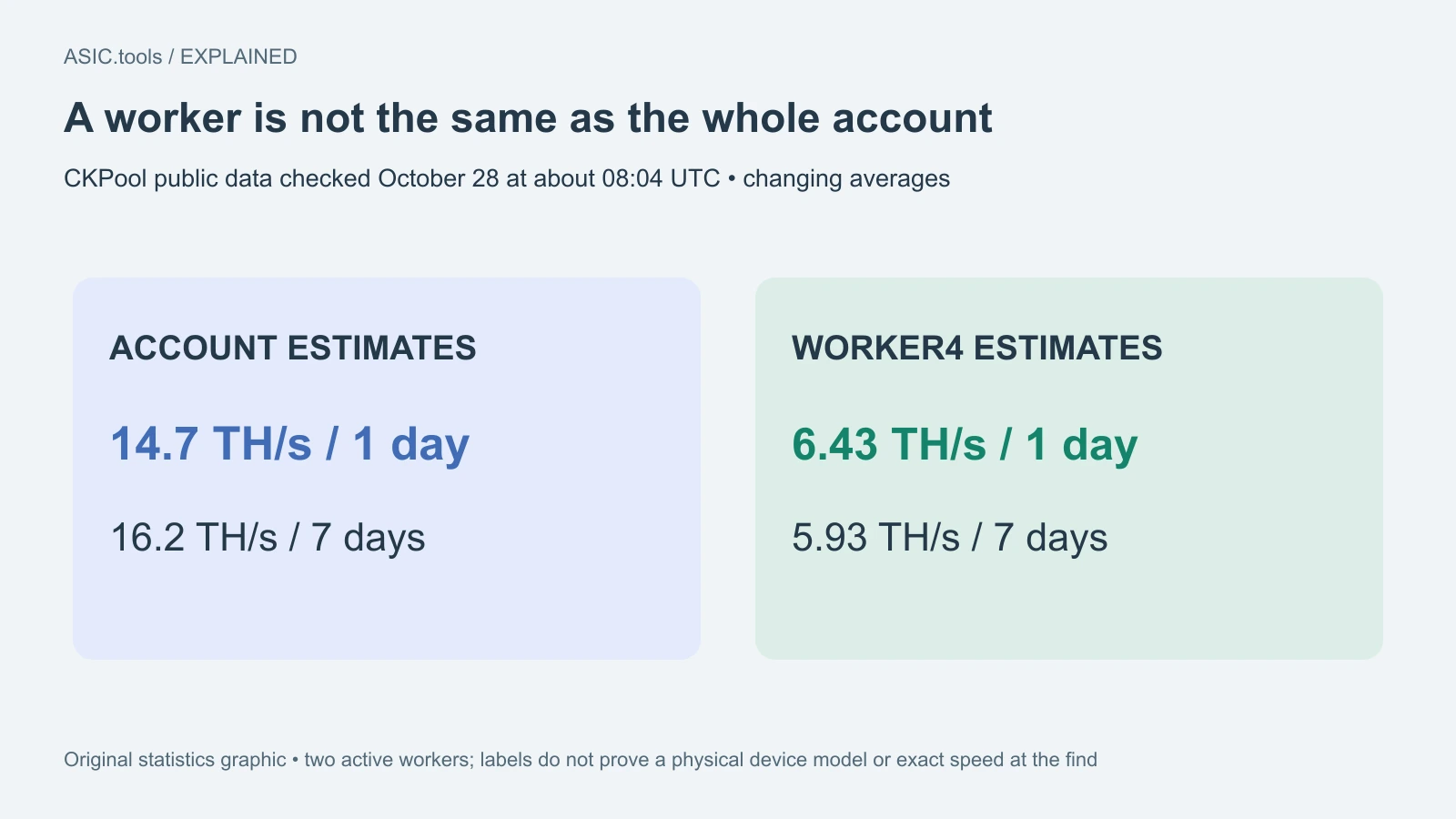
At our October 28 check around 08:04 UTC, the winning address’s CKPool account showed a one-day average of 14.7 TH/s and a seven-day average of 16.2 TH/s. These are live estimates over different windows, not the exact computing rate at the instant the block was found. The account reported two active workers and also retained entries for inactive ones.
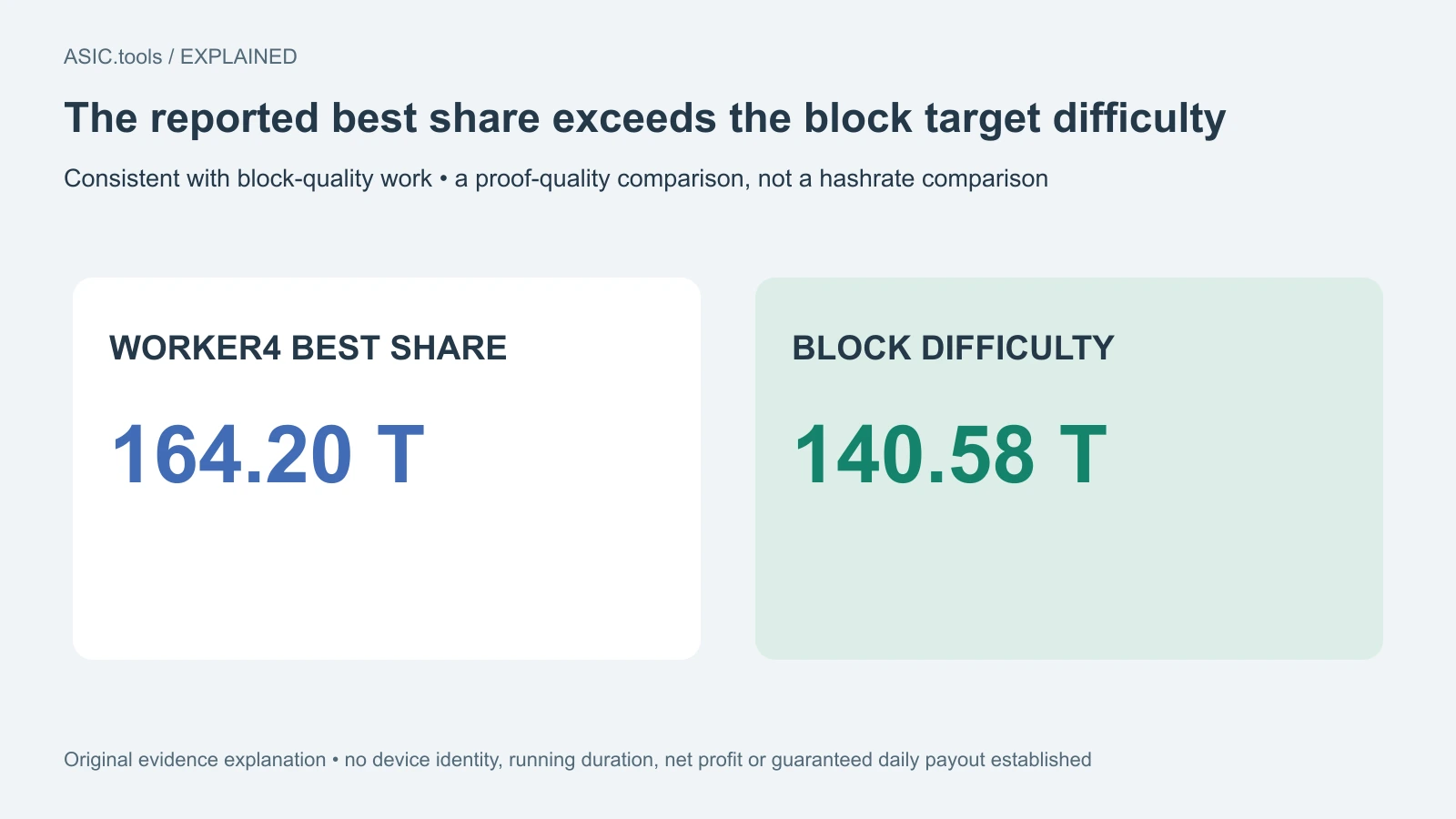
One entry, worker4, had a one-day estimate of 6.43 TH/s and a seven-day estimate of 5.93 TH/s. Its best-share value was approximately 164.20 trillion, above the block’s network difficulty of 140.58 trillion, consistent with a block-quality share. That supports describing a small reported worker, but a worker label can represent a machine, several devices or a proxy. It does not establish an Avalon Nano, Bitaxe or any other specific physical device.
Solo work does not become a steady daily payment
The coinbase contains CKPool and solo.ckpool.org text, supporting the service attribution. CKPool describes itself as shared infrastructure for individual solo miners, rather than a scheme that divides every discovered block among all connected users. It lets miners receive a winning reward at their own address, with the stated service deduction. That is different from receiving a small regular portion of other users’ blocks.
The same arrangement also leaves the individual with long periods in which no block is found. Another person’s success does not improve the chance of the next hash or establish a timetable for a particular home miner. Live average hashrate, a historical best share and the number of connected workers answer different questions; none is a guaranteed daily income statement or proof of how long the winning physical machine had been running.
The amount allocated is not net profit or a cash withdrawal
A coinbase is the special transaction that creates a block reward, and Bitcoin requires 100-block maturity before newly created outputs can be spent. A recorded output also does not show who holds its keys, what hardware they bought or whether coins were later exchanged for cash. Equipment, electricity and cooling costs remain unknown in this case. The 3.07689054 BTC figure is the on-chain allocation after the visible service share, not independently calculated net profit.
For a reader comparing solo options, check the operator’s fee and how reward outputs are formed, then keep the block’s actual record separate from changing dashboard estimates. This find is a real example of a CKPool worker receiving a block-sized allocation. Its useful lesson is precise: an individual solo outcome can be genuine while “100% with no pool fee” is still an inaccurate description of the service used.
Source: Bitcoin blockchain / Solo CKPool ↗ · Independent Blockstream block record ↗ · Solo CKPool terms and 2% fee ↗ · Winning address public CKPool statistics ↗
Mining calculator ↗