Bitdeer mined 1,355 Bitcoin in September: the yearly jump hides a smaller monthly gain
Source report: 2026-10-19 · Editorial analysis published: 2026-10-20
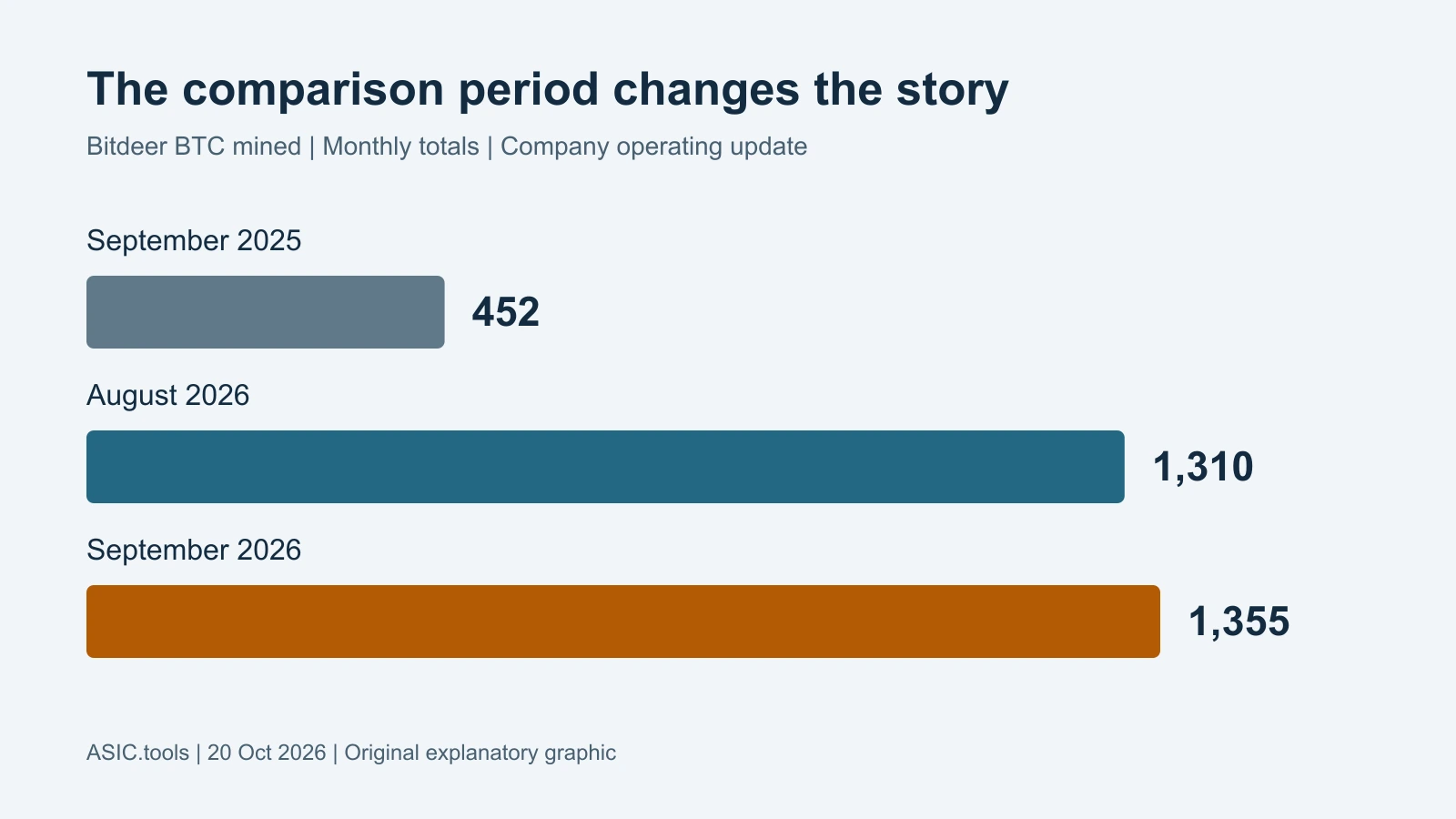
The October 19 operating update reports nearly three times last September’s output, but only 3.4% more than August. Different comparisons tell different stories about the same mining business.

A big annual rise, a modest monthly step
Bitdeer reported on October 19 that it mined 1,355 BTC in September, compared with 1,310 in August and 452 in September 2025. That is roughly a 200% annual increase, meaning output almost tripled. The month-on-month gain is 45 BTC, or about 3.4%. Keeping both comparisons together makes the news easier to judge than the largest percentage alone.
The figures come from an unaudited operating update. They measure coins produced during the month, not dollar profit. A mining business can produce more coins while its power bill, financing costs or market price also change. The output number is useful evidence of activity, but it answers a narrower question than whether the whole business became more profitable.
What the machines actually contribute
Bitcoin mining uses specialised computers to compete to add valid blocks to the network’s shared transaction record, called the blockchain. Hashrate describes the speed of that work: how many calculation attempts the equipment makes. An exahash per second, written EH/s, is a very large unit for the combined computing power of an industrial fleet.
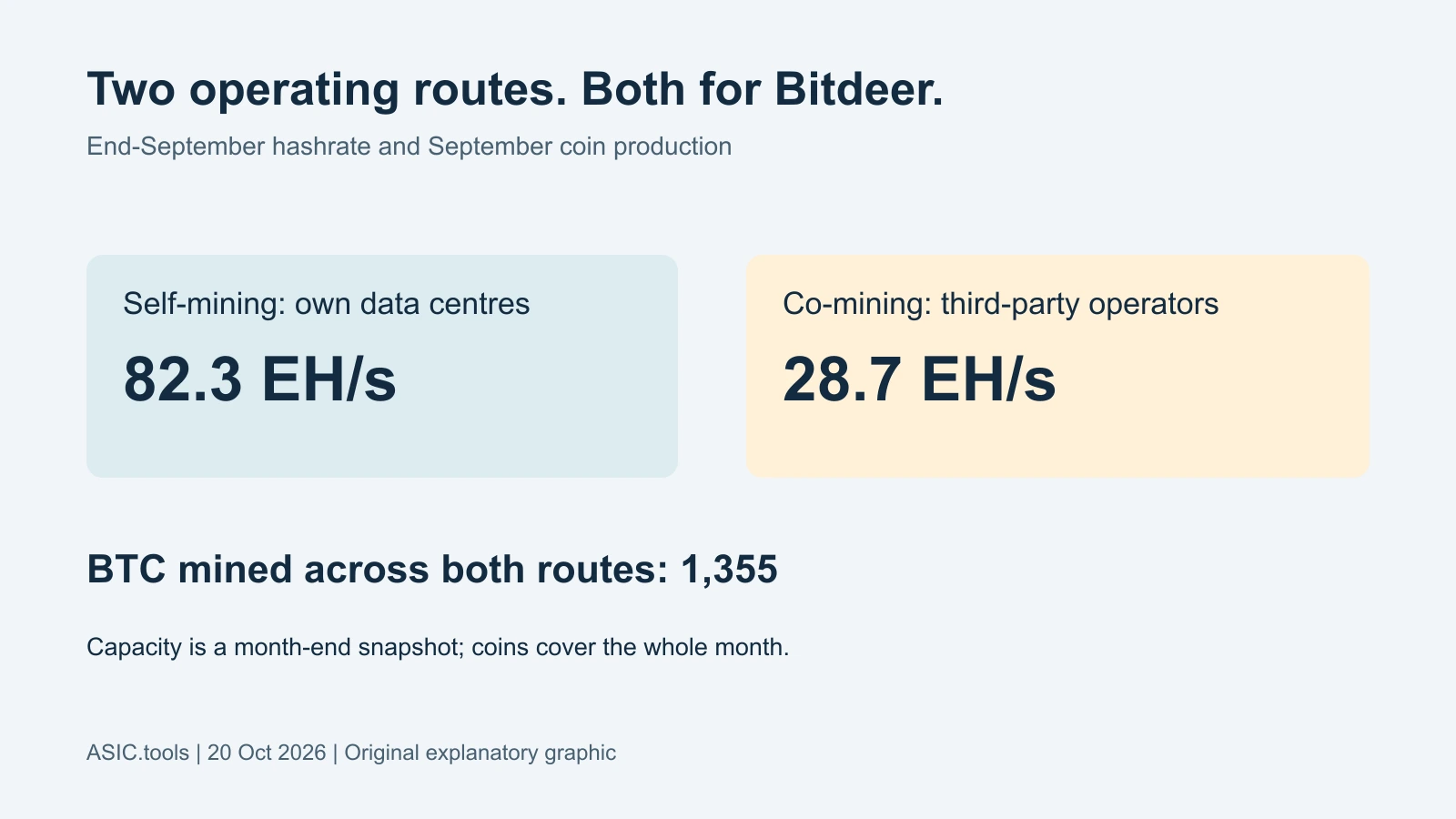
Bitdeer lists 82.3 EH/s of self-mining at its own data centres at September’s end, up from 79.9 in August. A month-end capacity figure is like a photograph taken on the last day. Monthly coin production is more like a film of the whole month. Equipment added late in the period cannot be assumed to have worked at full capacity throughout it.
One owner, two ways to operate
The company separately reports 28.7 EH/s of co-mining, up from 21.6 EH/s. In Bitdeer’s definition, this also uses its equipment for its own account, but third-party data centres operate it. The difference is who runs the site, rather than a claim that those coins belong to unrelated hosting customers. Its 1,355 BTC production figure includes both self-mining and co-mining.
That is why the source’s definitions matter. Readers should not divide all reported coins by only the own-site hashrate and call the result the fleet’s measured efficiency. Coins cover a month and both operating routes; the capacity line covers one date and one category. Comparing those mismatched boundaries produces a precise-looking number that does not measure what it appears to measure.
Bigger fleets do not enlarge every miner’s slice
A mining machine competes with other machines on the same network. More computing power can improve an operator’s share of that competition, but it does not give every existing machine a proportional increase in rewards. Network difficulty, the setting that regulates how hard it is to find a valid block, is another part of the picture.
A useful analogy is a group sharing a pie: bringing more participants does not automatically make the pie grow at the same rate. For an individual owner, the important question is how their own equipment performs relative to the wider network. A large company’s higher monthly output therefore should not be copied directly into a home miner’s income estimate.
The practical check for your own setup
Start with the device’s actual power use and mining performance. Then include the electricity price you pay, pool fees and downtime. A pool combines miners’ work and distributes payments under its rules; downtime is time the equipment is not producing. These inputs connect the machine on your premises to a running-cost calculation much more directly than an industry headline.
Keep income and costs in compatible units. BTC describes coins, dollars describe money, watts describe power and EH/s describes computing speed. Converting one into another requires a stated price or other assumption. Neither a hashrate total nor a coin-production figure by itself supplies the electricity tariff, the market selling price or the cost of buying a machine.
Production is different from the coins still held
The update reports 47 BTC held at September’s end, compared with 61 in August. Its definition excludes customer deposits and includes coins pledged as collateral. This is a balance at a date, while production describes coins generated across a period. A company can have a high output and a small reported reserve without those two figures contradicting each other.
Do not subtract the closing reserve from monthly production and label the difference confirmed sales. That would require the opening balance and a complete record of movements, including other transfers or transactions. The report’s operating table is not that cash-flow record. For an ordinary reader, the useful distinction is between making something during the month and still holding it on the last day.
How to read the next production update
Check whether the comparison is with the previous month or the same month last year. Then look for the dates and the company’s definitions of the operating categories. A month with a different number of days or a fleet that changes during the period can make a simple total less comparable than it first appears. Reported output is an observation, not a promise for the following month.
The new information here is a September result of 1,355 BTC across Bitdeer’s stated self-mining and co-mining operations. It shows continued expansion, with a much larger yearly than monthly change. For ordinary readers, that is the useful distinction: the biggest percentage in a mining announcement is only meaningful once its starting point and measurement period are clear.
Source: Bitdeer / SEC ↗
Mining calculator ↗