Bitdeer AI secures 65.1 MW for A202 in Johor; energization targeted for 2027
Source report: 2026-09-14 · Editorial analysis published: 2026-09-16
A ten-year data-center agreement covers A202 in Malaysia. The 65.1 MW refers to IT load; customer contracts and the $7 billion opportunity pipeline remain separate.

Analysis and practical implications
This section is our analysis and illustrative calculations, separate from the source report.
An infrastructure agreement with a future delivery date
Bitdeer announced on September 14 that its AI business secured the 65.1 MW A202 facility in Johor, Malaysia, under a ten-year data-center services agreement. Energization is expected in the third quarter of 2027. The power figure describes critical IT load. This is a capacity commitment with a future delivery milestone, not a statement that the new servers are already operating. For readers following mining companies’ diversification, the important question is which part of a computing business has been secured and what still has to happen before customers receive service.
Capacity, customers and commercial discussions
The release explicitly says no customer offtake commitments for A201 or A202 had been entered into at the announcement date. Its AI-cloud opportunity pipeline above $7 billion is management’s estimate of potential deals under discussion, not contracted backlog or booked revenue. A useful project record therefore keeps infrastructure rights, executed customer commitments, delivered service and collected cash in separate columns. A large number in one column cannot fill the others. This prevents a common reading error: treating a contract to obtain data-center capacity as a contract to sell every unit of that capacity.
IT megawatts and a utility meter are different
An independent example shows the distinction. Imagine a facility with 10 MW of IT load and a hypothetical PUE of 1.20. Total facility power would be 12 MW, including 2 MW of supporting consumption. At that constant draw for 24 hours, energy would be 288 MWh. These inputs are illustrative and do not describe A202’s measured efficiency. PUE is total facility energy divided by IT energy over a consistent boundary and period. Cooling, power conversion and other support systems affect the numerator. Comparing a mining site’s utility meter with a GPU site’s IT rating without matching boundaries can produce a misleading comparison.
Rack density adds another constraint
Suppose that same hypothetical 10 MW IT budget is allocated at 100 kW per fully loaded rack. Simple division gives 100 racks before other design constraints. The result is an accounting illustration, not a proposed A202 layout. Physical space, cooling connections, network capacity and maintenance access can bind before the nominal electrical limit. Redundant components also need careful treatment: two backup paths serving the same load are not automatically twice the sellable compute capacity. A deployment plan should tie rack quantities to usable power and cooling at the chosen reliability level rather than infer server counts from a headline MW figure.
Installed equipment and billable work
For a second independent illustration, consider 100 identical compute units, each available for 24 hours. That is 2,400 available unit-hours; at an assumed 60% paid utilization, only 1,440 unit-hours are billable under a simple usage-based model. At 80%, the figure becomes 1,920. This example is not a Bitdeer forecast and does not describe its pricing or contract structure. Reservations, fixed commitments and consumption billing behave differently. The operational lesson is to track availability and commercial utilization separately, because installing equipment, making it usable and selling its time are distinct steps.
Cooling and networking must be commissioned together
A power connection alone cannot prove a complete AI service is ready. A practical acceptance plan would test the electrical chain, coolant distribution, leak detection where applicable, network paths and workload behavior under defined conditions. It would also record the response when a component or connection is unavailable. These are editorial engineering criteria, not claims about defects at this project. For an operator experienced in ASIC mining, the change in workload matters: GPU services must be assessed against the customer’s actual compute and communication requirements, rather than judged only by how many watts a building can receive.
Reusing a campus does not remove dependencies
Locating an expansion beside existing infrastructure can simplify some work, but shared resources should be mapped. A common upstream connection, cooling segment or network route may become a shared constraint. A useful review distinguishes existing, contracted and newly required equipment, then checks whether the expansion changes maintenance access or operating headroom. The analysis is about dependencies, not a claim that A202 has a particular failure mode. Similar-looking campus buildings can have different service readiness dates, and a ready neighboring building is not proof that the next phase has passed its own acceptance tests.
Milestones that can be checked later
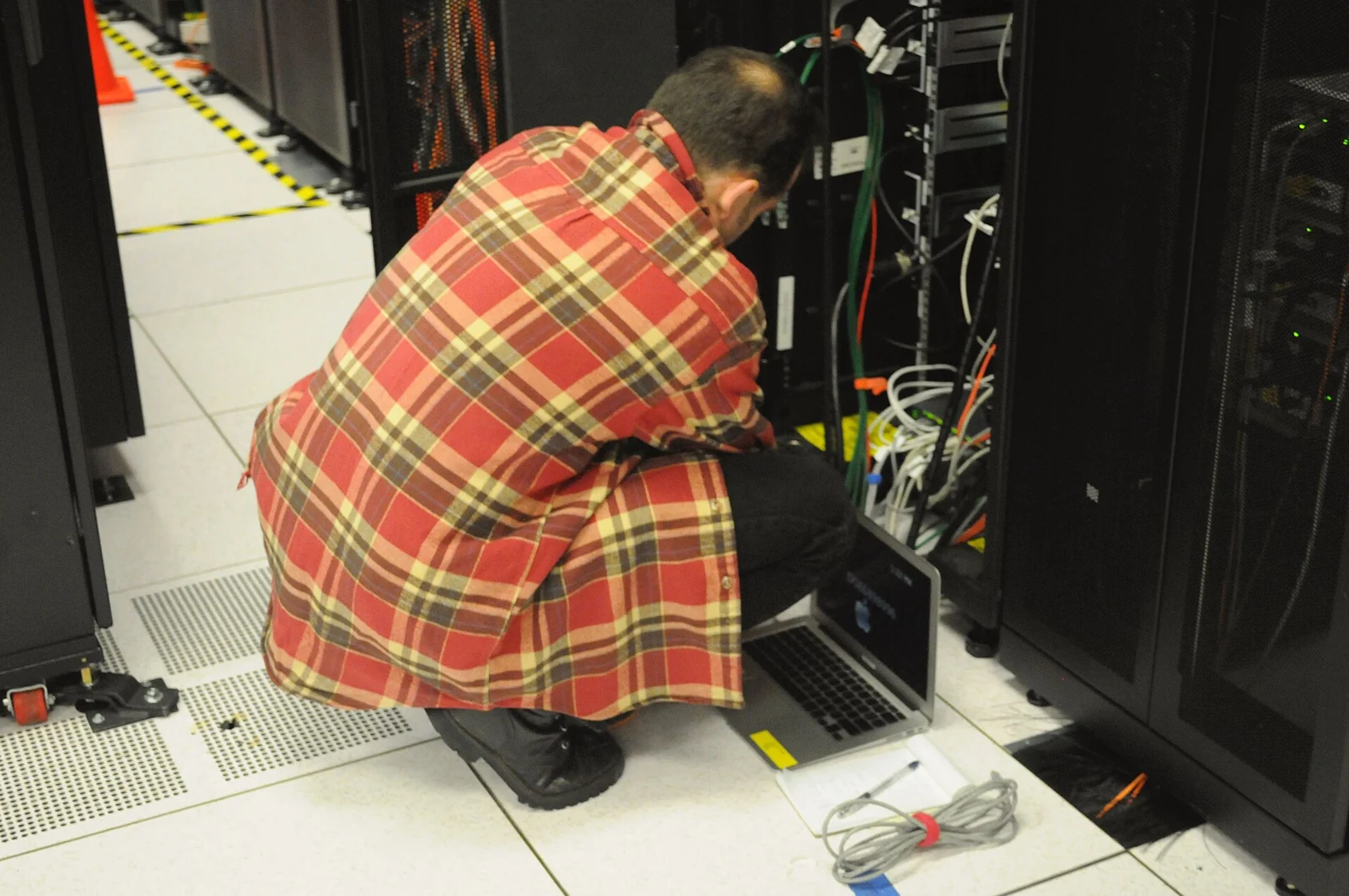
Track handover conditions, energization, commissioned IT capacity, signed customer contracts and service commencement as separate dated events. Compare later announcements with those categories instead of adding every project-stage figure together. The September agreement is relevant to mining-sector infrastructure diversification, but it does not change any ASIC model’s hashrate or establish a present-day hosting tariff. The arithmetic in this article is original illustrative analysis. The photographs show archival Johor Bahru city context and a technician at NERSC; neither is represented as a photograph of the A202 building or installed Bitdeer equipment. The source announcement is dated September 14; our publication on September 16 does not change the event date.
Source: Bitdeer ↗
Mining calculator ↗