unMineable adds Quantus for older GPUs: choosing a payout coin still matters
Source report: 2026-10-24 · Editorial analysis published: 2026-10-26
An October 24 notice enables Quantus-based mining across unMineable’s supported payout coins and names GTX 1080 and RX 470/570 cards. Support is not a measured profit guarantee.
An additional option for an existing graphics card
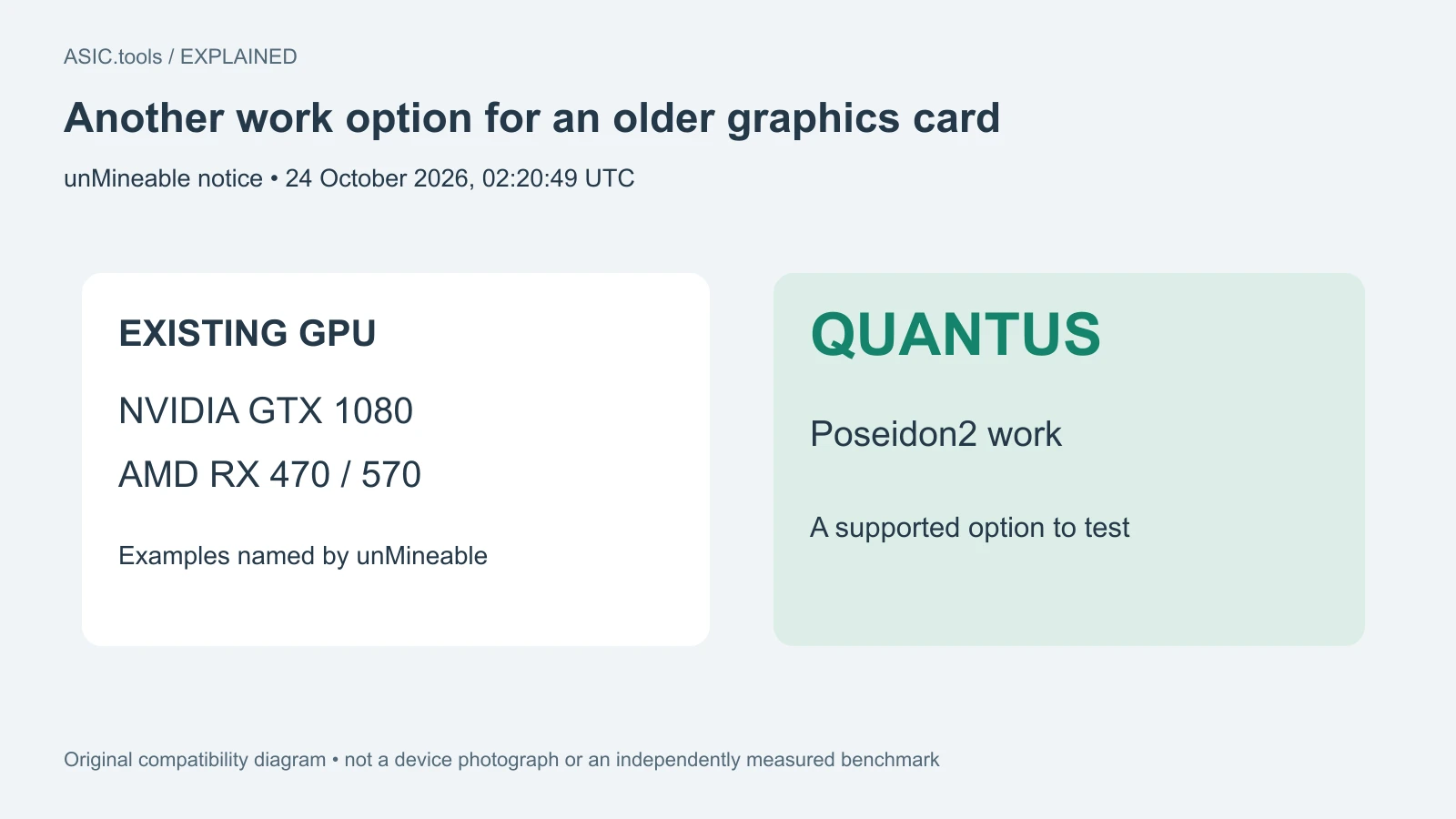
unMineable announced on October 24 that Quantus-based mining is enabled for all its supported payout coins. The notice specifically names older NVIDIA GTX 1080 and AMD RX 470/570 graphics cards. For someone who already owns such a card, the change adds a route to test without assuming a new hardware purchase.
The provider’s public notice feed dates the announcement to 02:20:49 UTC on October 24. We checked that feed on October 26. This is a change in the service’s supported mining options, not evidence that Quantus itself launched that day or that every edition and memory size of the named cards was independently tested by us.
The official setup data calls the option Quantus and identifies its work as Poseidon2. In plain terms, that is the computation the card must perform. A graphics card running suitable software can choose among several kinds of work; a Bitcoin ASIC built for SHA-256 cannot become a Quantus GPU by changing a pool address.
The coin you mine and the coin you receive can differ
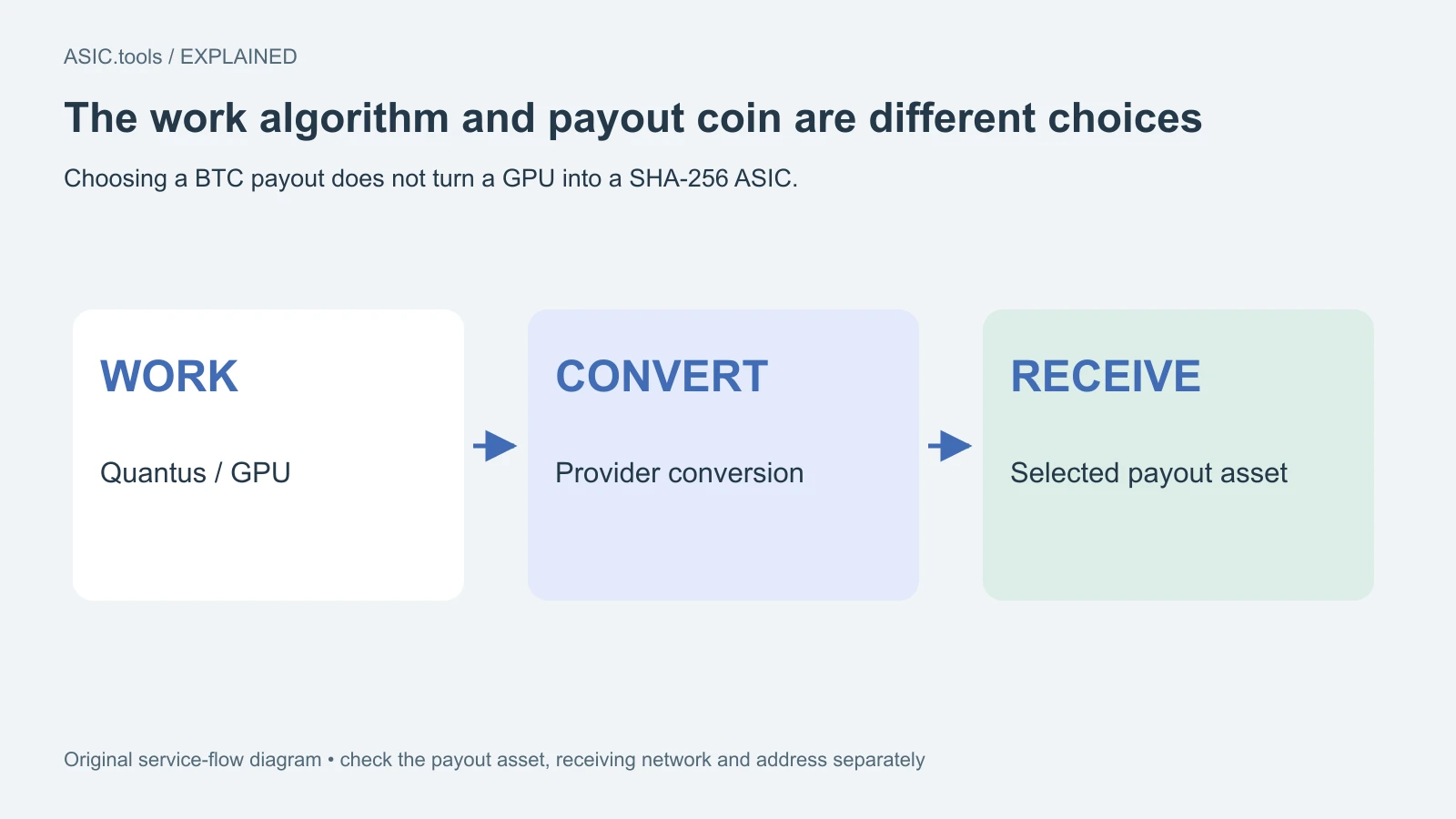
unMineable combines mining with automated reward conversion. Its coin page explains that users supply CPU, GPU or ASIC work on a supported proof-of-work algorithm, while the service converts rewards into the chosen payout asset. The new announcement concerns Quantus work within that model.
For example, choosing a supported Bitcoin payout does not mean the graphics card is directly solving Bitcoin’s SHA-256 blocks. The work, its intermediate rewards and the asset sent to the wallet are separate steps. This distinction helps explain why a displayed BTC balance is not proof that the device is operating as a Bitcoin ASIC.
The selection also does not make every payout asset mineable on its own blockchain. Before starting, identify the work algorithm, the payout coin and the receiving network. An exchange deposit address that accepts one network is not automatically suitable for a different route, even when a familiar token name appears on screen.
Compatibility is the starting point of a test
The announcement gives examples of supported older cards; it does not provide a complete matrix of memory variants, operating systems, drivers and miner-software versions. Use the provider’s current setup instructions for the actual card rather than borrowing a command intended for another algorithm.
Begin with a small, reversible configuration change and keep the previous working settings. Check that the mining program reports accepted work, then confirm that the service records that worker. A local speed number alone does not show whether the remote service accepts the work or credits the intended account.
Watch stability, temperature and whole-system electricity use during the test. A result that looks fast for a few minutes can be less useful if the card resets or the computer draws much more power than expected. Power reported for a graphics chip can exclude the processor, fans, memory and conversion losses in the power supply.
Compare money credited with electricity bought
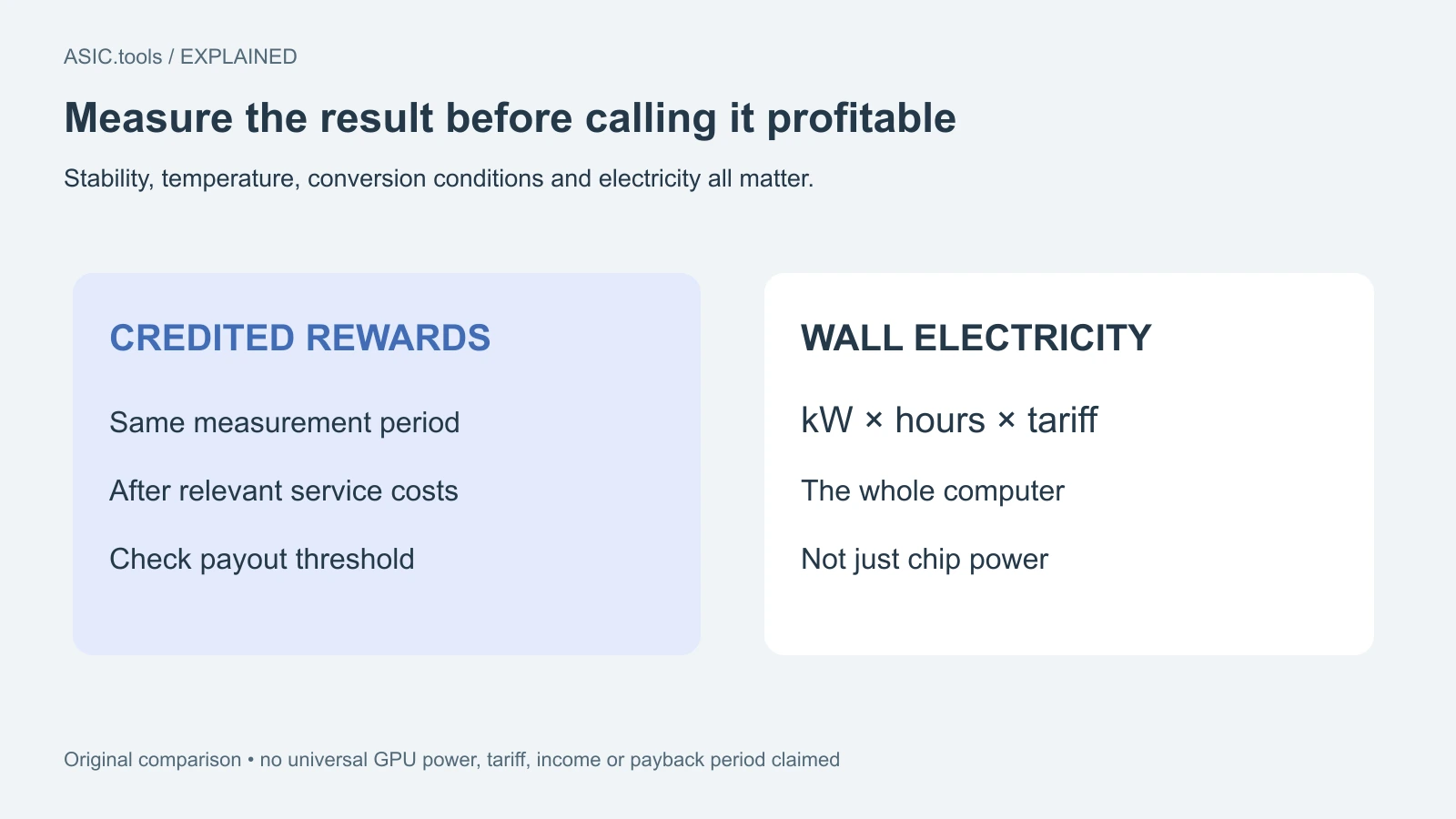
To decide whether to continue, compare credited rewards over a representative period with the electricity recorded at the wall. Keep the period and currency consistent. A short estimate calculated from a momentary coin price is less informative than what the service actually credited during the same hours the meter measured.
The useful electricity calculation is simple: average wall power in kilowatts multiplied by running hours and the applicable price per kilowatt-hour. Use the tariff that applies to that home, including time-of-use periods where relevant. The announcement does not provide a universal power figure or electricity price to substitute for a measurement.
Also account for payout thresholds, conversion conditions and withdrawal costs shown for the selected asset. A balance below its payout threshold is different from spendable coins already received in a wallet. If the goal is a particular coin, compare the eventual amount received rather than treating every displayed reward figure as cash in hand.
There is no fixed profitability ranking
The same notice says PearlPoW currently leads in profitability for modern GPUs. That is the service’s dated assessment, not our benchmark and not a permanent rule for every machine. It can change with coin prices, network competition, software, rejected work and electricity costs.
Quantus support can be relevant even without proving it is the best option. It gives an owner of existing hardware another configuration to compare under the same conditions. The sensible result of a test can be to keep the old option or stop mining if credited rewards fail to cover the household’s additional costs.
Cooling, noise and wear also matter in a home. Reusing a card is different from buying one specifically on the strength of a short announcement. No reliable payback period follows from the notice alone, so the change should not be turned into a promise that a particular second-hand GPU will pay for itself.
Use the new notice, keep older dates straight
The homepage keeps several older pinned notices beside the new one. Its Ghostrider and RTM payout update is dated October 11, not October 24. We checked the timestamps separately so that an older discontinuation is not presented as a second new event or confused with Quantus support.
Install software from the project or provider’s official download route and verify the destination before entering account or payout details. The service warns that it has no official Telegram or Discord channels. Someone offering to activate a miner through a private message should not be given wallet recovery words or remote access on that claim.
For an existing GPU owner, the practical change is a new supported work option with a familiar choice of payout assets. Select Quantus deliberately, verify accepted work and the receiving network, and let measured electricity use and credited rewards determine whether it is useful. The announcement itself does not require replacing an ASIC or moving every working miner.
Source: unMineable ↗ · Official notice feed with timestamps ↗ · Supported payout coins and conversion model ↗ · Quantus setup selection ↗
Mining calculator ↗