A small solo miner found Bitcoin block 977057: 3.066 BTC after the pool fee
Source report: 2026-11-22 · Editorial analysis published: 2026-11-23
CKPool reports roughly 11.1 TH/s for the account and 3.47 TH/s for its winning worker, using daily averages. On-chain outputs confirm the reward split.
A rare block for a small mining account
A miner using the European Solo CKPool service found Bitcoin block 977057 on 22 November. Its header timestamp is 12:54:23 UTC. The pool operator congratulated an account averaging about 11.1 TH/s over a day, with the successful worker averaging 3.47 TH/s over the same window. It is a striking example of small equipment participating in Bitcoin's block search.
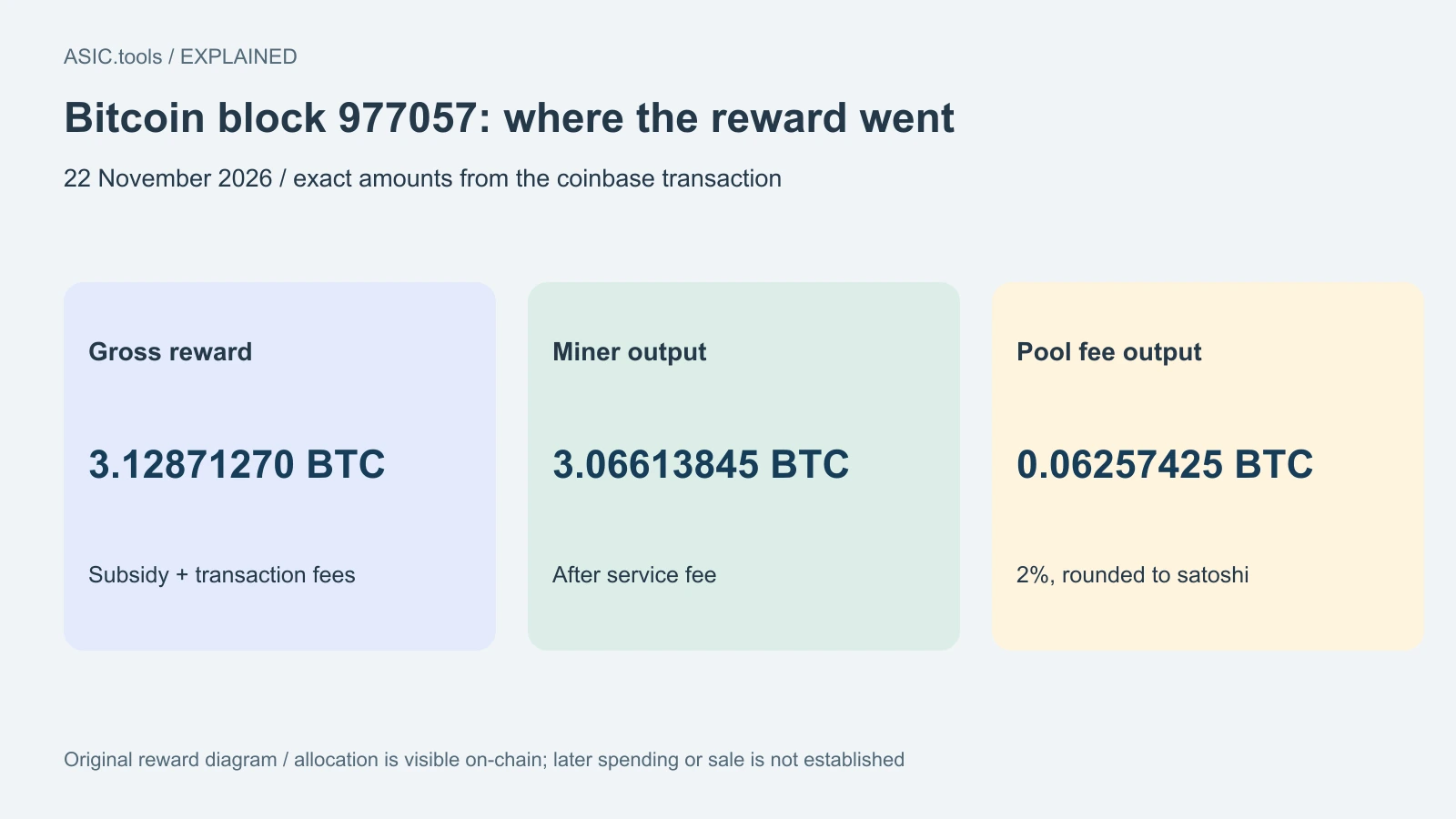
The block carried 3.12871270 BTC in total reward: the 3.125 BTC subsidy created under Bitcoin's rules plus 0.00371270 BTC in transaction fees. The explorer records 584 transactions in the block. That gross reward is not the amount assigned entirely to the winning miner after the pool's charge.
The coinbase transaction, which allocates a block's reward, assigns 3.06613845 BTC to the miner's address and 0.06257425 BTC to another output. Those two spendable outputs add to 3.12871270 BTC. The split matches the service's stated 2% fee after rounding to a satoshi, Bitcoin's smallest unit. These are reward allocations, not evidence of a later sale or cash withdrawal.
Why the published hashrate numbers differ
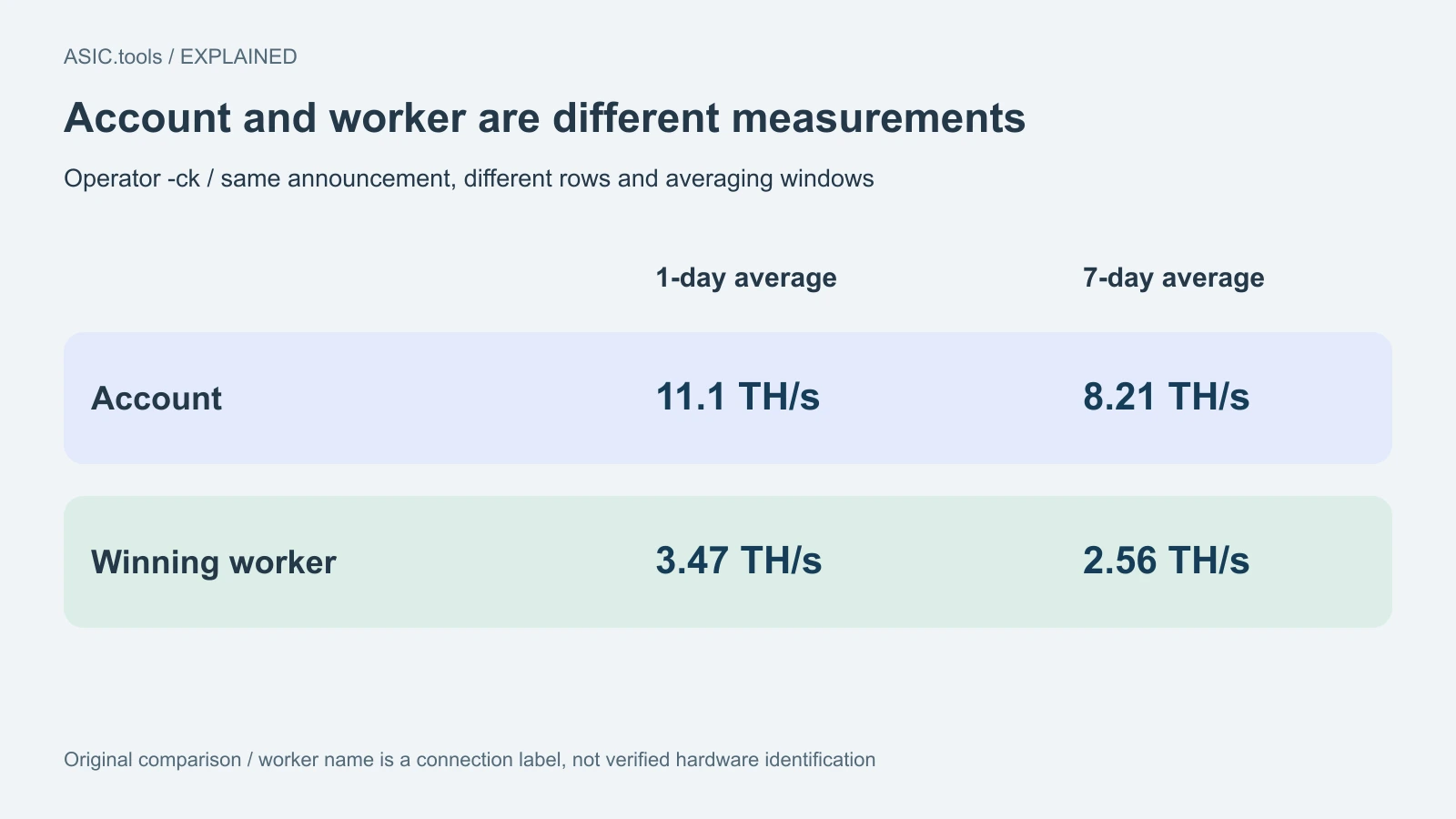
TH/s means trillions of hashing attempts per second. The operator's account log shows 11.1 TH/s as a one-day average and 8.21 TH/s as a seven-day average. Its winning worker shows 3.47 TH/s for one day and 2.56 TH/s for seven days. Numbers taken from different rows or time windows describe different things.
An account can aggregate work from more than one worker, and a worker is a named connection used to identify submitted work. It is not a verified inventory of a particular physical device. The operator's worker label does not independently establish the maker, board version, power consumption or purchase cost of the machine that found the block.
That distinction matters when reading a headline that calls this an “8 TH/s miner” or names a device from a connection label. The primary announcement supports the stated account and worker averages, not a hardware inspection. This report therefore keeps the averaging windows visible and makes no claim about an unverified model or electricity bill.
A win does not shorten the next wait
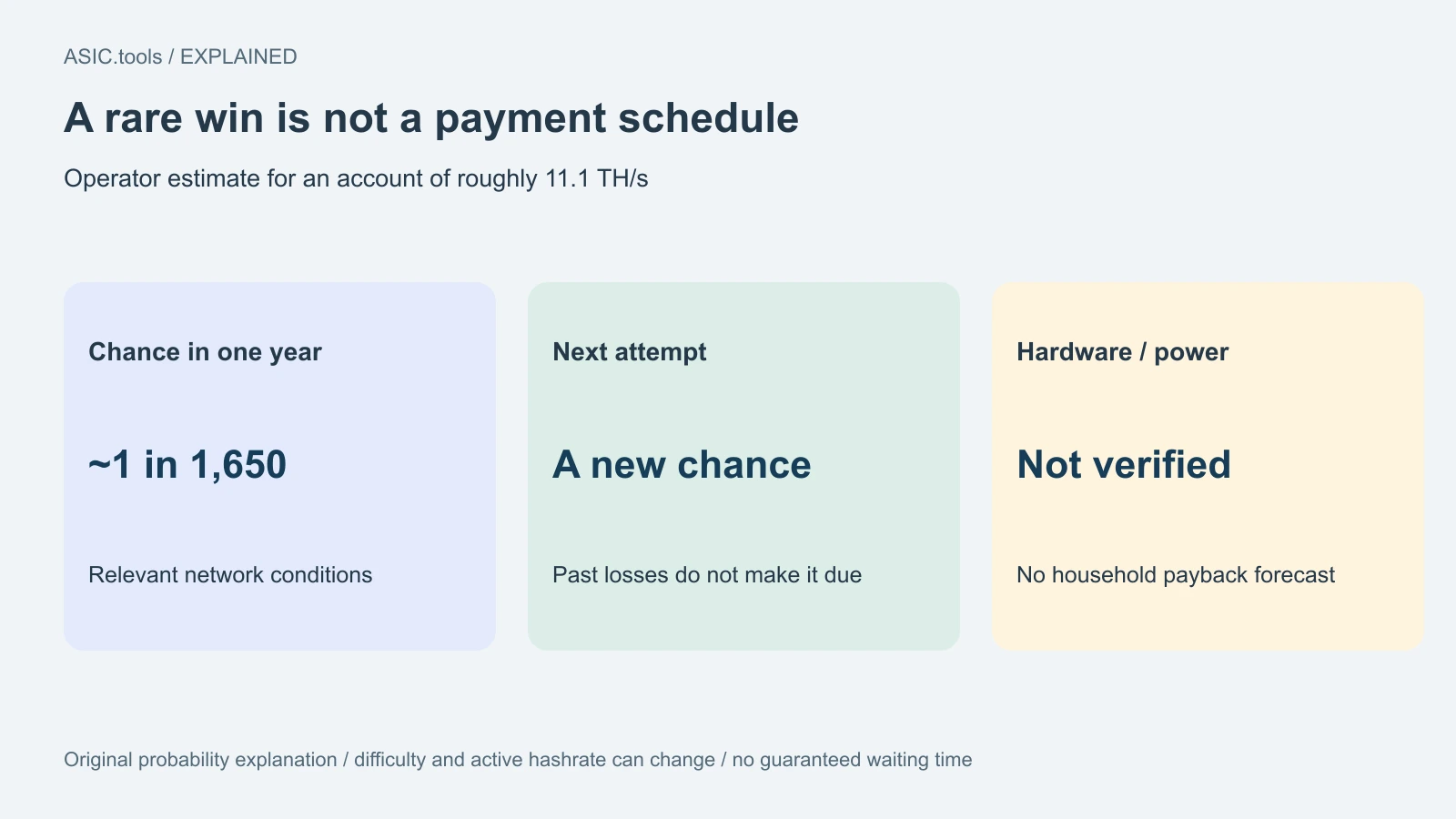
The pool operator estimates that an account of this size has roughly a one-in-1,650 chance of finding a block in a year. It is a probability estimate at the relevant network conditions, not a schedule that guarantees one block after 1,650 years. Bitcoin difficulty and the account's active hashrate can change over time.
Every hashing attempt is another chance; a long unsuccessful run does not make the next one due. The same principle explains how a small miner can succeed unusually early while a much larger operator waits longer than expected. One winner demonstrates that an outcome is possible, but says little about a typical household miner's next month's revenue.
At fixed difficulty and continuous hashrate, more attempts improve the probability over a given period. Buying a device at a discount, changing its name in a dashboard or simply keeping an old losing streak does not do so. Turning this block into a payback forecast would require assumptions about energy, equipment cost, network conditions and payout structure that the event itself does not supply.
What Solo CKPool actually provides
The official service describes an anonymous solo-mining connection with a 2% fee. It supplies infrastructure that lets compatible miners submit work toward a block. The term “pool” here does not mean that every connected miner receives a regular share of somebody else's successful block under a conventional pooled payout scheme.
In ordinary pooled mining, a payout method can distribute the value of many miners' work over time, reducing individual income variance. Solo mining concentrates the outcome around whether the miner finds a block. The small account in this event succeeded, while other participants' electricity costs do not disappear during a wait. Choosing between the two changes the pattern of payments, not Bitcoin's underlying proof-of-work requirement.
The useful news is both the confirmed success and its scale: a small account received a large but rare block reward, with the fee visible in the transaction. Readers can inspect the operator's dated announcement, the block and the reward outputs themselves. The case supports an honest account of a solo win without turning a fortunate result into a promise of routine income.
Source: Solo CKPool / Bitcoin ↗ · Bitcoin block 977057 ↗ · Coinbase transaction and reward outputs ↗ · Official Solo CKPool service and 2% fee ↗
Mining calculator ↗