Nerva activates fork 14 and switches CPU mining to CryptoNight-Adaptive v8
Source checked: 2026-11-11 · Editorial analysis published: 2026-11-11
Nerva’s main chain shows version 14 at block 4,480,000. The new mining rules are live, and CPU miners can check whether their nodes followed the switch.
The change is visible on the chain
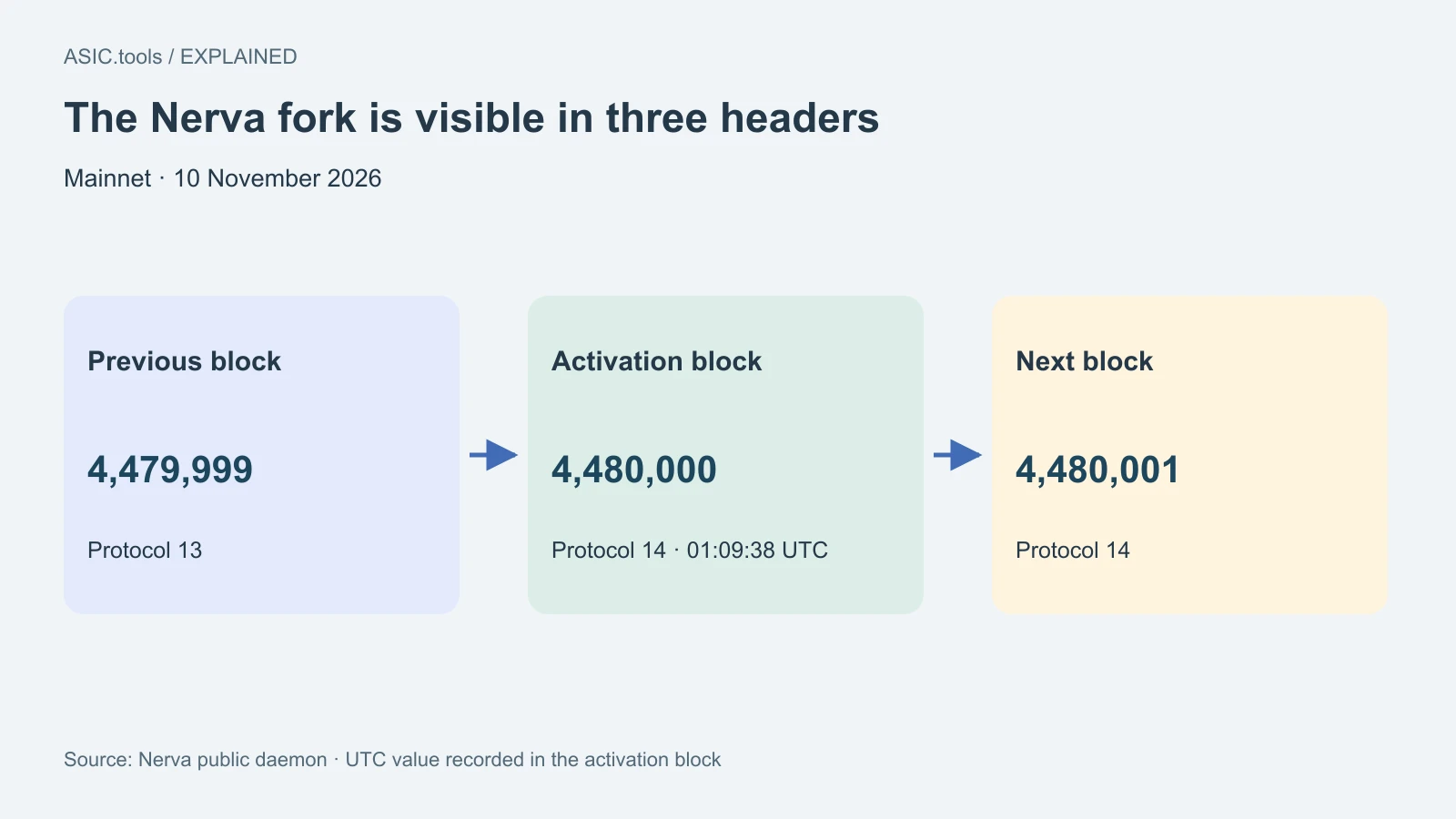
Nerva’s main chain switched to version 14 at block 4,480,000 on November 10. The block header records 01:09:38 UTC. The preceding block has version 13, and the next block continues on version 14. The project’s public node reports fork 14 enabled. This confirms the network event that the October client release prepared for.
For miners of XNV, Nerva’s coin, the switch makes CryptoNight-Adaptive v8 the active proof of work. Proof of work is the calculation a miner repeats in search of a result the network can accept. A computer running the old rules may still show activity, so the first useful check is whether its node is following the same chain as the project’s public node.
What changed in the calculation
The project’s v0.4.0.0 release describes a 1 MB scratchpad, a small working area in memory used during the calculation. The algorithm also reads from the history of block hashes. Those hashes are identifiers of earlier blocks. This links the work to Nerva’s chain history and fits the project’s approach of running mining with a full node and a general-purpose processor.
The project says the new work is cheaper for a node to verify and estimates about four times faster synchronization across the fork-14 range. That describes a node checking and catching up with those blocks. A miner measuring its own machine has a separate question: how much power it uses and how much work it performs under the current rules. Those measurements depend on the system and its settings.
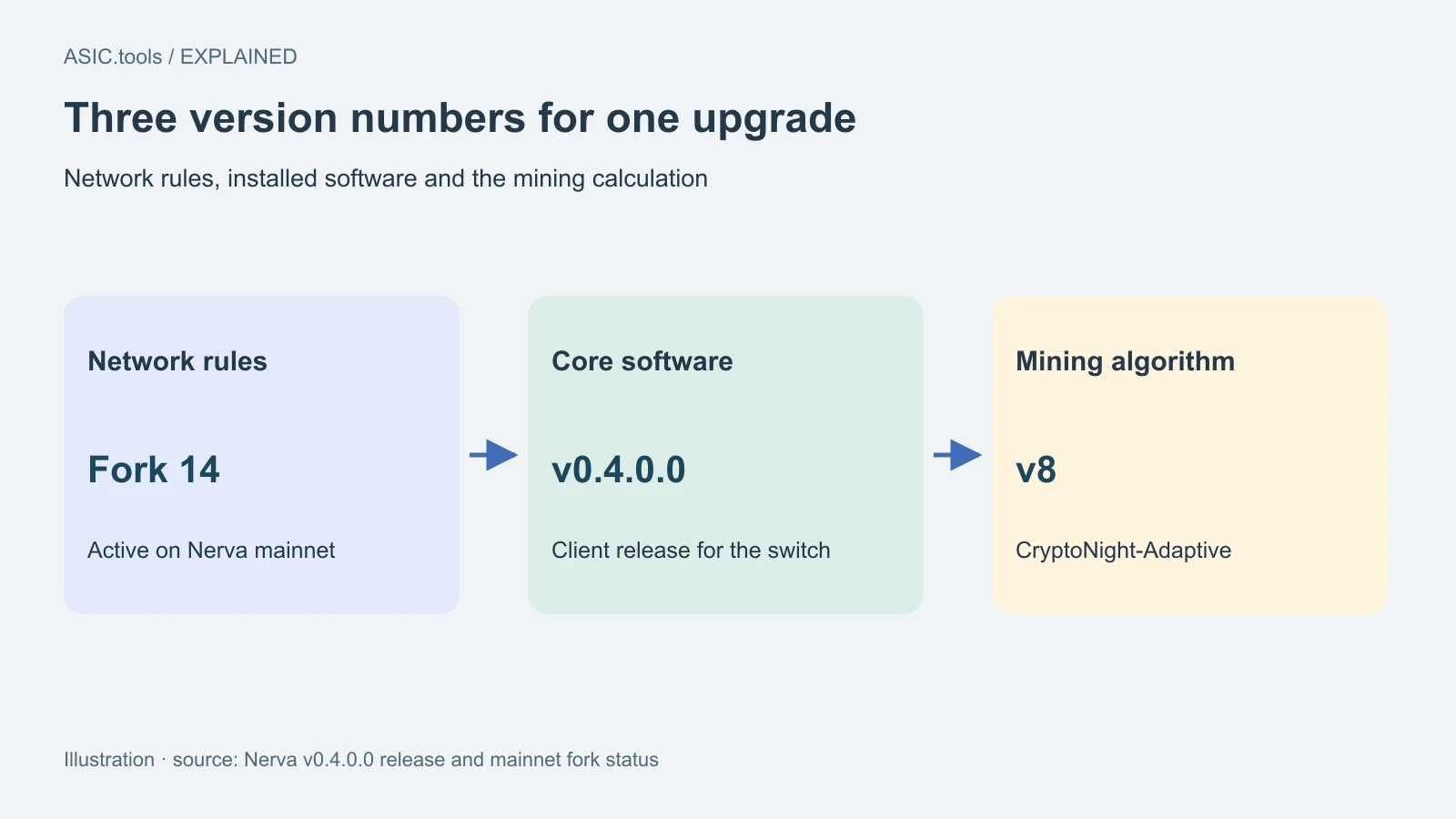
Check the node before reading the hashrate
Version 14 is the network’s ruleset number, v0.4.0.0 is the software release and v8 is the name of the mining algorithm revision. On a local node, check mainnet mode, the reported fork version and whether the chain height is advancing. If the node is still catching up, compare again after synchronization. A version string alone cannot show that a machine is current.
Hashrate counts attempts per second. When the calculation changes, a different count can reflect a change in what one attempt entails. For an electricity comparison, keep the measurement conditions consistent, including the processor, number of mining threads and the load from other work. The fork activation confirms the new rules. It does not establish anyone’s individual output or profit.
The upgrade also changes transaction rules
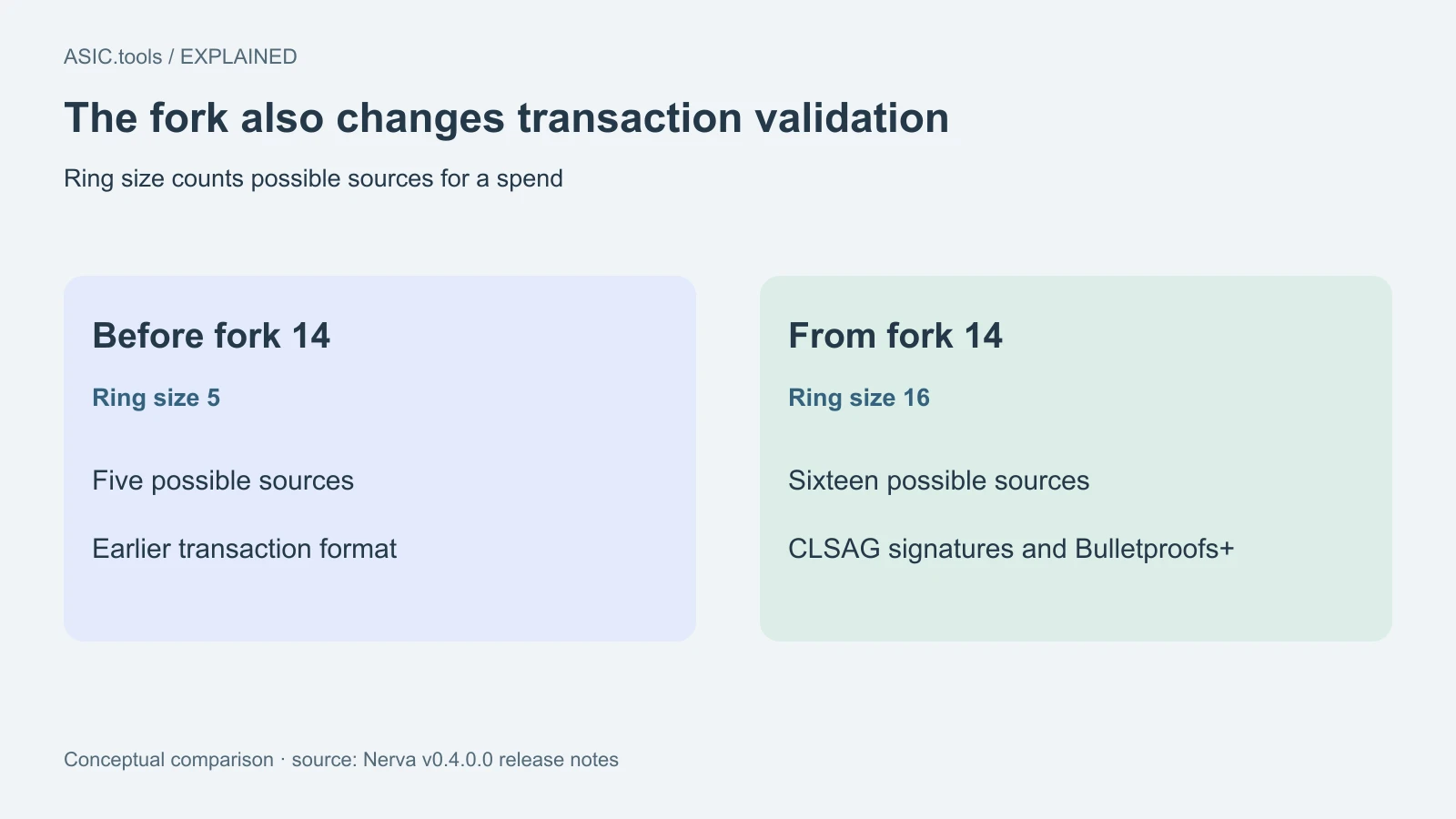
Transactions after the fork use ring size 16, up from 5. A ring gives a verifier a group of possible sources for a spend without singling out which one supplied the funds. The upgrade also adopts CLSAG signatures and Bulletproofs+, ways to verify signatures and prove amounts are in the allowed range. These are transaction changes alongside the change to mining.
Nerva’s notes say the hardware-wallet signing protocol predates CLSAG and cannot sign fork-14 transactions. The practical check for anyone moving an XNV reward is whether their particular wallet and service support the new transaction rules. A connected mining node and a wallet that can sign a transfer are two separate pieces of the path.
What a solo miner can observe
Nerva’s core project describes XNV mining as CPU-only and says it does not support mining pools. A pool normally counts each machine’s smaller contributions and shares out the proceeds. In Nerva’s solo setup, a working node and a busy processor show that a machine is participating, while a block it finds and the network accepts is a separate event. Short runs can therefore tell an operator about power draw and local performance well before they show what rewards to expect.
On the public chain, look at height as the sequence of blocks. Nearby timestamps can differ from the order in which blocks appear. For this upgrade, the adjacent headers and their version numbers are the evidence to compare. The project’s public node reported a mainnet height beyond the fork during our November 11 check.
Read the block time as a recorded time
The October release estimated activation at about 01:30 UTC on November 10. The rule took effect at a specific block height, and the time in the first version-14 header is the timestamp carried by that block. The versions of the surrounding blocks provide the direct evidence of the transition. The project’s active-fork response confirms that the upgraded chain kept moving.
A miner who paused around the switch can use the block explorer to check the boundary and the node status to check current operation. For a CPU already in service, the most relevant comparison is now with its own readings under v8: node progress, observed work and electricity draw over the same period.
Source: Nerva mainnet / block explorer and daemon ↗ · Nerva mainnet block header ↗ · Nerva active hard fork status ↗ · Nerva v0.4.0.0 release notes ↗ · Nerva Core project and mining design ↗
Mining calculator ↗