
June sets a lower hashprice average
Source report: 2026-07-10 · Editorial analysis published: 2026-09-10
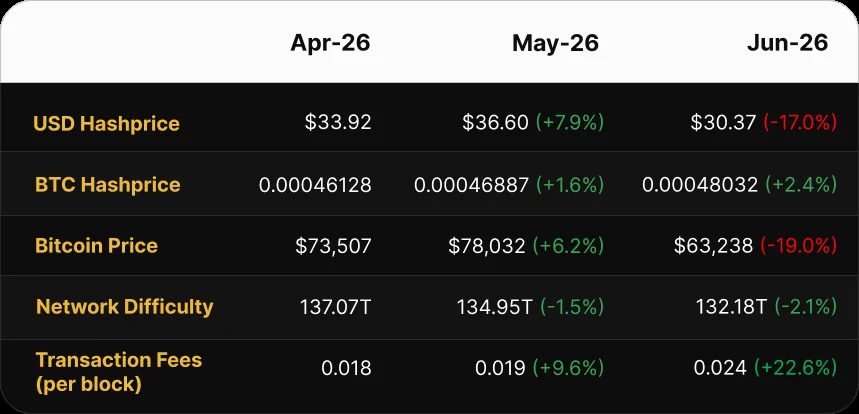
Luxor reports a June average of $30.37 per PH/s/day, down 17%, with a daily low of $27.74 on June 6.

Analysis and practical implications
This section is our analysis and illustrative calculations, separate from the source report.
A weak monthly average is a budgeting signal
A monthly average smooths daily fluctuations and can be useful for reviewing operating performance. It should still be distinguished from the receipts of an individual fleet. Different uptime, fees and machine settings can cause the site's realized result to differ from a continuously operating market reference.
Use the reported average as a starting point for reconciliation. Compare it with actual accepted work and the electricity invoice for the same period. Record unusual repairs and planned shutdowns separately so that the market effect does not become an explanation for every change in the site's result.
Small revenue changes can have large margin effects
A machine's electricity bill may remain similar while gross mining revenue falls. Because the bill is deducted from receipts, the percentage decline in the remaining contribution can be much larger than the percentage decline in revenue.
For illustration, if a hypothetical machine earns 8 dollars and spends 6 dollars on electricity, its contribution before other costs is 2 dollars. If revenue falls to 7 dollars with the same electricity cost, the contribution falls by half. The example explains why operators close to their cost boundary react strongly to apparently modest market changes.
Review groups of machines rather than one fleet average
A mixed fleet can contain both positive and negative contributors. An overall average may conceal the least efficient or least reliable group. Separate machines by operating characteristics and calculate their contribution using measured output and consumption.
Maintenance data is part of that review. A machine that repeatedly requires intervention can impose labor and spare-parts costs that do not appear in a basic power calculation. The decision to continue operating it should consider those recurring demands rather than only its nominal efficiency.
Preserve options instead of assuming a rebound
When conditions are weak, useful actions include improving records, addressing avoidable downtime, checking unnecessary auxiliary loads and reviewing operating profiles. Each action should have a measurable objective. A forecast of better conditions is not a substitute for controlling today's expenses.
For planning, test the effect of a longer weak period on cash needs and maintenance capability. A site needs enough flexibility to keep essential equipment and obligations under control without relying on one favorable market move. The monthly review is most valuable when it leads to a clearer operating plan and a realistic reserve.
Source: Hashrate Index / Luxor ↗
Mining calculator ↗