August closes with a hashprice rebound
Source report: 2026-09-08 · Editorial analysis published: 2026-09-10
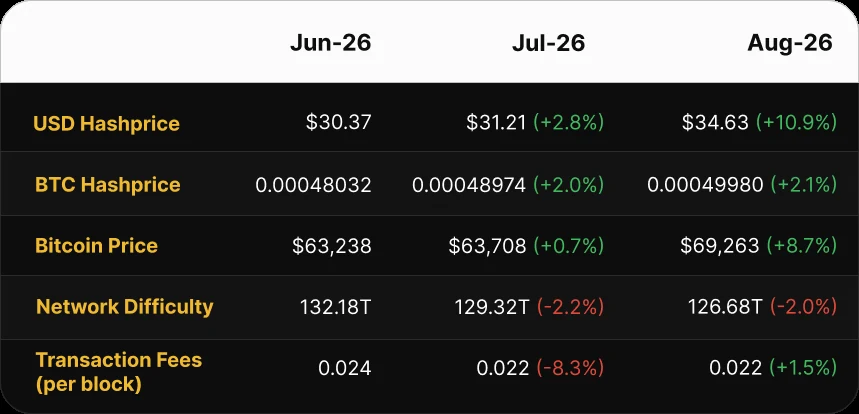
Luxor reports a 24.4% August rise, from $31.63 to $39.33 per PH/s/day. These are historical month-end figures.

Analysis and practical implications
This section is our analysis and illustrative calculations, separate from the source report.
What a monthly rebound actually changes
A stronger closing hashprice improves the revenue available to a miner that is operating at that moment. It does not retroactively improve the first days of the month. The distinction matters when a monthly headline is used to evaluate an electricity invoice or a machine purchase. A closing observation, a monthly average and the revenue earned by a specific fleet describe different things.
For a historical review, line up daily pool receipts with daily operating hours and the electricity actually consumed. If machines were offline during the strongest days, their realized result will differ from a continuously operating reference fleet. Conversely, a site that avoided expensive hours may have a better operating margin despite producing fewer total hashes.
Translate the movement into a machine scenario
An illustrative 234 TH/s machine represents 0.234 PH/s. At a gross hashprice of 31.63 dollars per PH/s per day, its theoretical daily revenue is about 7.40 dollars. At 39.33 dollars the corresponding figure is about 9.20 dollars. These are simple multiplications using the two reported endpoints; they are not a reconstruction of the month or a promise of future revenue.
A 3510-watt load running for 24 hours uses 84.24 kWh. At an assumed electricity rate of 0.07 dollars per kWh, that costs about 5.90 dollars per day. Electricity therefore does not rise automatically when hashprice rises. This creates a larger percentage change in the remaining operating margin than in gross revenue. Pool fees, repairs, hosting charges and financing still have to be deducted.
Do not confuse currency exposure with machine performance
A miner can earn a similar amount of Bitcoin while the dollar value of those receipts changes substantially. Improving firmware cannot remove that currency exposure. When reviewing a month, keep one record in the mined coin and another in the currency used to pay expenses. Otherwise a market rally can be mistaken for an equipment improvement.
For the same reason, compare equipment tests under matched market conditions. If one profile was tested before a price movement and another afterwards, compare accepted work and measured energy rather than raw dollar receipts. The experiment should identify what the machine changed, not what the market changed around it.
Use the rebound to rebuild a operating buffer
A temporary improvement creates choices: replenish spare parts, reduce overdue bills, reserve cash for downtime or expand capacity. Test expansion against a less favorable hashprice as well as the current observation. Equipment generally remains on site much longer than one monthly market move.
A useful review sheet contains daily gross receipts, fees, operating time, energy costs and extraordinary repairs. Add a note whenever the fleet composition changes. That record makes the next monthly comparison meaningful and helps distinguish a durable efficiency gain from favorable market timing. The strongest conclusion from a rebound is improved flexibility today, not certainty about the next quarter.
Source: Hashrate Index / Luxor ↗
Mining calculator ↗