Fog Hashing becomes Fog Computing while retaining its mining brand
Source report: 2026-10-01 · Editorial analysis published: 2026-10-01
The cooling-infrastructure supplier is widening its scope to prefabricated AI data centers and colocation, while Fog Hashing continues as its Bitcoin mining infrastructure brand.
Analysis and practical implications
This section is our analysis and illustrative calculations, separate from the source report.
Fog presents a broader company identity
Fog announced on October 1 that Fog Hashing is now part of Fog Computing, a new identity positioned around modular AI data centers. The announcement describes a broader operating scope rather than the closure of the original mining business. Fog Hashing will continue as the company’s Bitcoin mining infrastructure brand. Customers should therefore distinguish the parent brand, the continuing mining product line and any future AI-specific contracts when evaluating support or product documentation.
The company started with immersion and hydro cooling
Fog says it began six years ago by solving thermal problems for high-density Bitcoin mining. Its initial work centered on immersion and hydro cooling for hashrate. Those capabilities are relevant to AI racks because both markets need reliable power distribution and heat removal, but the engineering requirements are not identical. GPU clusters can demand tighter availability, network redundancy and service-level commitments than interruptible mining loads, so prior mining deployments do not automatically prove AI-colocation readiness.
Fog claims 400 MW operating across more than 40 countries
The company reports that its technology supports 400 MW of running capacity in more than 40 countries, with over 90% of that capacity in North America. These are company-supplied portfolio figures in the rebrand announcement. Fog does not publish a site-by-site list, an independent assurance report, customer utilization, or the split between immersion and hydro systems. The numbers should therefore be attributed to Fog and not treated as independently audited operating capacity.
The first new line spans power to compute
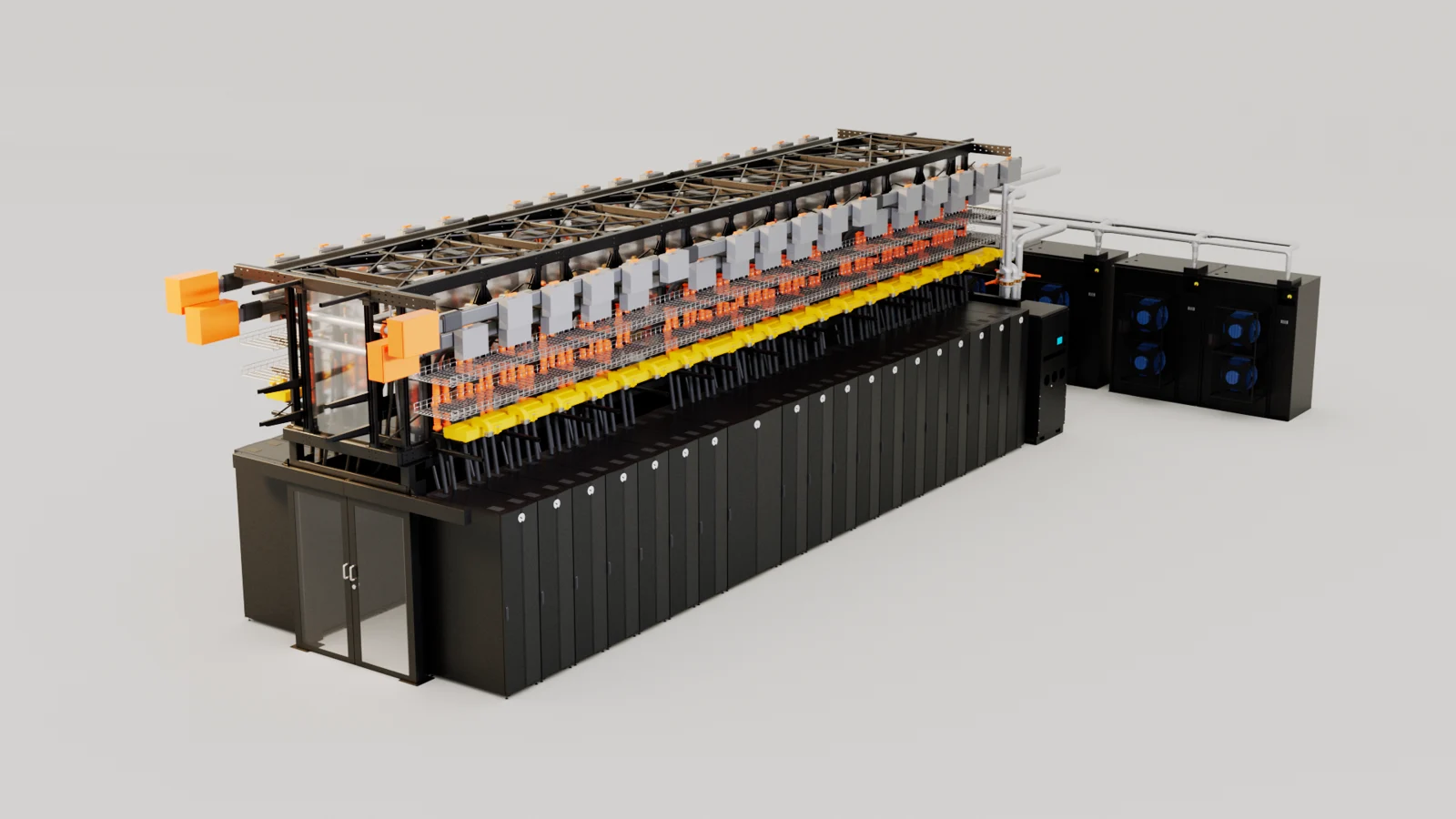
Fog Computing says it will build the infrastructure between the grid connection and the computing rack, including power equipment, cooling plant and prefabricated data halls. The stated commercial idea is to deliver the pieces under one integrated contract rather than require a customer to coordinate separate suppliers. Integration can reduce interface risk, but actual delivery still depends on site permits, utility equipment, manufacturing slots, commissioning and acceptance tests.
A second line offers completed AI capacity
The company also describes AI capacity as colocation. Together with partners, it plans to develop facilities and hand them over ready for customer GPUs. A finished powered shell is not the same as an operating AI service: customers still need confirmed power quality, networking, cooling performance, security, operational staffing and contractual uptime. Fog does not name the partners or customers in this announcement, so the commercial status of individual projects cannot be verified from the post alone.
The announced AI pipeline exceeds 100 MW
Fog says it now has more than 100 MW of AI capacity in its pipeline. Pipeline capacity can include sites at different stages and should not be equated with energized critical IT load, installed GPUs or contracted revenue. The announcement does not break out land-controlled, utility-contracted, permitted, under-construction and live megawatts. For comparison with public data-center operators, readers need the stage of each project, the expected delivery date and the portion backed by signed customer agreements.
Mining customers remain part of the strategy
Fog explicitly says Fog Hashing continues as the Bitcoin mining infrastructure brand, now supported by a larger team and supply chain. That continuity matters for operators using its immersion tanks, dry coolers, pumps and power systems. The post does not announce a firmware change, a new ASIC model or a discontinuation of existing mining products. Existing customers should look for updated legal entities, warranty terms, support contacts and product road maps rather than assume every contract has automatically changed.
The rebrand follows a shift in the constraint
Fog argues that AI expansion is increasingly limited by powered land, interconnection queues, manufacturing and delivery rather than by chips alone. The same constraints are familiar to mining developers, which explains why cooling and modular construction experience can transfer. Yet AI colocation usually requires higher capital per megawatt and stronger redundancy. Operators should compare actual PUE, water use, rack density, lead time, service responsibility and guarantees instead of relying only on the shared phrase high-density compute.
What is confirmed and what remains to prove
The primary announcement confirms the Fog Computing name, the continued Fog Hashing mining brand, two stated business lines and management’s 400 MW operating and 100 MW AI-pipeline claims. It does not identify new customers, signed AI megawatts, revenue, construction dates or audited portfolio evidence. The next useful checkpoints are named projects, permits, energization, commissioning data, performance guarantees and customer acceptance. Until then, this is a strategic rebrand with declared scale, not proof that the AI pipeline is live.
Source: Fog Computing ↗
Mining calculator ↗