Switzerland approves its first retail Bitcoin ETF: what the approval changes
Source report: 2026-10-20 · Editorial analysis published: 2026-10-21
FINMA’s October 20 decision allows a Swiss retail fund to invest directly in Bitcoin. Fund shares offer a different way to hold price exposure; regulatory approval does not remove Bitcoin’s price risk.
A new Swiss retail route to Bitcoin
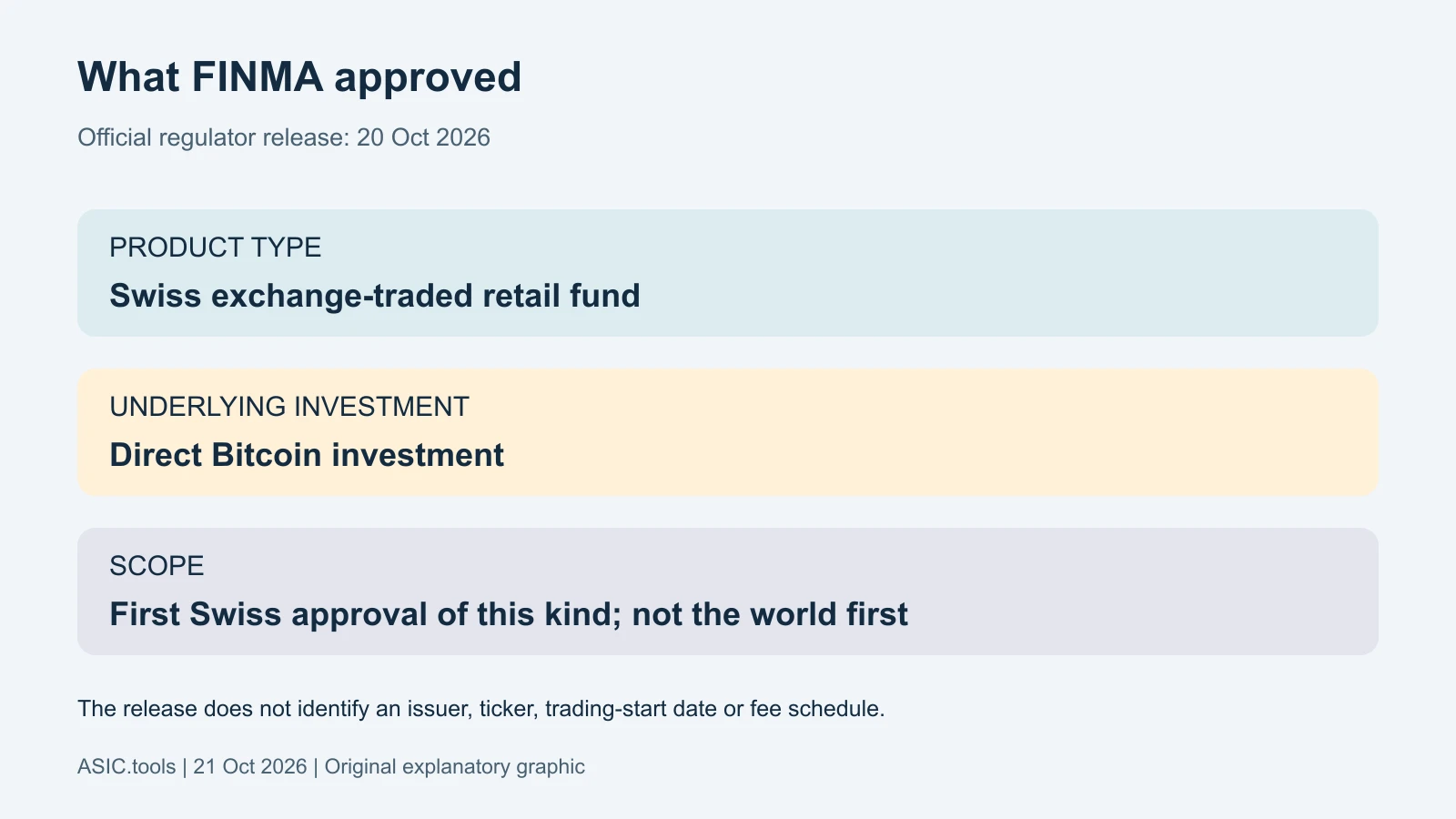
Switzerland’s financial regulator FINMA announced on October 20 that it had approved, for the first time, an exchange-traded retail fund investing directly in Bitcoin. That opens a new category of access under Swiss fund rules for ordinary investors. It is not the world’s first Bitcoin ETF, and it should not be read as a claim that no Bitcoin-linked exchange-traded products previously existed in Switzerland.
The important words are retail fund, direct Bitcoin investment and Swiss approval. A retail fund is intended for a broader investor audience than a fund reserved for qualified investors. FINMA points out that it authorised a crypto fund for qualified investors back in 2021. The new decision therefore concerns the form and audience of the fund, rather than the first time the regulator has ever considered a cryptocurrency investment product.
What an ETF actually puts in an account
ETF means exchange-traded fund. A buyer acquires fund shares through a securities account, while the fund’s investment arrangement provides the exposure to the underlying asset. Here FINMA says the fund invests directly in Bitcoin. That differs from buying mining-company shares, which represent a business with electricity costs, management decisions and other activities, and from buying a product whose exposure comes from a different instrument.
Buying a fund share also differs from receiving BTC at a wallet address whose keys you control. The investor owns an interest in the fund; the prospectus and service arrangements govern how it works. One should not assume that a normal share purchase creates a personal Bitcoin receiving address or a right to withdraw coins under any chosen conditions. These practical differences matter to miners deciding how to keep, sell or account for their own production.

Why custody still matters inside a regulated product
Custody means looking after assets and the systems needed to control them. FINMA says supervised institutions must reduce operational and custody risks, referring to its January 12 guidance. Operational risk includes the way people, processes and technology work, rather than only the movement of Bitcoin’s market price. Professional arrangements can change who handles those tasks; they do not make those tasks disappear.
For an ordinary reader, the distinction is straightforward: direct ownership puts wallet-management responsibilities with the holder, while a fund places asset-management and custody functions inside a legal and service structure. The structure and disclosures deserve attention alongside the headline price. It would be misleading to describe the approval as proof that every possible loss is insured, that custody cannot fail or that the regulator guarantees repayment of invested money.
Approval does not switch off price swings
FINMA explicitly says Bitcoin investments remain highly risky even through an approved ETF. A fund can make access and administration more familiar without turning a volatile asset into a stable savings balance. The regulator requires clear explanations of risk and appropriate conduct when institutions offer crypto-based instruments, including attention to suitability or appropriateness assessments under the applicable Swiss financial-services rules.
This approval includes an exception from applicable diversification rules, which FINMA links to Bitcoin’s comparatively long trading history and high trading volume. Diversification means spreading exposure across different investments. A fund concentrating on Bitcoin does not gain that spread simply because it has a regulated wrapper. The main market risk is still the underlying asset, and a reader should not confuse a regulated distribution process with a promise about future returns.
What the announcement does not tell us yet
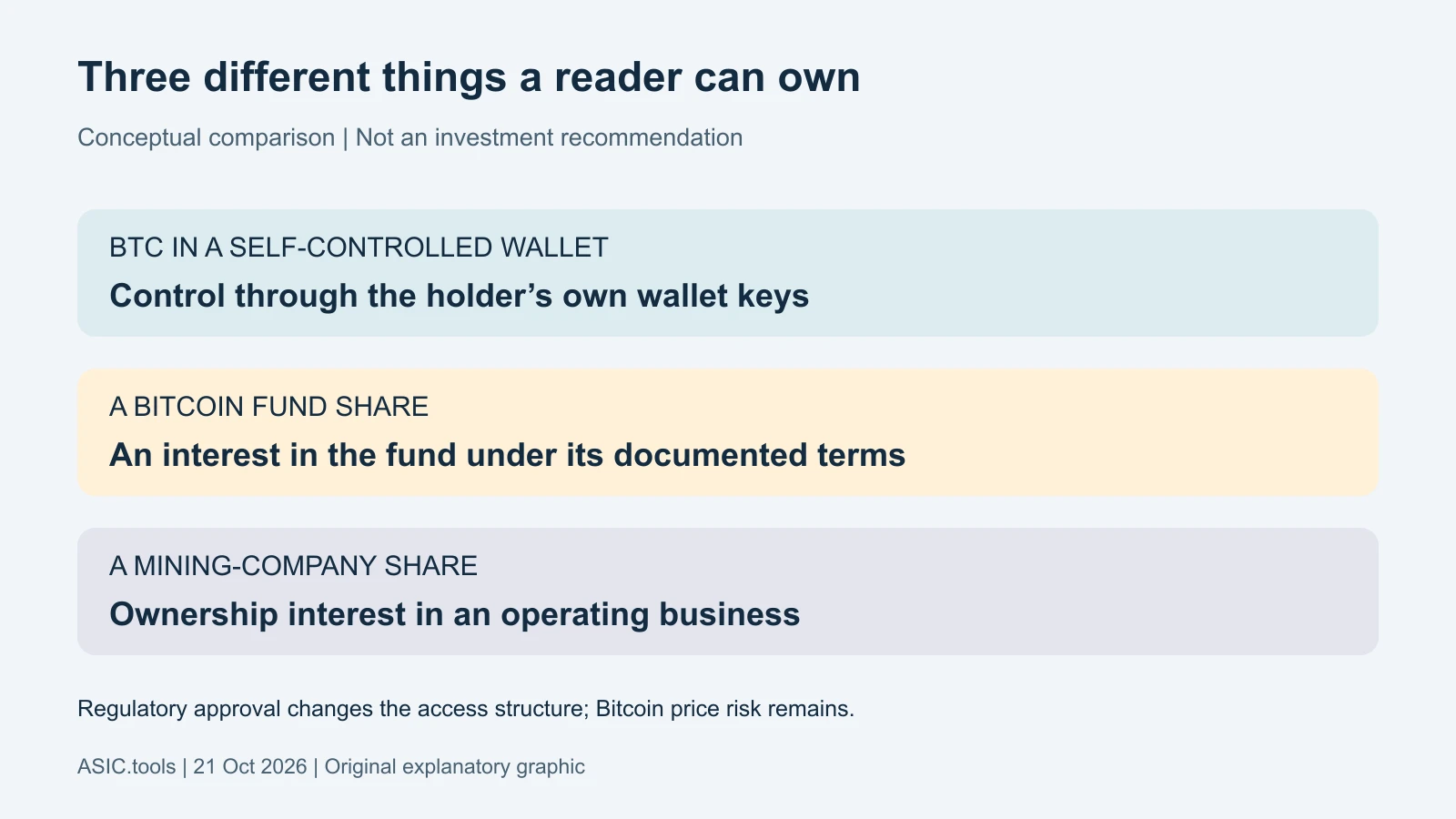
FINMA’s release does not identify the issuer or ticker and does not provide a trading-start date or fee schedule. We therefore do not attach a product name, subscription instructions or a claimed price advantage to this decision. Approval of a fund and the opening of trading in a particular account are separate things. Product documents and the investor’s intermediary are needed to establish the actual availability and terms.
The regulator also says other providers have submitted or announced Bitcoin ETF applications. An application is not an approval, and approval is not evidence of money already flowing into the market. Likewise, a high trading volume in shares would not by itself reveal how much fresh Bitcoin a fund had purchased. Those are different measurements that require their own data, not conclusions that follow automatically from the existence of a new fund.
Once a product is identified, useful document checks include its management charges, trading costs and custody arrangement. Those details can affect a holder’s outcome even when two products refer to the same Bitcoin price. The regulator’s short announcement is not a substitute for those terms, and it supplies no percentage from which we could calculate the cost of holding this unnamed fund.
The link to mining is access, not extra block rewards
Bitcoin mining still follows the network’s own rules. A Swiss fund approval does not increase the number of coins paid for a block or reduce an ASIC’s power consumption. For the wider market, the event is about another route through which people can hold exposure to Bitcoin. Any eventual effect on demand or price depends on what users and funds actually do after launch, not on an assumed guaranteed inflow today.
For miners, the useful comparison is between the assets they produce and the financial products they may encounter when managing them. A wallet balance, a fund share and a mining-company share are not interchangeable claims. FINMA’s decision makes one Swiss retail-fund route possible while requiring safeguards and clear risk information. The next facts to check are the identified product, its documents and actual trading availability, without turning this regulatory milestone into a prediction of price or mining profit.
Source: FINMA ↗
Mining calculator ↗