One Bitcoin ASIC price index holds at $10.35 per TH/s as hashprice falls
Source checked: 2026-11-06 · Editorial analysis published: 2026-11-06
Endless Mining’s weekly recap shows flat asking prices on its own marketplace and a 3% fall in hashprice. The November 6 snapshot still shows $10.35 per TH/s. These are offers, not completed sales.
The hardware price did not follow the coin down
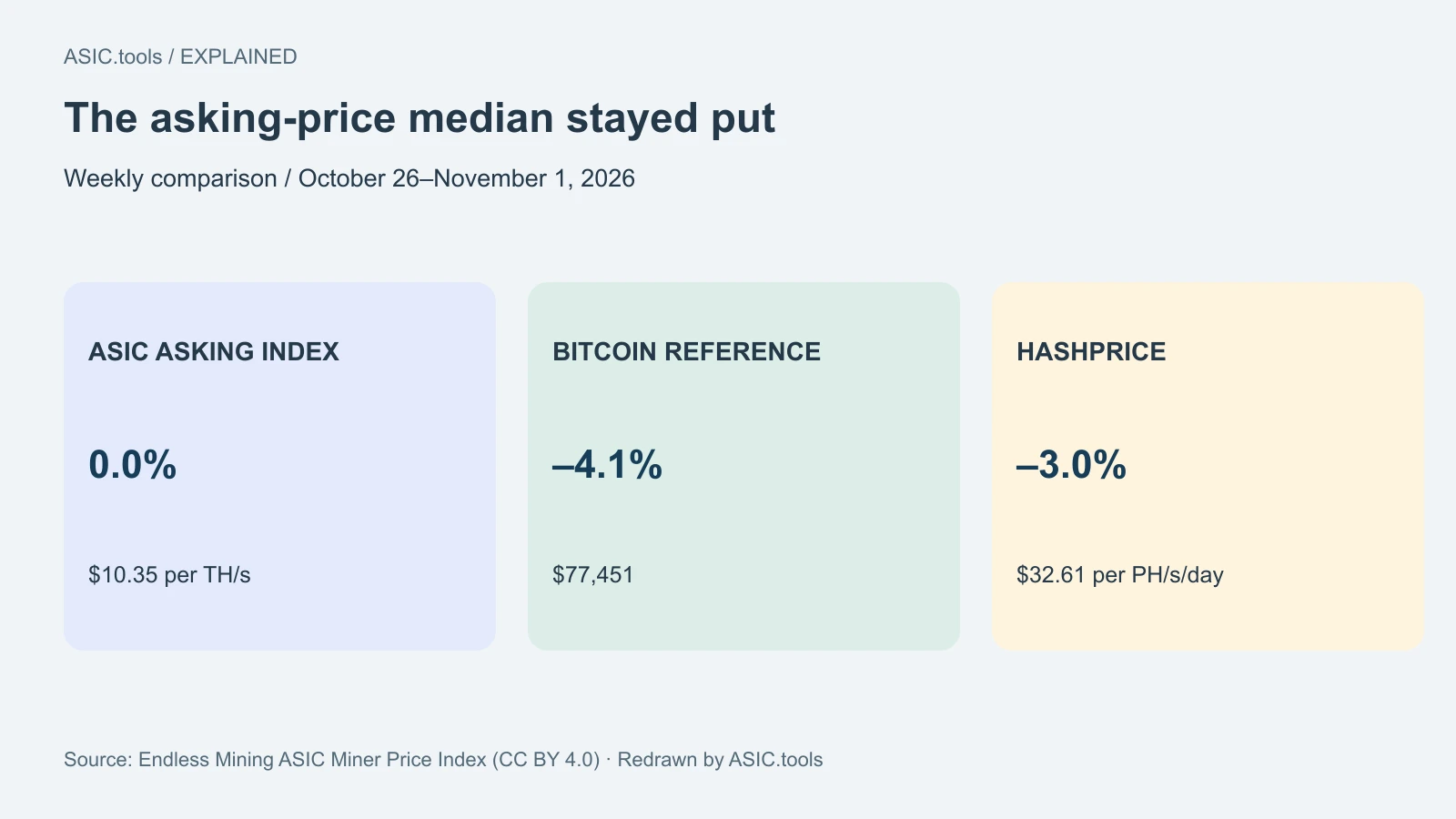
Endless Mining's latest weekly recap puts the median asking price for eligible Bitcoin ASIC listings at $10.35 per TH/s for October 26–November 1, unchanged from the preceding week. Its Bitcoin reference fell 4.1% to $77,451 and hashprice fell 3.0% to $32.61 per PH/s per day. The hardware buyers saw on that marketplace did not become cheaper in step with the revenue available to miners.
On November 6 the page still showed $10.35 per TH/s at both 02:00 and 03:01 US Eastern Standard Time. The displayed Bitcoin reference moved from $75,636 to $75,551 between those snapshots. Keep both dated checks separate from the completed weekly comparison. They do not describe every exchange or what a seller will accept this afternoon.
Hashprice is an estimate of how much gross revenue a fixed amount of Bitcoin computing power can generate in a day. One PH/s equals 1,000 TH/s. A lower reading means the same machine starts its electricity calculation with less gross revenue under that estimate, whether or not the advertised purchase price changes.
What the $10.35 actually measures
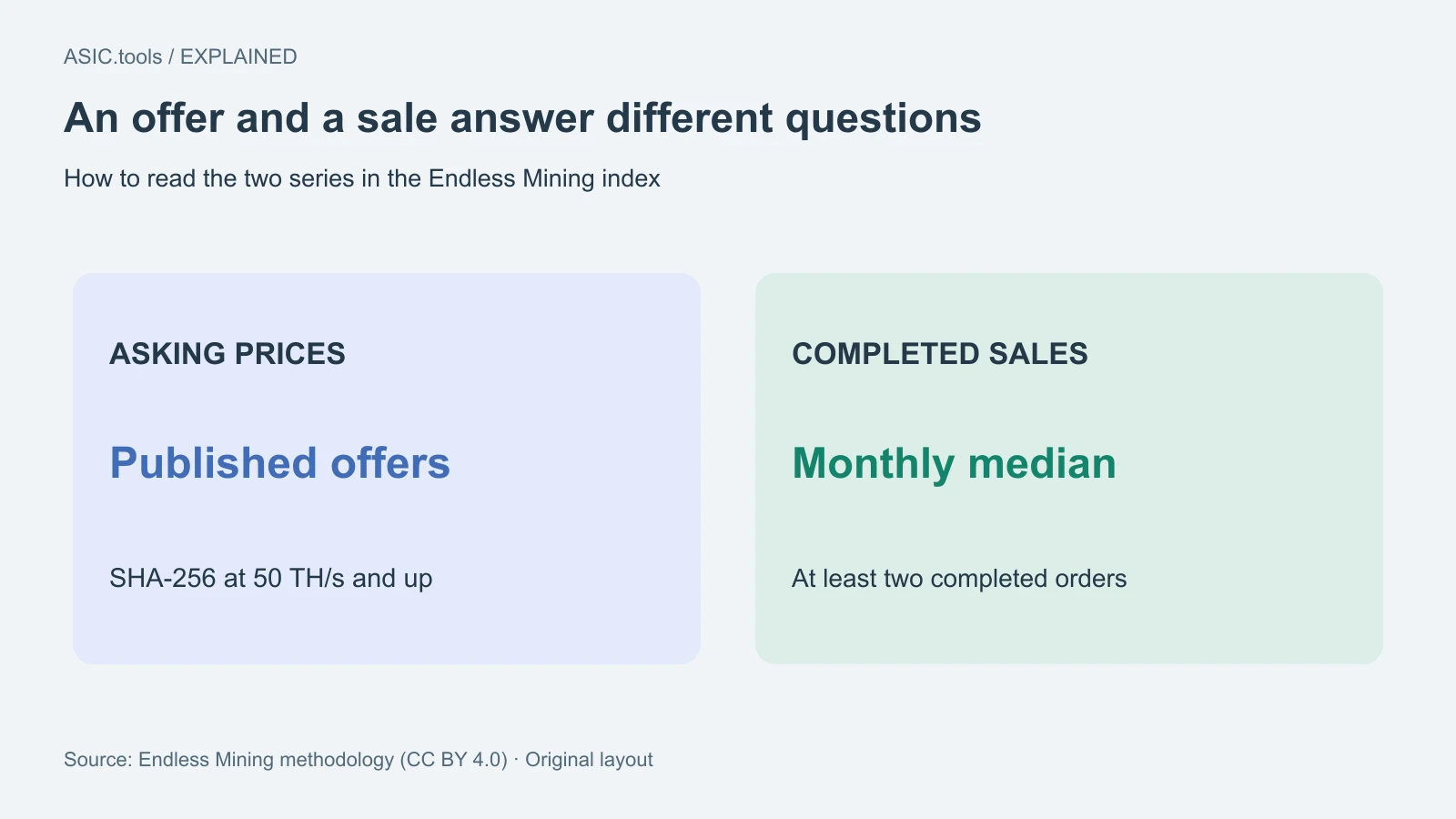
The index uses published listings on Endless Mining for SHA-256 machines rated at 50 TH/s or more. It leaves out hosting subscriptions, accessories and stale listings excluded by the provider. Smaller home and solo miners may appear in the separate model table without entering this headline figure. It is one marketplace's price series, not an average across every device or seller.
The provider divides the asking price by the advertised computing speed and then takes the median. The median is the middle of the sorted observations, not the cheapest machine. For a selected time bucket, each listing counts once at its last price within that period; a bucket needs at least three listings. New and used equipment can sit next to each other in the unfiltered series.
The composition of a marketplace can change when a seller removes a listing or a different configuration is offered. An unchanged median does not require every listing to stay put. Check the exact model, hashrate bin and condition before comparing price moves. A home miner should use the actual quotes for compact machines, since the headline index deliberately leaves many of those out.
An asking price is not a receipt
Endless Mining keeps a separate series for completed sales. It uses monthly medians and requires at least two completed orders for a month. An asking price is what a seller displays. A sold price is what a buyer actually paid under the provider's definition. A screenshot of a large markdown cannot substitute for the sale series or show that anyone bought the machine at its earlier price.
Some offers attach an energy contract or a location to the machine. Before comparing two quotes, check whether the price is for the hardware alone, whether it can be shipped to you and which costs are due after delivery. Freight, duties and repair terms can change the result even if the price per TH/s looks better.
Watch the units on the model table as well. A Bitcoin ASIC reports TH/s; an Equihash Zcash machine may report kilohashes or solutions per second in a different column. The website lists model moves for both, but their dollar-per-rate figures are not directly comparable. The $10.35 headline is a SHA-256 figure.
A lower price per TH/s can still lose money on power
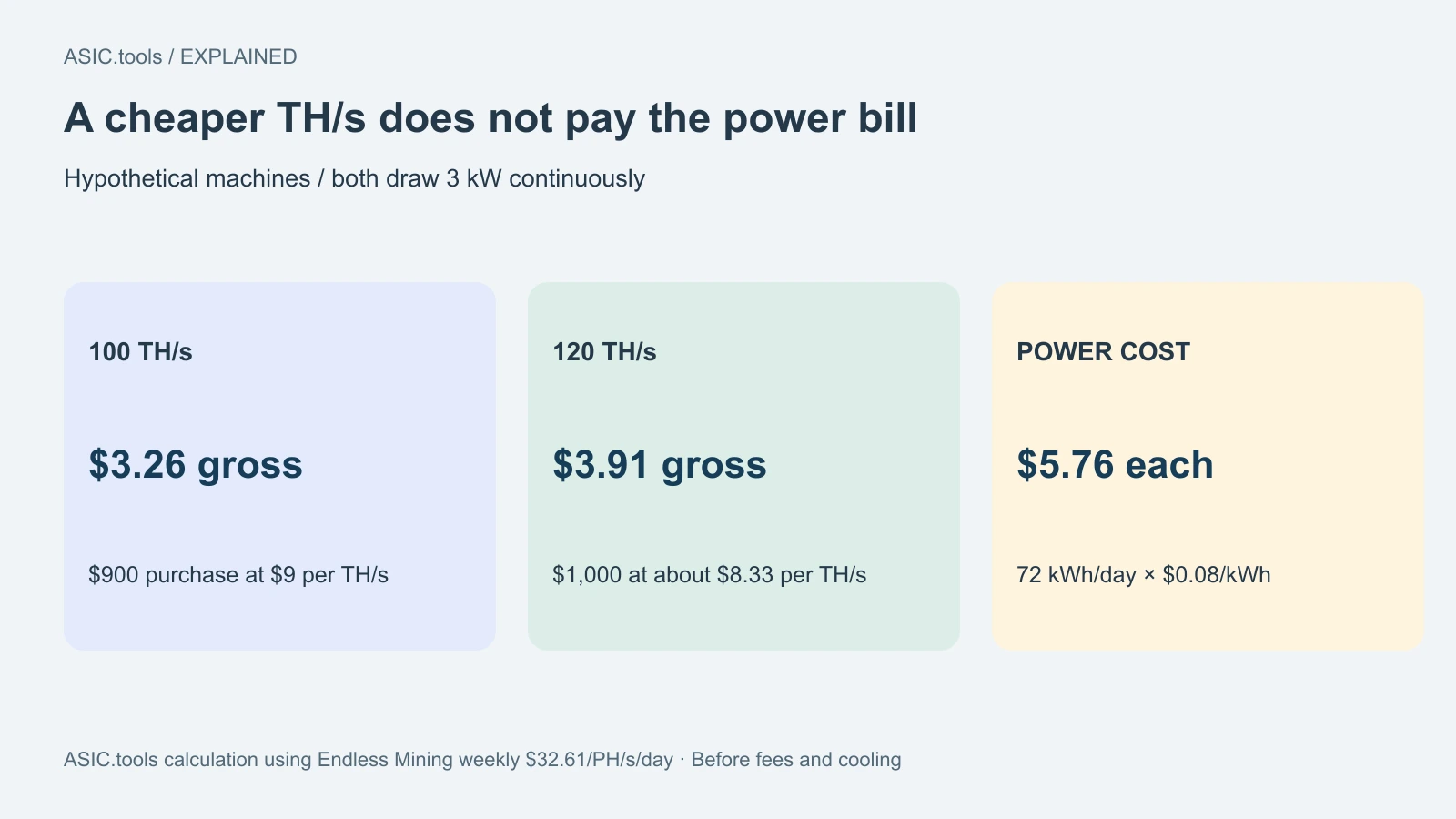
Consider two hypothetical offers: $900 for 100 TH/s and $1,000 for 120 TH/s. The price per TH/s is $9 for the first and about $8.33 for the second. If both draw 3 kW continuously, each uses 72 kWh a day. At $0.08 per kWh that is $5.76 in electricity for either machine, before cooling outside the device.
Using the recap's $32.61 per PH/s per day as a fixed example, 100 TH/s gives about $3.26 and 120 TH/s about $3.91 in estimated daily gross revenue. Both are below that electricity cost before pool charges or repairs. The $1,000 option buys more hashrate for each dollar of purchase price, but that does not make it profitable under these assumptions.
These are invented offers and a chosen tariff to show the arithmetic, not listings from the marketplace or a recommendation. Your bill may use a different rate, and machine uptime, accepted work and payout costs change the numbers. Calculate power at the wall and apply the rate that actually covers the hours you plan to run.
A short list before comparing machines
Start with the full price to get the working machine to your chosen location. Check the exact factory hashrate and power as a pair; don't use the fastest figure from one version and the lowest wattage from another. For a used machine, ask what was tested, which parts are covered and how a defective unit can be returned.
Then run an income scenario with the current estimate and one with weaker revenue. Do the same with your electricity price if it changes by time of day. The weekly chart shows why that second pass matters: a machine's sticker price can stay flat while the network revenue on each unit of hashrate drops.
The new snapshot is a useful market reference precisely because its scope is clear. It helps frame a negotiation for a comparable Bitcoin ASIC. The actual decision still rests on the delivered price, the machine you receive and the margin you can retain after paying to operate it. Endless Mining releases the index data under CC BY 4.0; our graphics plot the dated figures with attribution.
Source: Endless Mining price index ↗
Mining calculator ↗