Cherkasy adds emergency cuts on November 5 while hourly schedules continue
Source report: 2026-11-05 · Editorial analysis published: 2026-11-05
The operator’s 10:35 notice says emergency and scheduled cuts apply together. For miners, the published timetable is a planning reference, not a measurement of actual uptime.
Two types of restriction are applying together
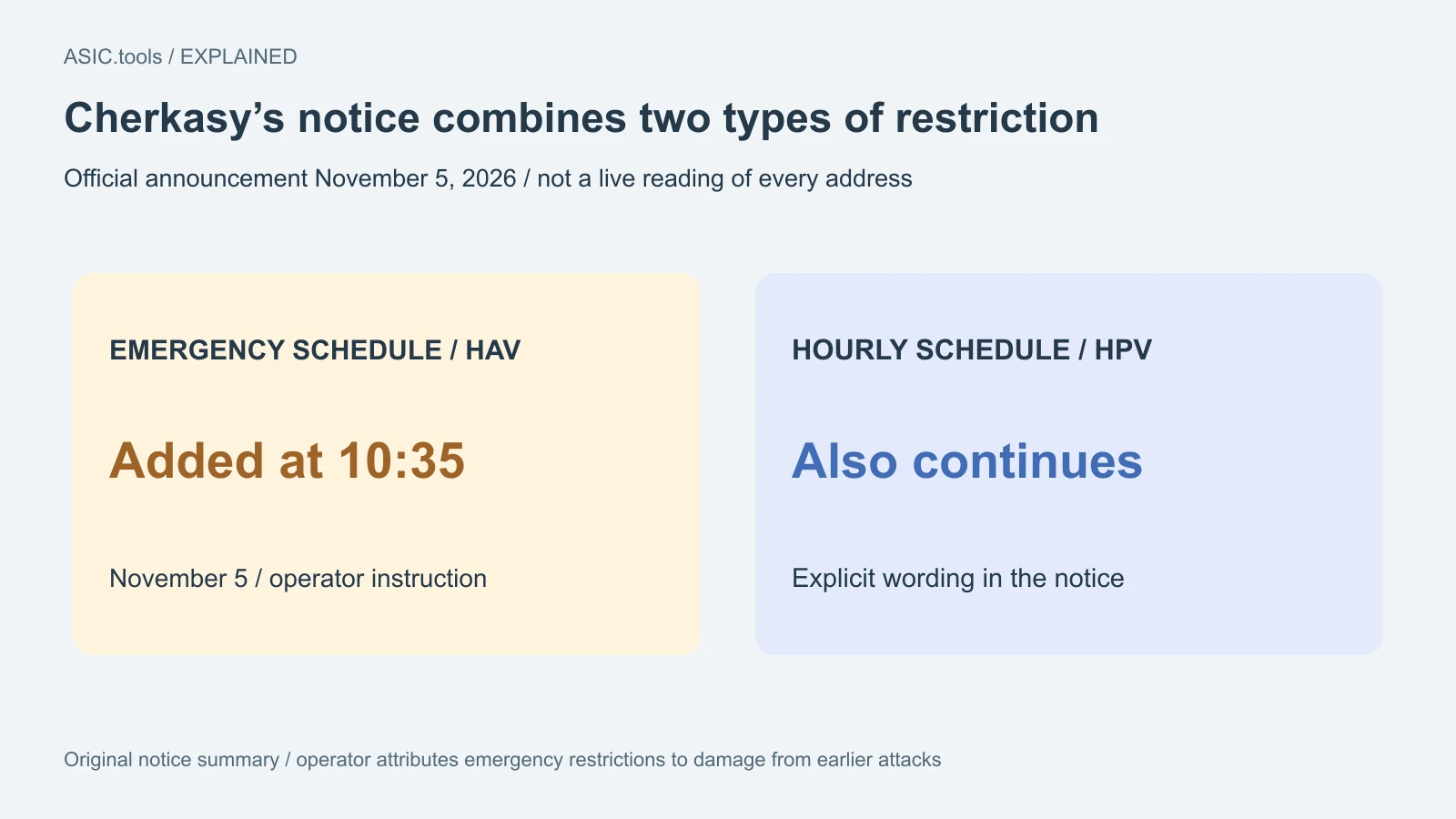
Cherkasyoblenergo reported on November 5 that emergency power-cut schedules had been introduced across the Cherkasy region from 10:35, on Ukrenergo’s instruction. The operator linked the measure to damage from earlier large missile and drone attacks. Its notice explicitly says the hourly cut schedules also continue. That wording matters for a miner expecting to restart solely because a planned outage window has ended.
The emergency schedules are known locally as HAV, while the hourly schedules are HPV. The former respond to an urgent system need; the latter are the published rotation for groups of consumers. The November 5 notice describes their combination, rather than announcing that the earlier timetable has simply been cancelled or that every address receives the same interruption.
This is the operator’s dated announcement, not a live observation of every connection at the time someone reads this article. The message gives no guaranteed restoration time. For a working rig, the immediate consequence is that an announced supply window cannot be treated as a promise of uninterrupted electricity. Actual power availability and later operator updates remain separate pieces of information.
The published timetable still helps, within its limits
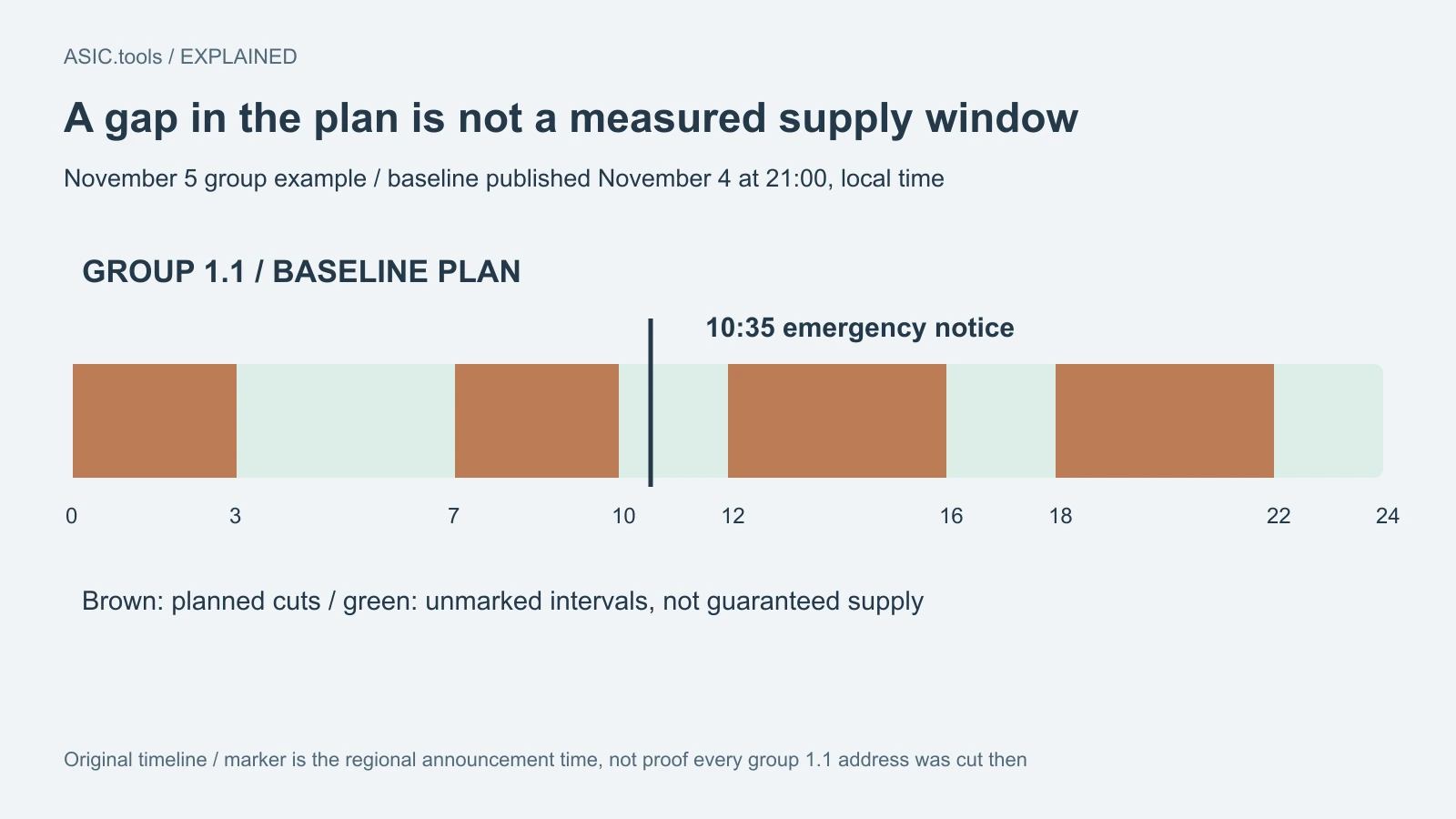
The baseline November 5 schedule was published at 21:00 on November 4. For example, group 1.1 lists interruptions at 00:00–03:00, 07:00–10:00, 12:00–16:00 and 18:00–22:00. These are the operator’s planned intervals for that group, in local time, not a report that every affected installation actually switched off and on at exactly those moments.
The emergency announcement at 10:35 falls between the 10:00 end and 12:00 start in that particular baseline example. It illustrates why a gap in the timetable is not proof that a miner will be able to work through the whole gap. It does not establish that every group 1.1 address was cut at 10:35; the operator’s commands and local network operation determine actual interruptions.
The company explains that switching some lines requires manual work and that a worsening system situation can change the number of disconnected consumers. It also notes that different parts of one building can belong to different supply groups. Check the actual address and subgroup using the operator’s official services; a neighbour’s lights are not an exact measurement of the circuit feeding your equipment.
Record what the miner did, not only what the timetable allowed
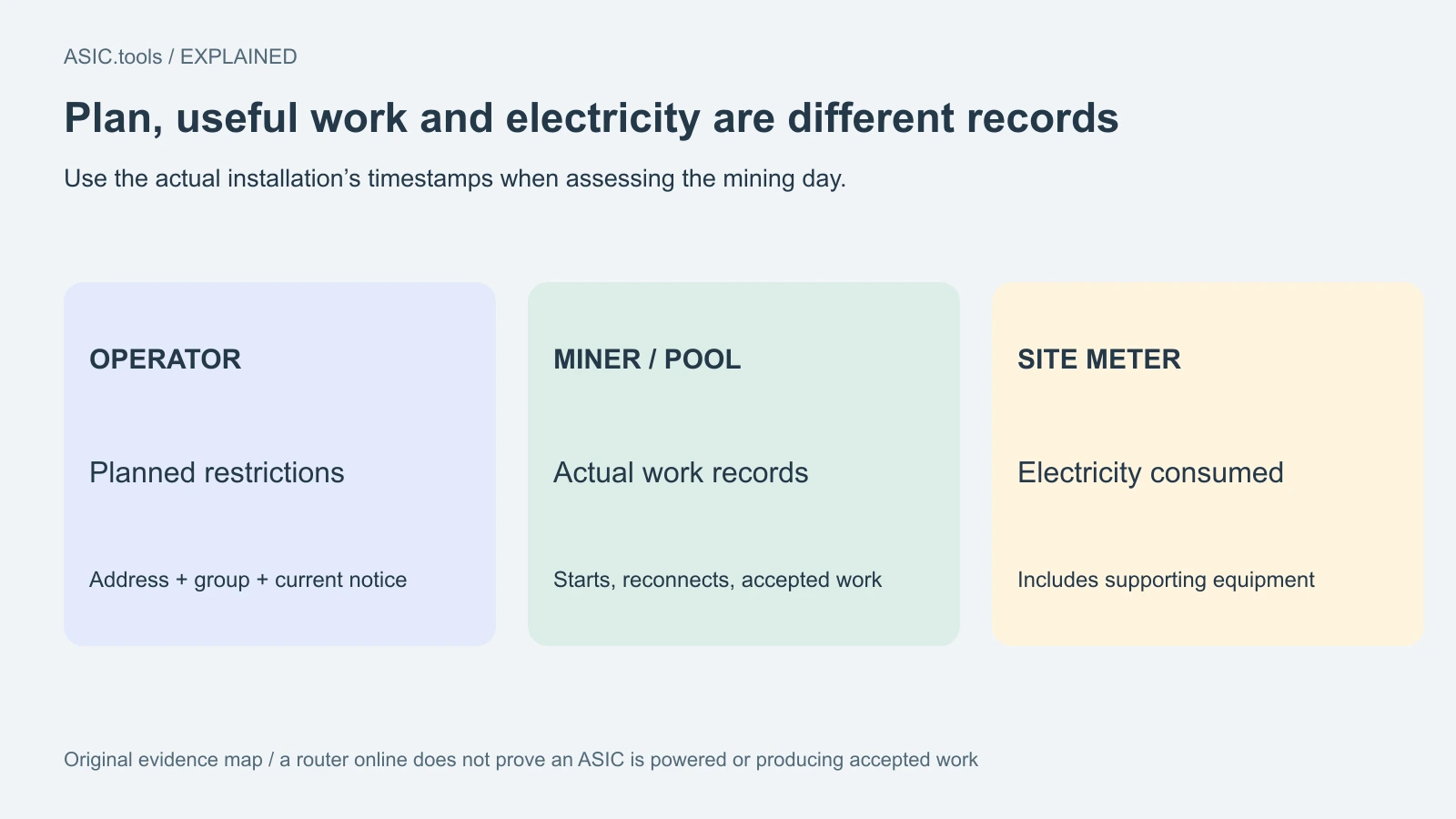
For a mining operation, useful evidence includes device start and stop records, the pool’s accepted-work history and the site electricity meter. A timetable answers when cuts were planned. Those other records help establish when the installation actually drew power and when it performed work credited by the pool. Keeping the two descriptions separate makes a later income calculation more realistic.
A worker disappearing from a pool dashboard does not identify the failed component by itself. A powered miner can lose its router or internet connection, while a router remaining online does not show that an ASIC has electricity. Match the timestamps before interpreting every offline period as a hardware defect or assuming that every planned supply hour produced accepted work.
Idle devices, networking and external cooling can also use energy during periods without useful mining. Conversely, equipment without supply cannot maintain its normal output merely because its reference hashrate remains in a calculator. Use actual operating records and measured site consumption when assessing the day; do not fill the missing hours with a guaranteed production estimate.
Restarting and stable voltage are separate questions
In a November 4 explanation, Cherkasyoblenergo said attack damage had limited the technical ability to regulate voltage levels. That is relevant context when electricity returns: an installation receiving supply again and an installation operating normally under load are different observations. It is not evidence that every home or miner in the region has suffered the same voltage event.
If an installation reports repeated power-related faults after supply returns, changing a pool address or a firmware target is not a repair to the external power network. Electrical capacity, protection and the equipment’s documented requirements belong to the installation assessment. No universal restart delay, voltage threshold or protective-device model is specified by this news report.
The practical value of recording the restart is to connect the power event with the miner’s real behaviour. Did it reconnect, receive jobs and resume accepted work, or is it only visible on the local network? These observations help separate a continuing electrical problem, a network interruption and an ordinary recovery sequence without pretending that a news timetable diagnoses the equipment.
Keep the date and the address attached to the decision
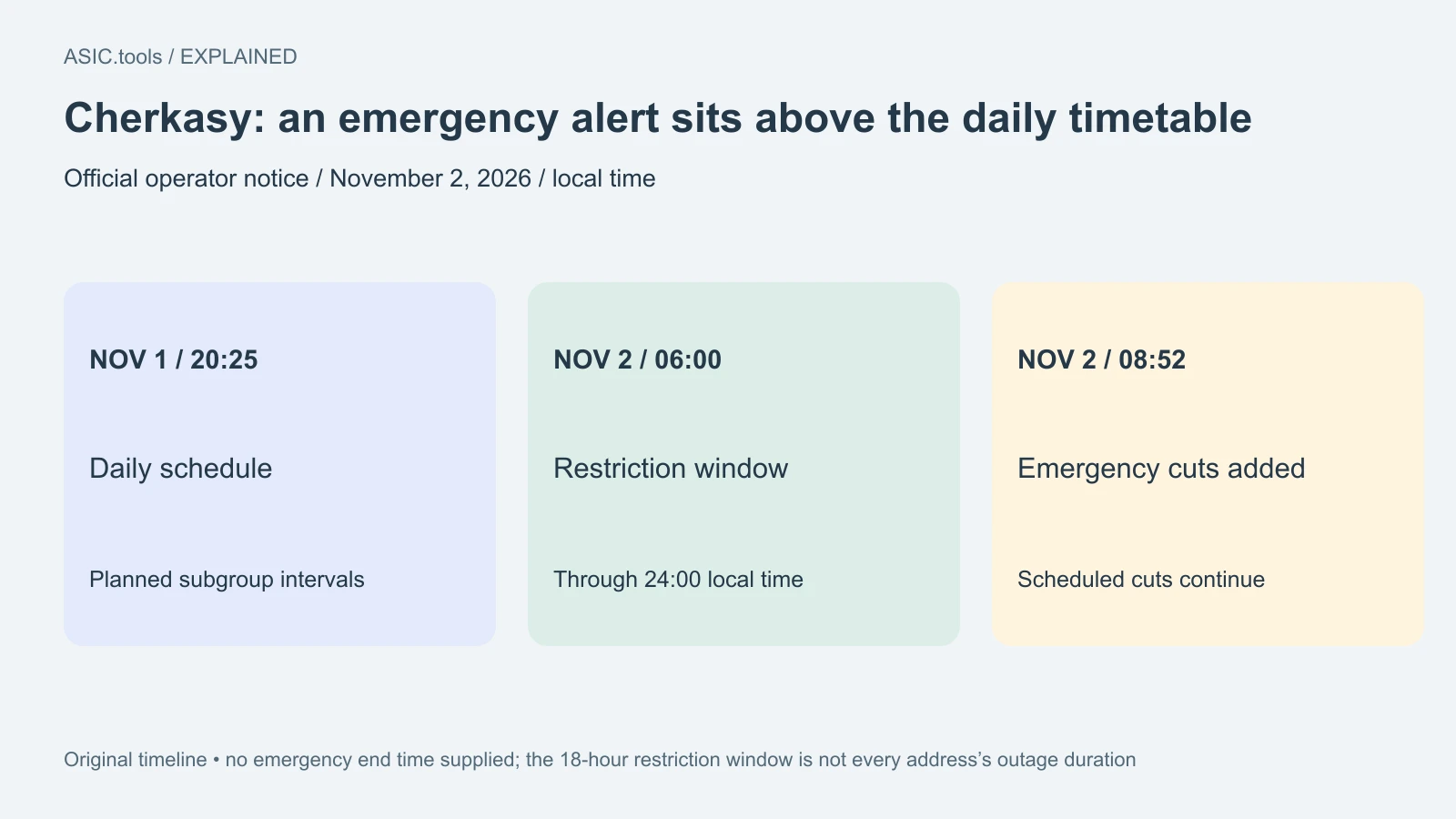
The November 5 announcement is distinct from earlier emergency notices, including the November 2 event previously covered by ASIC.tools. Its new factual point is the 10:35 instruction and the operator’s explicit statement that hourly schedules continue alongside it. Copying an older notice or a generic regional headline would lose that distinction.
The operator directs consumers to its official site and address/group services for updates. A saved schedule can still be useful for explaining a plan, but subsequent instructions can change how it applies. This article does not extend the November 5 notice to another day, to all of Ukraine or to a particular reader’s contractual power limit.
For miners, the lesson from this specific event is operational: the schedule supports planning, while device, pool and meter records support the account of what happened. Use the current operator information for the location and the actual records for runtime and costs. Neither a gap in a printed table nor a single green status indicator is a substitute for those observations.
Source: Cherkasyoblenergo ↗ · Official November 5 hourly schedule, published November 4 ↗ · Operator updates and outage explanations ↗ · Operator voltage advisory dated November 4 ↗
Mining calculator ↗