Bitcoin mining gets crowded again as network power returns to 1 ZH/s
Source report: 2026-10-22 · Editorial analysis published: 2026-10-23
BlocksBridge reports the seven-day hashrate estimate back at 1,000 EH/s. Large miners moving toward AI has not automatically made earning Bitcoin easier for those who remain.
The big number is really a competition story
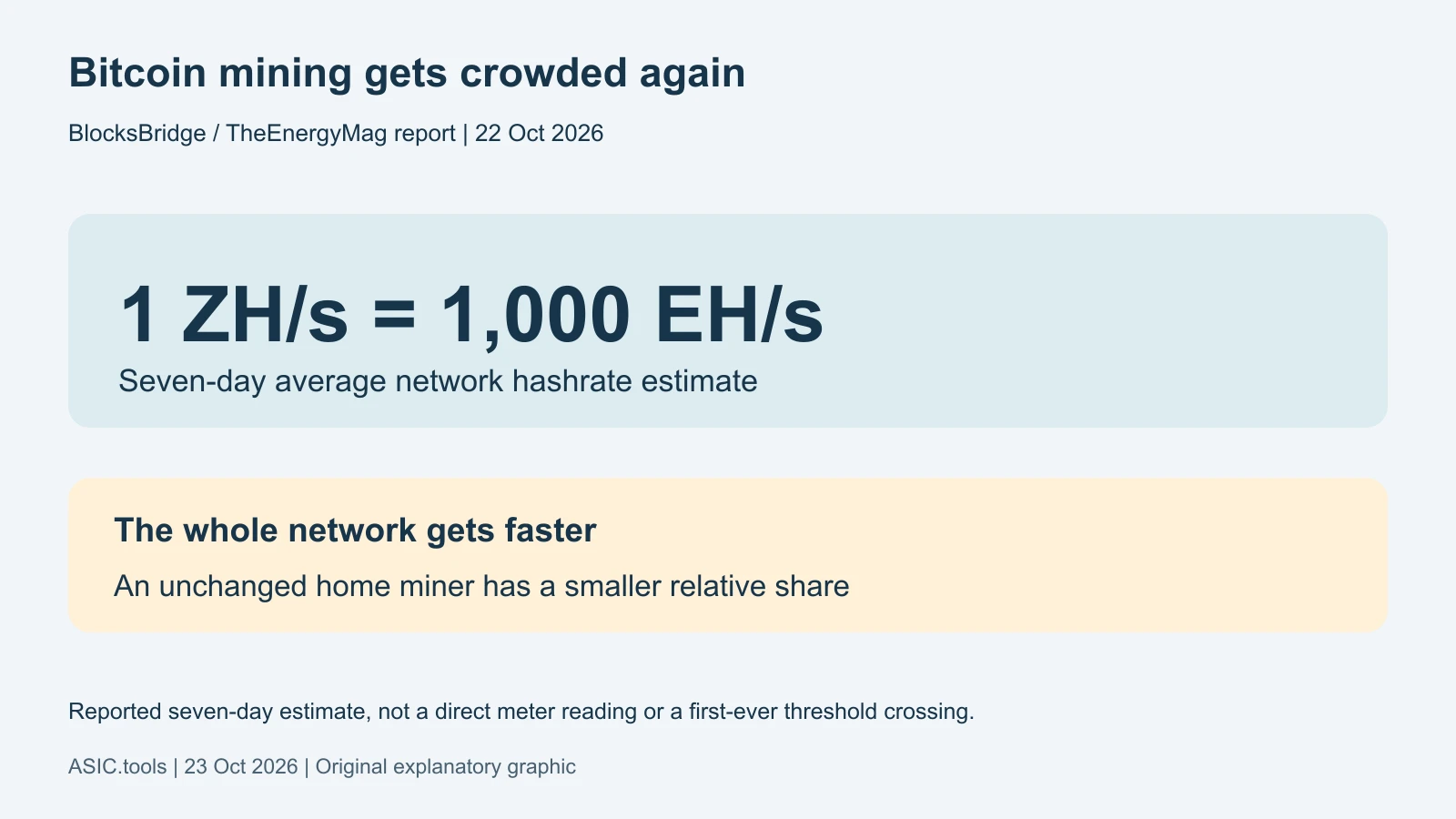
Bitcoin’s seven-day average hashrate estimate has returned to 1 zettahash per second, according to BlocksBridge’s October 22 Miner Weekly report in TheEnergyMag. That is 1,000 exahashes per second, or 1,000 EH/s. The report calls it the highest level since March 3, rather than a first-ever crossing of the threshold.
Hashrate describes how quickly mining equipment tries possible answers to Bitcoin’s proof-of-work puzzle. The network figure is an estimate from observed block production, not a direct reading of every miner’s electricity meter. A seven-day average smooths short bursts of luck, so it should be compared with the same kind of average, not an unrelated momentary reading.
Why another miner’s extra speed affects your machine
Bitcoin does not promise each machine a fixed number of coins per day. Participants compete for block rewards. If the network becomes faster while your equipment stays the same, your relative share of that competition becomes smaller. Your machine can be working normally while the expected reward for its contribution falls.
Think of more people entering a draw whose available prizes do not grow in proportion to the number of participants. Mining is computing rather than a literal ticket raffle, but the comparison explains why a bigger global headline is not automatically good news for an individual miner’s daily income. Pool reward rules and fees still influence how the result reaches an account.
Difficulty is the rule that follows the changing pace
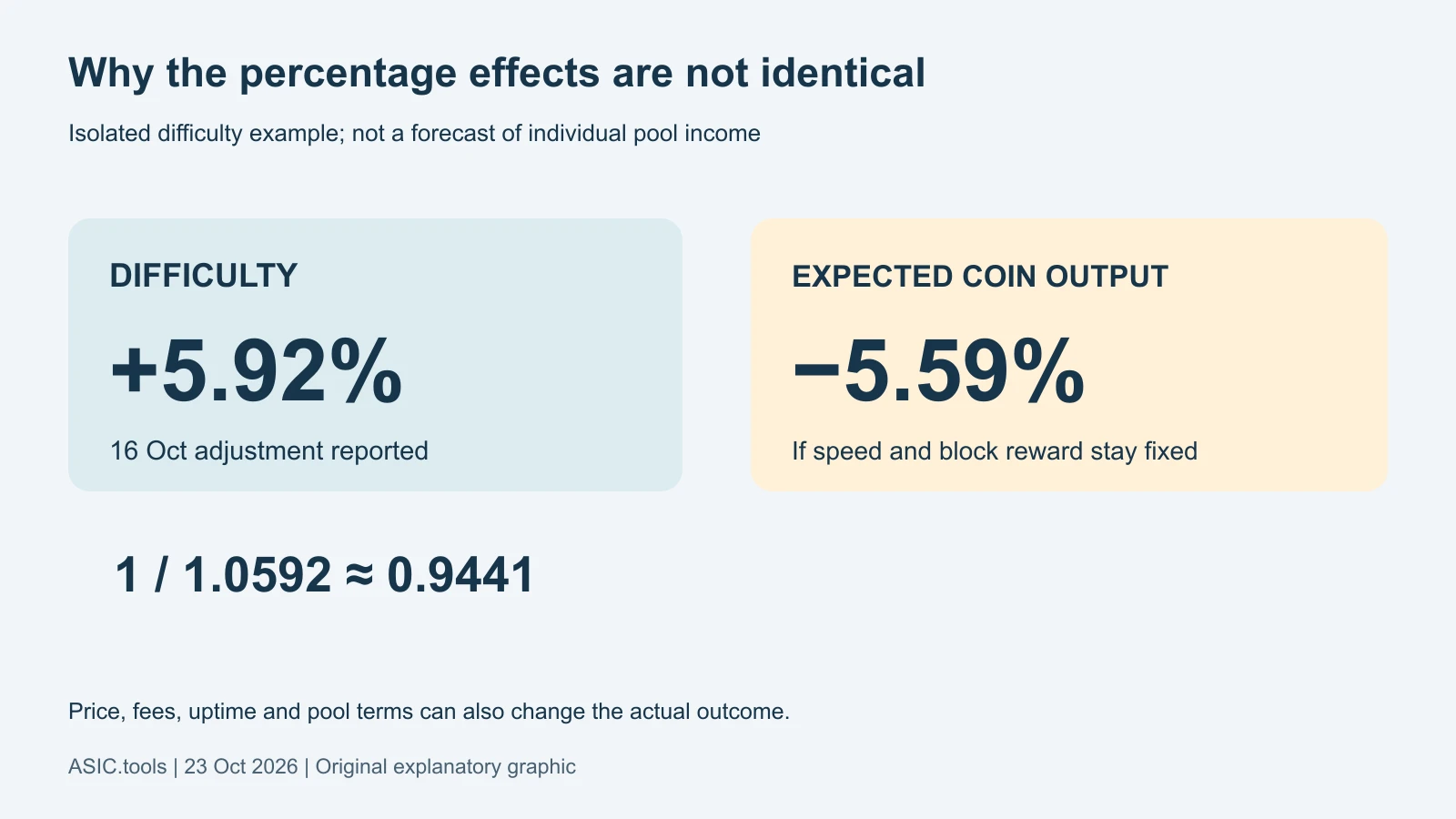
The same report records a 5.92% difficulty increase on October 16. Difficulty is the threshold that determines how hard a valid block is to find. Bitcoin recalculates it every 2,016 blocks, aiming for about ten minutes per block over time. Faster block production can lead to a higher threshold at the next adjustment.
For intuition, holding machine speed and the Bitcoin reward per block constant, multiplying difficulty by 1.0592 divides expected coin output by 1.0592. That is about 5.59% less, not a 5.92% subtraction. This is an isolated explanation of the difficulty effect, not a forecast of actual account income: fees, uptime and pool terms can change too.
AI conversions do not describe the whole Bitcoin network
The interesting part of the October 22 report is the contrast: some large listed miners are converting sites to AI computing while Bitcoin’s overall estimated speed recovers. Moving one company’s power to another business does not establish that total competition elsewhere must fall. Other operators can add new machines or use available equipment.
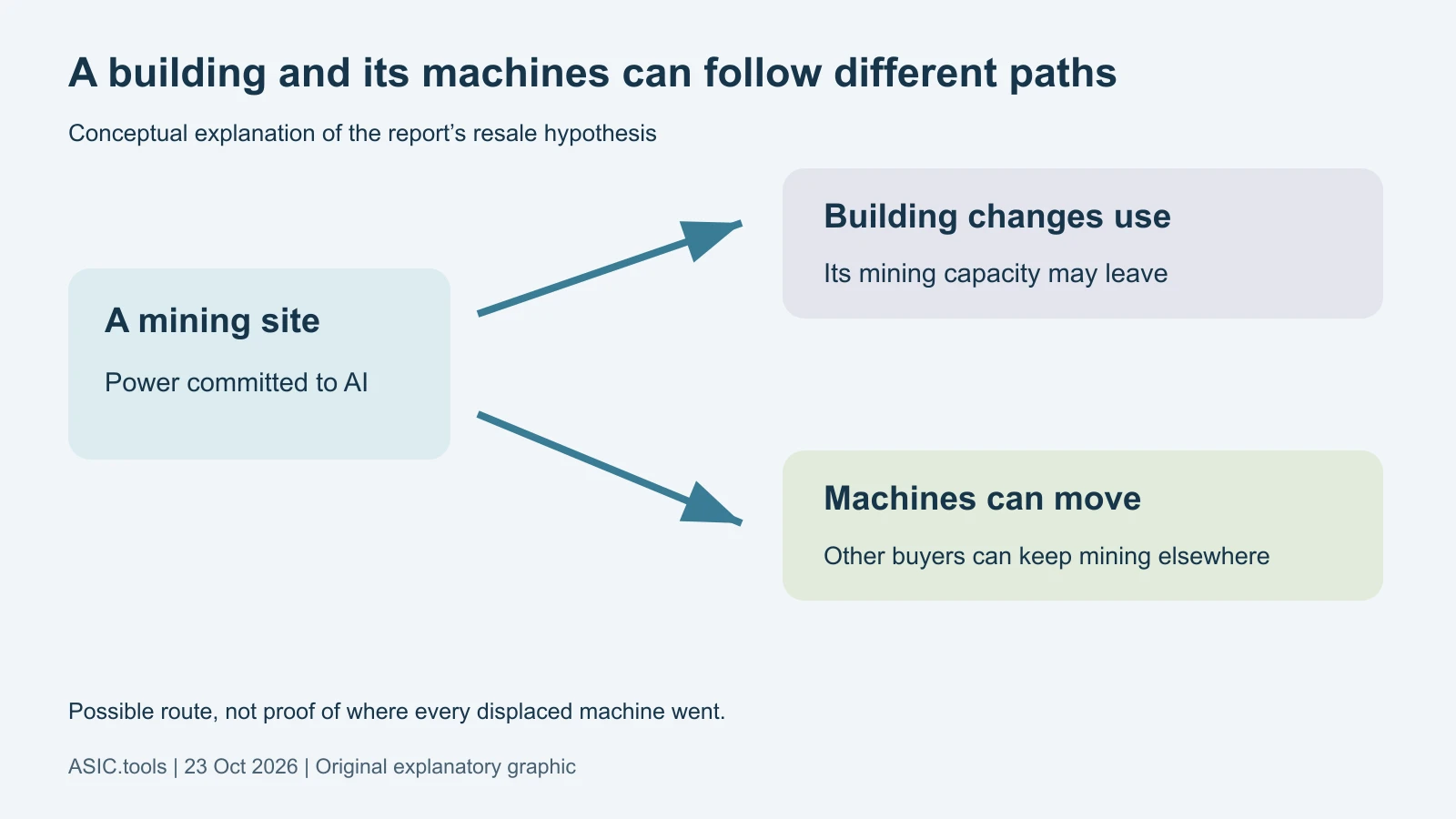
BlocksBridge points to expansion by Bitdeer and discusses used equipment finding other buyers. The resale explanation is a plausible contribution, not a census proving who now owns every displaced miner. A converted building and its former machines are different things: the building can leave Bitcoin while the machines keep working somewhere else. It does not follow that all of them did.
A forecast is still waiting for the next blocks
On October 22, the publisher estimated another 5.16% difficulty increase in about seven days. That figure was a projection at the report’s date; it was not an adjustment already applied and should not be treated as today’s fixed reading. New blocks can change both the estimated percentage and the estimated time.
The practical distinction is between what has happened and what is taking shape. The October 16 adjustment is a completed event in the report. The next one remains future until its boundary is reached. A planning spreadsheet can use alternative scenarios, but quietly turning the estimate into a confirmed network setting would overstate what the source actually shows.
What a small miner should compare now
Compare actual accepted work, electricity consumption and pool payments over matching periods. Hashprice is the expected gross revenue for a unit of mining speed over time; it is not profit after power, hosting or repairs. Bitcoin’s market price can move dollar revenue even when the hardware behaves identically.
An inexpensive used ASIC still needs enough useful work per kilowatt-hour to make sense at your tariff. For a heat-reuse setup, record the heat you genuinely needed separately instead of assuming every watt saves a household expense. The clear message of the rebound is that a corporate shift toward AI has not, by itself, removed the need to calculate costs and competing network work carefully.
Block rewards combine the protocol’s subsidy with transaction fees, so more competition is only one part of gross revenue. Meanwhile, watts are a rate and kilowatt-hours are energy used over time. Match the period of the electricity bill with the period of the mining record before drawing a conclusion: a short speed sample cannot explain a full month’s costs by itself.
Source: BlocksBridge / TheEnergyMag ↗ · Bitcoin proof of work and difficulty rules ↗
Mining calculator ↗