Bitcoin Core will publish easy-to-find bug fixes sooner: what node owners should know
Source report: 2026-10-22 · Editorial analysis published: 2026-10-24
A policy change merged on October 22 removes the usual embargo for easily discoverable flaws. Fixes and an advisory should arrive together across maintained major versions.
A shorter wait for a specific class of bugs
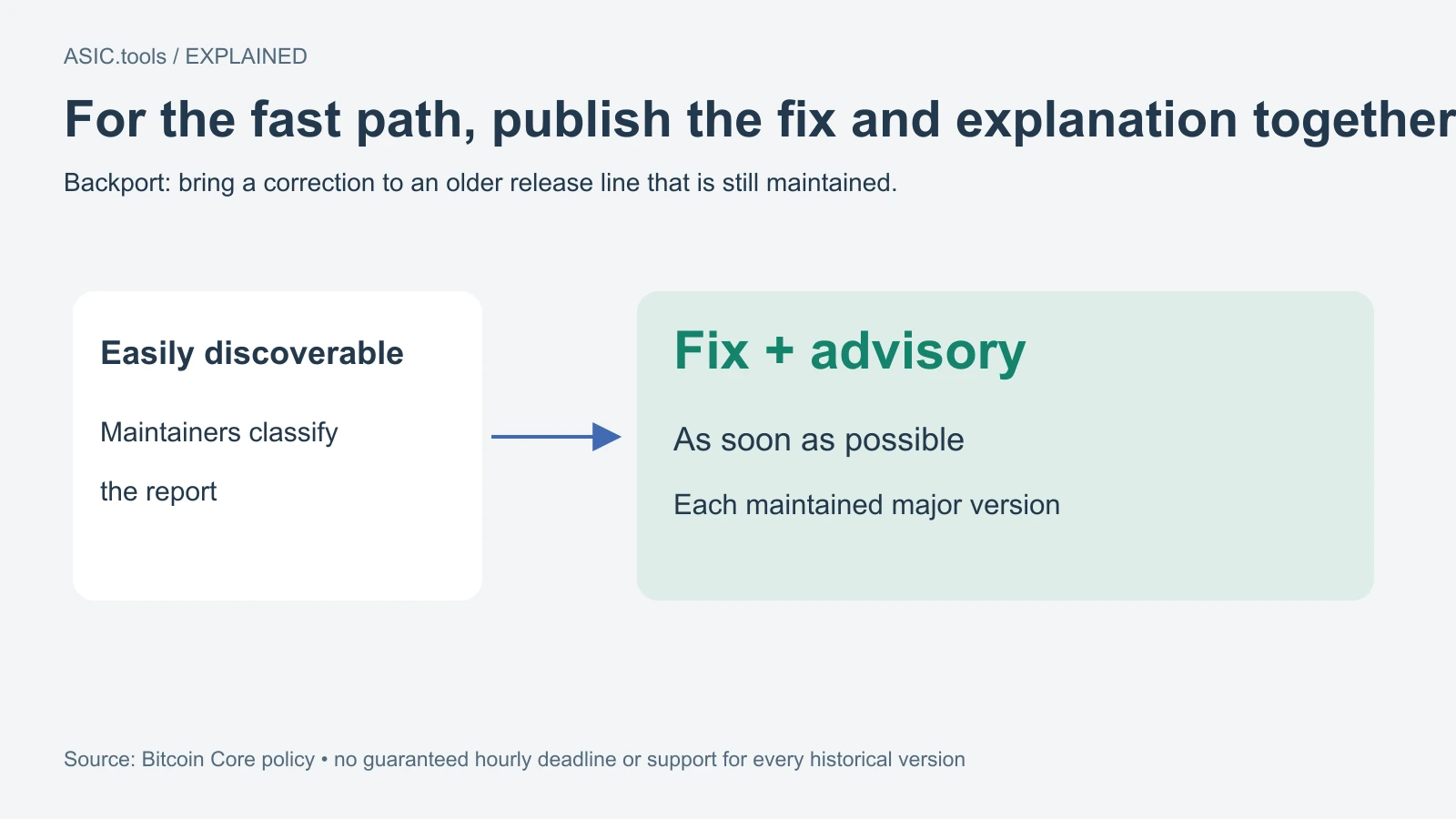
Bitcoin Core changed its security disclosure policy in a website update merged on October 22. For vulnerabilities classified as easy to discover, the project now plans to issue a fixed point release for every maintained major version as soon as possible, with a security advisory alongside it. The usual severity-based waiting periods will not apply to that category.
A node is software that checks Bitcoin’s rules and transactions. Some miners and pools operate their own nodes; other users rely on a service that operates them. The practical consequence concerns whoever maintains that software: details of an easy-to-find flaw may become public at the same time as its fix, making attention to release notices more useful.
This is a change in how future reports are handled, not the announcement of a new exploit, a stolen-wallet incident or a change to Bitcoin’s issuance rules. The merged file changes the website’s disclosure policy. It does not itself install an update on a node or replace a miner’s firmware.
Easy to discover is not a fifth severity level
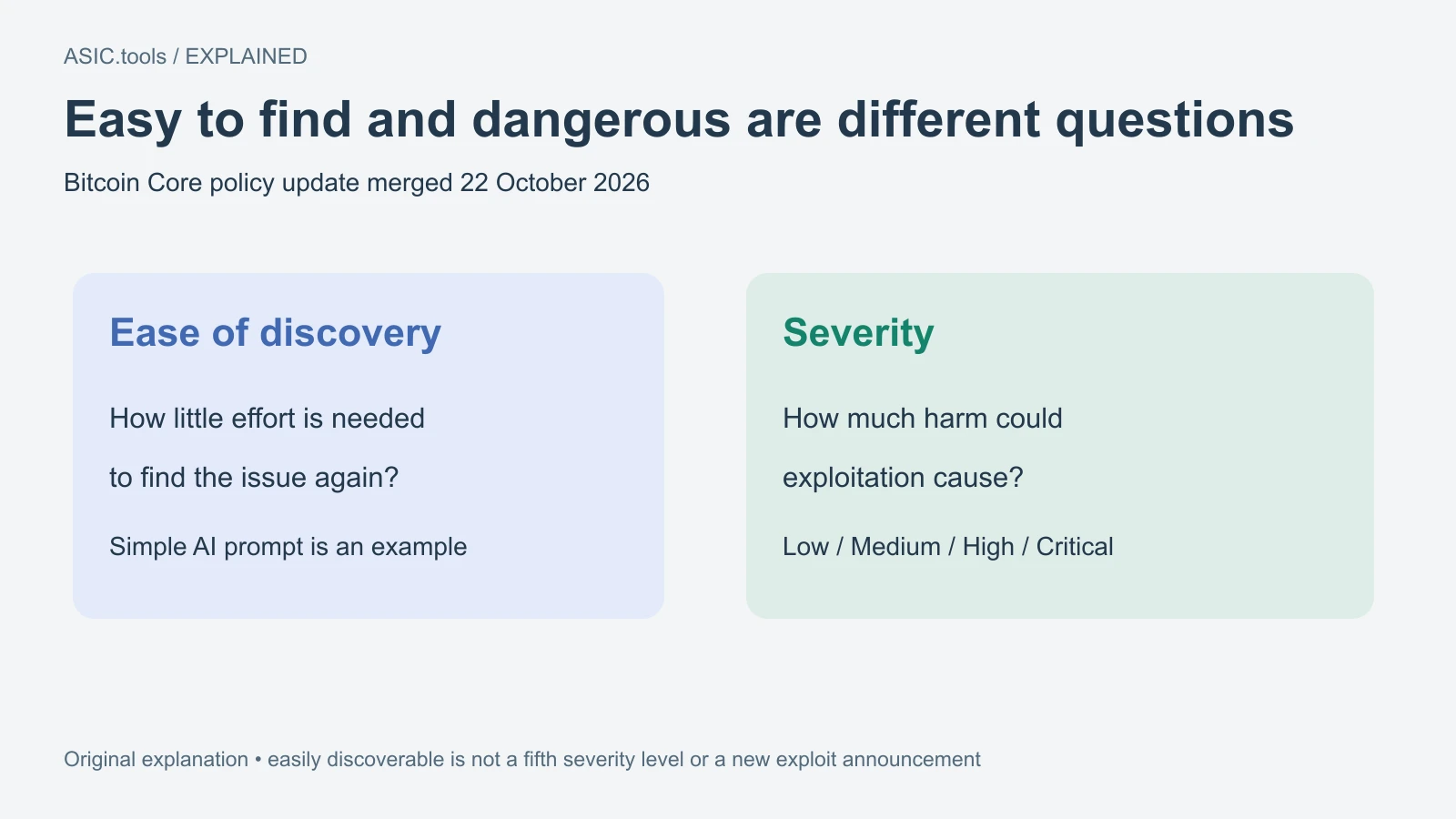
The policy describes easily discoverable flaws as those that can be found with minimal effort, giving a simple prompt to a large language model as an example. A large language model is the kind of AI system used in many chat assistants. The example concerns the effort needed to rediscover a flaw, not a requirement that AI was actually used to find it.
Severity answers a different question: how damaging could exploitation be? The existing Low, Medium, High and Critical classifications remain. A defect can be easy to rediscover and still need its impact assessed; ease of discovery is not a promise that it is harmless or automatically catastrophic.
Maintainers classify reports during triage, the process of checking what a report means and how it should be handled. The change does not say that every AI-generated allegation is valid. A chatbot suggesting a problem is not the same thing as a confirmed vulnerability or a published advisory for an affected release.
What backport and point release mean
A backport takes a correction into an older release line that is still maintained. It lets an operator receive that fix without necessarily moving to the next major version. A point release is a smaller version update within such a line, distinct from a new major generation of the software.
The new rule promises that process for each maintained major version as soon as possible. It does not promise support for versions that have reached end of life, nor does it set a fixed number of hours in which every correction must appear. A system being old enough to run is not the same as being on a maintained release line.
The proposal’s explanation says long secrecy is a poor trade-off when attackers can easily rediscover the issue, because it can delay availability of a fixed release. The policy seeks a different balance between transparency and time to upgrade. It is a response to discovery becoming easier, not evidence that AI can defeat all Bitcoin security.
Other disclosure rules still exist
For other low-severity vulnerabilities, the policy retains disclosure two weeks after a major release containing the fix. Medium and high issues are generally disclosed two weeks after the last affected release reaches end of life. These are the usual rules for the other category, not waiting times imposed on the new easy-to-discover path.
The two-week advance notice described by the page now explicitly refers to embargoed vulnerabilities. An embargo means withholding public details for a period; it is not a period in which a bug cannot exist or be found by someone else. Critical issues may require an individual procedure rather than the standard timetable.
Keeping these distinctions avoids two misleading headlines: that every security delay has ended, or that all flaws now have to wait for the same new deadline. The confirmed change is narrower. It adds a fast disclosure-and-fix path for reports maintainers classify as easily discoverable while preserving the rest of the framework.
What to check in practice
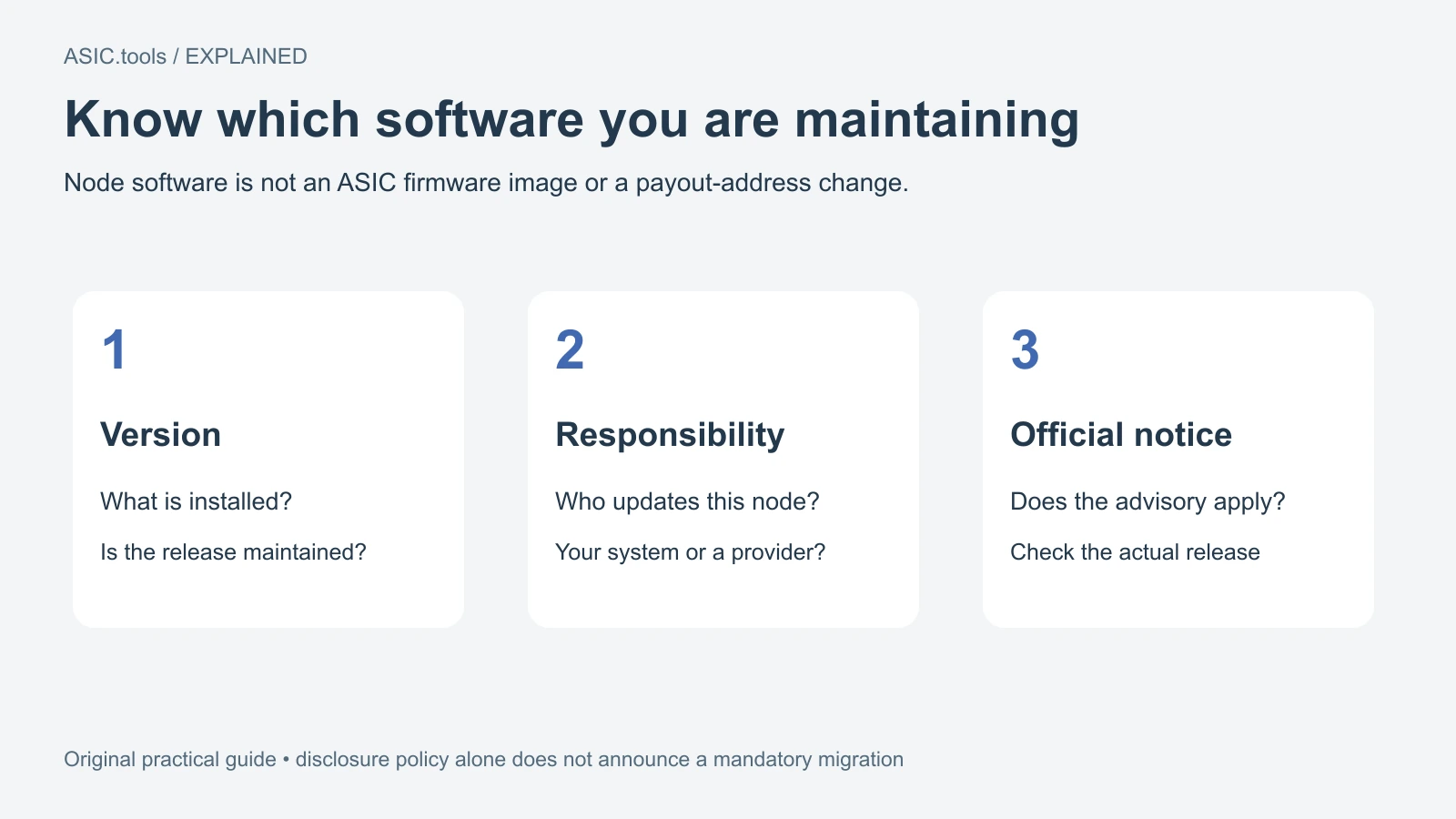
If you run a node, identify the installed version and who is responsible for updates. Follow the project’s official release and security pages, and read whether an advisory applies to your actual release. When using a pool or a hosted service, distinguish its maintenance responsibilities from software you operate yourself.
A Bitcoin Core node update is not automatically an ASIC update or a change of payout address. Do not treat an article about disclosure policy as a request to enter a recovery phrase into a website. Obtaining software through the project’s official route and checking the published download information are separate from reading a news headline.
The useful takeaway is a clearer expectation: some fixes and their explanations should now arrive together across maintained lines. There is no new mandatory migration announced by this policy alone. The event to watch is an actual applicable release and advisory, with its own version numbers and instructions.
Source: Bitcoin Core ↗ · Current disclosure policy ↗
Mining calculator ↗