Bitcoin Testnet 5 miners find the first block
Source report: 2026-11-14 · Editorial analysis published: 2026-11-14
The November 14 block anchors a separate test chain to a recent Bitcoin block. The bootstrap is working while Bitcoin Core support remains under review.
A block from a different chain
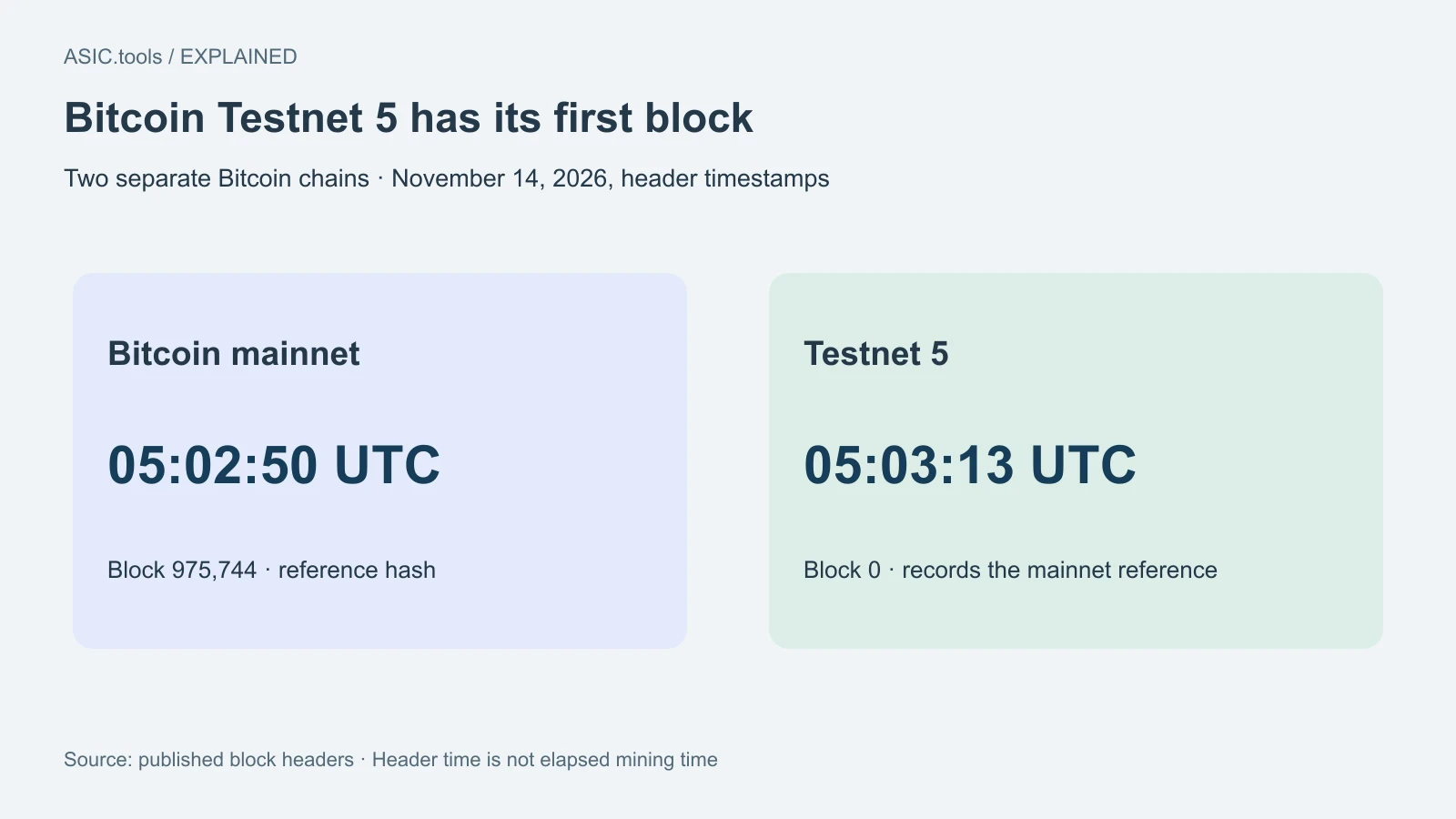
Miners found the first block of Bitcoin Testnet 5 on November 14. Its header records 05:03:13 UTC, and the bootstrap operator has published the block and the first part of the chain. This is a test network for experimenting with Bitcoin software. It has its own blocks and coins. It gives a developer or pool operator a place to try a change without putting mainnet payouts at stake.
The first block, also called a genesis block, gives compatible nodes a common starting point. Its hash begins with 00000000000008c1. ASIC.tools recomputed the full hash from the published header and checked that the result is below the required target. That is a check of the data, separate from trusting a dashboard label or a screenshot.
The name “Bitcoin Testnet 5” describes what it tests, not where rewards are paid. For example, a pool that wants to test a change in its block handling can use a separate worker and leave the machines earning BTC on their current pool. Keeping those profiles separate makes it easier to see which network generated a log entry.
Why the first block points to Bitcoin
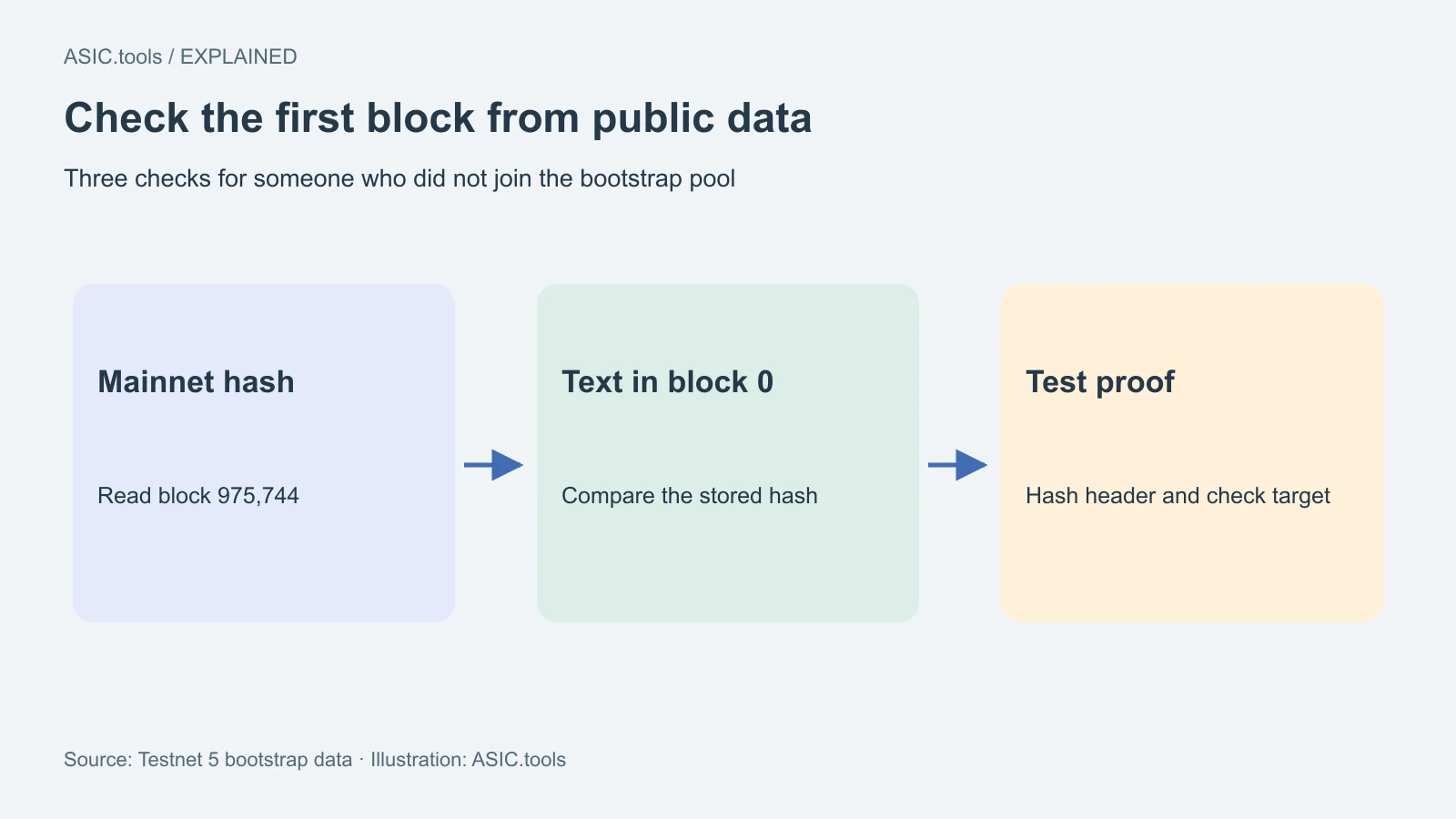
The test block’s first transaction contains the date, the number 975,744 and the hash of that Bitcoin mainnet block. The mainnet block header records 05:02:50 UTC. The bootstrap plan used its hash so miners could not prepare work for the published test block before that mainnet value was known. A change to even one character would have made different work.
The two blocks do different jobs. The mainnet block is the one at which Bitcoin mining difficulty changed. The test block uses its hash as a reference to an event that already happened. The 23 seconds between the header timestamps are a useful way to order the records, but do not measure exactly how long anyone’s machine was mining or when a pool first saw either block.
The reference also lets someone verify the starting condition without joining the pool. Locate the mainnet block by its height, compare its hash with the text in the test transaction, and check that the header hash satisfies the separate test target. Those checks tell you which first block was published and what earlier event it depends on. They do not identify how many miners were working.
What the early results show
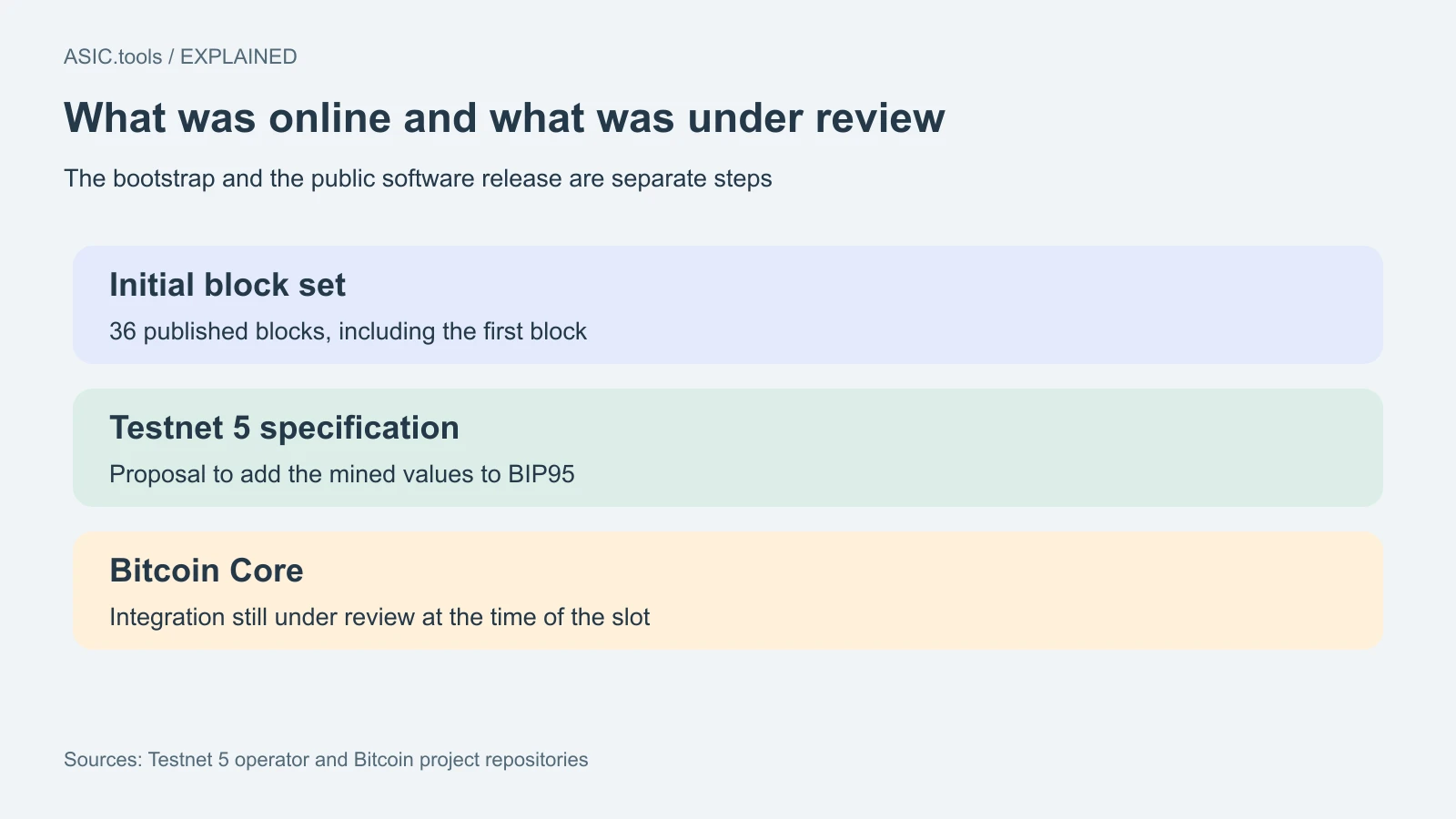
The bootstrap operator posted a downloadable set of 36 blocks including genesis. That file is an initial sample. The operator’s separate status panel tracks a node that can move beyond the packaged set. An operator can check the links between the published headers or use the early blocks to exercise their software. A machine submitting work to this project is using its time and electricity on a test exercise.
The initial proof-of-work difficulty is about 1.05 million on the usual scale against difficulty one. The setup was designed around dedicated SHA-256 mining hardware. That gives developers something close to the equipment and pool path they use on mainnet. Test coins remain on this network; work on it does not produce ordinary BTC or offset the machine’s electricity bill.
For a pool, useful tests include issuing new jobs as the test chain advances and seeing whether the node accepts a submitted example. Keep the job log and node log together so you can tell which change caused a problem. A successful submission on the test chain is evidence about your software path; it is not a result from mining mainnet.
Working bootstrap, ongoing review
A proposal adding the actual genesis values to BIP95 was opened on November 14. BIP95 is the specification that describes this test network. Bitcoin Core’s implementation was still under review when checked. Seeing a valid first block therefore tells you the test chain exists; it does not tell you that the regular release installed on your node already knows about it.
Keep a test setup distinct from the one that handles money. Check the software version, network selection and payout destination before moving any worker. If you only mine mainnet BTC, the bootstrap is no reason to change your pool settings. If you test mining infrastructure, use the published records to check that your node sees the intended chain and your pool accepts fresh test work.
The operator’s instructions treat the bootstrap as provisional and list more work, including node discovery, a faucet and an explorer. A faucet distributes test coins for experiments. Those services make the network easier to use; the mined first block and the usability of a regular release are different milestones.
Source: Testnet 5 bootstrap ↗ · Bootstrap block data ↗ · Anthony Towns — bootstrap and proof ↗ · BIP95 genesis parameters proposal ↗ · Bitcoin Core integration ↗
Mining calculator ↗