Volusia bars large data centres outside its cities: where the 50 MW rule applies
Source report: 2026-10-21 · Editorial analysis published: 2026-10-22
The Florida county adopted a local land-use prohibition. The official notice distinguishes unincorporated areas, city decisions and an anticipated peak power threshold.
A local decision about land and electricity
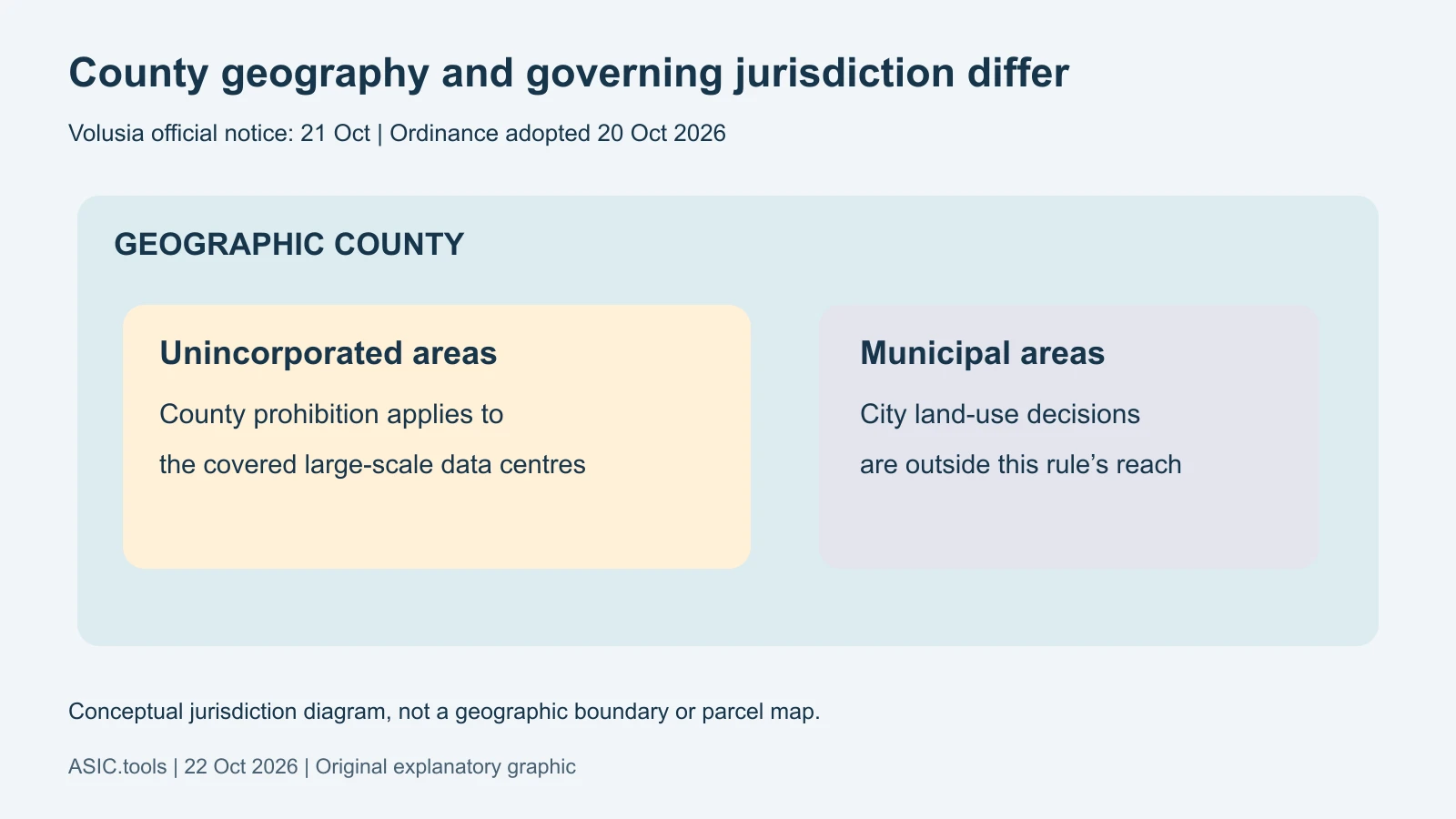
Volusia County in Florida announced on October 21 that its council adopted an ordinance the previous day prohibiting large-scale data centres throughout its unincorporated areas. The county says the initiative is intended to protect water resources and infrastructure capacity and address effects on nearby communities.
This is a specific local decision, not a statewide ban on computing or a national ban on Bitcoin mining. For readers following the rapid growth of power-hungry facilities, its importance is that a project can face a land-use restriction before questions about equipment or electricity prices are even reached.
Outside city limits does not mean outside government
Unincorporated areas are places outside municipal jurisdictions where county government handles the relevant land-use decisions. The announcement says the prohibition applies in those areas and does not govern decisions within municipalities. A city located inside the geographic county still has its own decision-making boundary.
That distinction matters when reading a headline saying simply that a county has banned data centres. The precise question is where the site is and which authority controls the proposed use. The notice does not announce that every city in Volusia has adopted the same rule.
Fifty megawatts is a power threshold
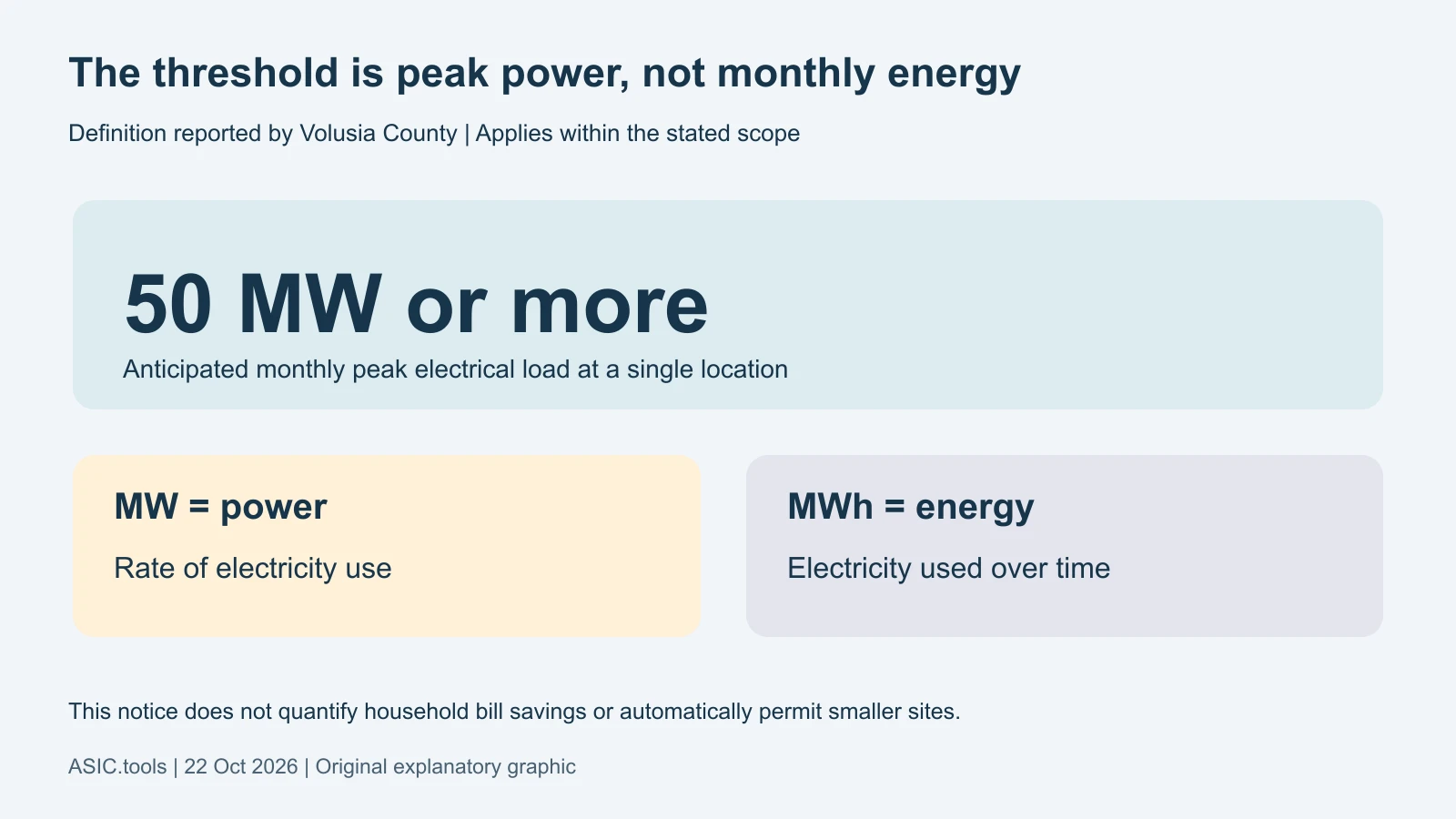
The county cites the state definition: a data centre at a single location with an anticipated monthly peak electrical load of 50 megawatts or more. The boundary includes exactly 50 MW. It is a measure of peak power, not 50 megawatt-hours of monthly energy consumption.
Power describes how fast electricity is being used; energy describes the amount used over time. A short high load and a lower continuous load can have different energy totals. The rule described in this notice uses an anticipated peak, so substituting a monthly average bill or an energy total would answer a different question.
What the county says it will stop processing
The official notice says the county will not accept or process applications and approvals associated with establishing, constructing or operating the covered large-scale data centres. It lists development approvals, comprehensive-plan amendments, rezonings, building permits and site plans among the affected routes.
The prohibition also covers proposals to expand or intensify those operations. It is therefore broader than a statement that one particular development lost a single permit. At the same time, the short announcement is not a substitute for checking the full ordinance and any applicable circumstances of an individual property.
Why mining readers should care about the scope
A mining site and a general-purpose data centre both need a suitable location, electrical capacity and the necessary permissions. The Volusia decision illustrates why a low advertised electricity tariff alone is not a complete project plan. Land-use eligibility and available power have to be checked as well.
The notice does not classify every cryptocurrency installation or say that every use below 50 MW is automatically allowed. It should not be turned into a claim that household miners are banned, or into a blanket permission for smaller industrial farms. Those conclusions would require details beyond this county news release.
What changes for nearby households
The county’s stated reasons concern water, infrastructure and surrounding communities. The announcement does not quantify a reduction in household electricity bills, the water a particular project would have used or emissions avoided. Those outcomes cannot be calculated simply from the 50 MW definition.
The confirmed news is the October 20 adoption and the scope the county described on October 21. Check the actual location, responsible authority and full published rules before drawing conclusions about a particular site.
Source: Volusia County Government ↗
Mining calculator ↗