Solo CKPool finds Bitcoin block 975,427 with a 3.154 BTC reward
Source report: 2026-11-11 · Editorial analysis published: 2026-11-13
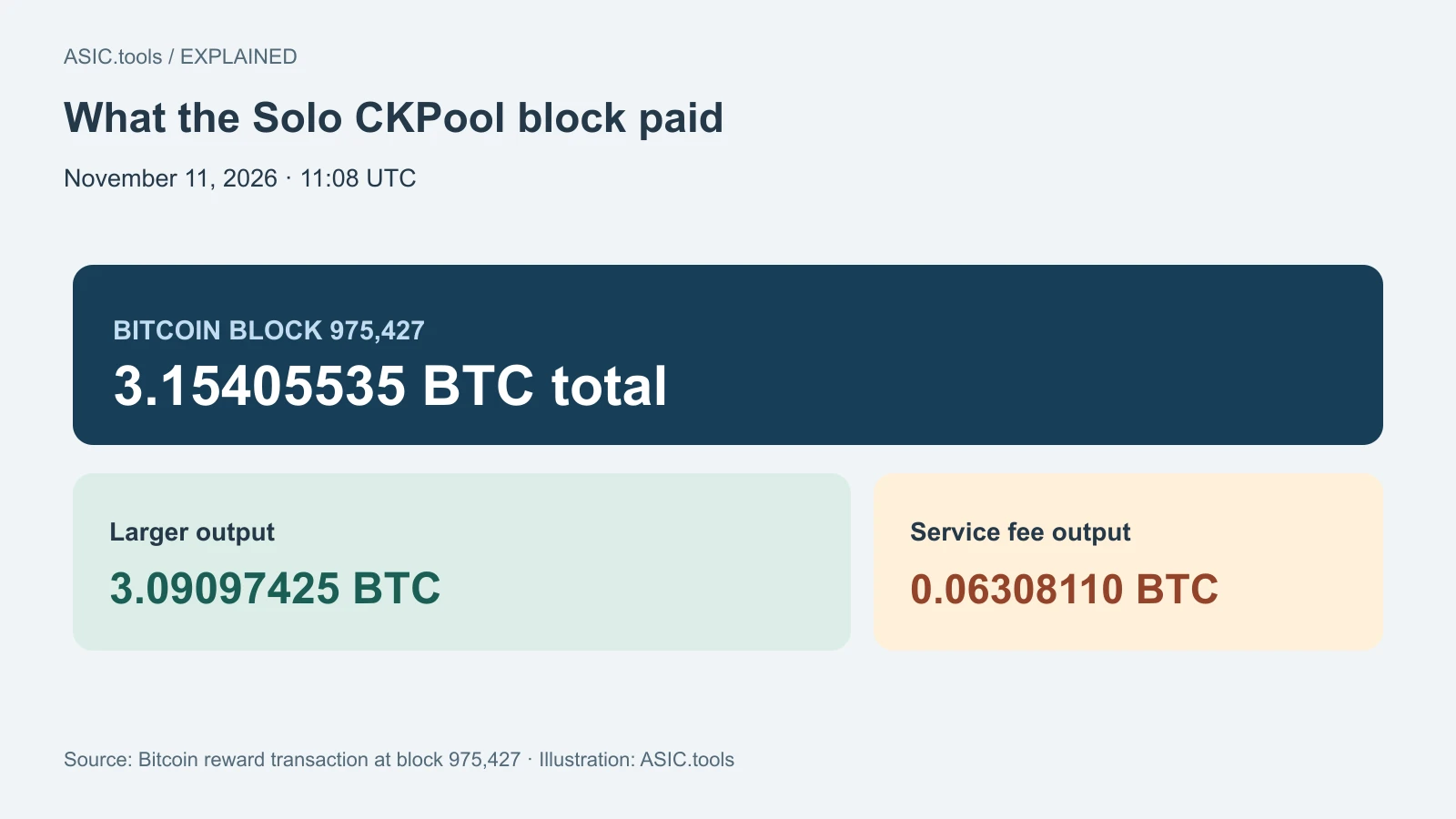
The November 11 block records 3.15405535 BTC in total, with 3.09097425 BTC in its larger output. The public record shows the payment split.
A solo block on November 11
Bitcoin block 975,427 carries the Solo CKPool tag. Its header records November 11 at 11:08 UTC, or 13:08 in Kyiv. The reward transaction paid out a total of 3.15405535 BTC. The larger of its two payments was 3.09097425 BTC. The block offers a clear look at what a solo win actually pays.
The tag is in the reward transaction, called the coinbase. It is a short text marker used by the service. The transaction shows what was paid on the chain. To identify an exact ASIC or count the machines running, you would need information from the operator or miner.
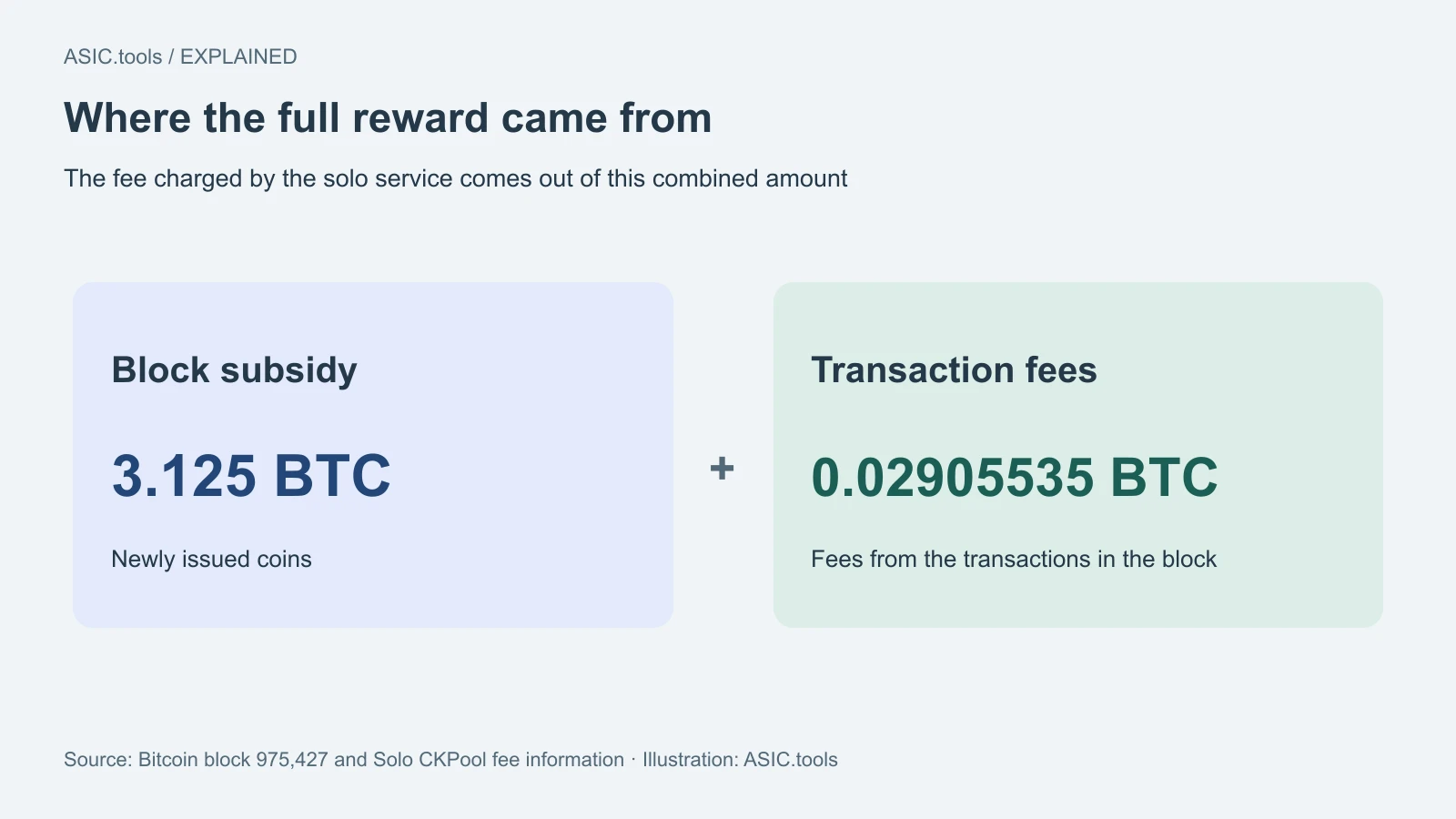
How the reward was split
The reward combines 3.125 BTC in newly issued coins and 0.02905535 BTC in transaction fees. These fees are what users paid to have transactions included. They vary from block to block. The block contains 3,414 transactions, including the reward transaction itself.
The second payment was 0.06308110 BTC. Solo CKPool advertises a 2% service fee, and the smaller payment matches 2% of this reward to the precision recorded in the transaction. The two amounts add up to the total. This gives readers a way to check the difference between the full block reward and the amount directed to the winning miner.
Bitcoin requires coinbase outputs to mature before they can be spent. The waiting period is measured in blocks, with a minimum of 100. The amount appears in the block explorer first. Spendability depends on the network adding enough blocks after it, so a payout record and the ability to move the funds are separate milestones.
The smaller payment corresponds to the fee on the full reward, including the transaction fees. Applying 2% only to the 3.125 BTC subsidy would give 0.0625 BTC. Comparing the actual amount with both calculations shows which base was used.
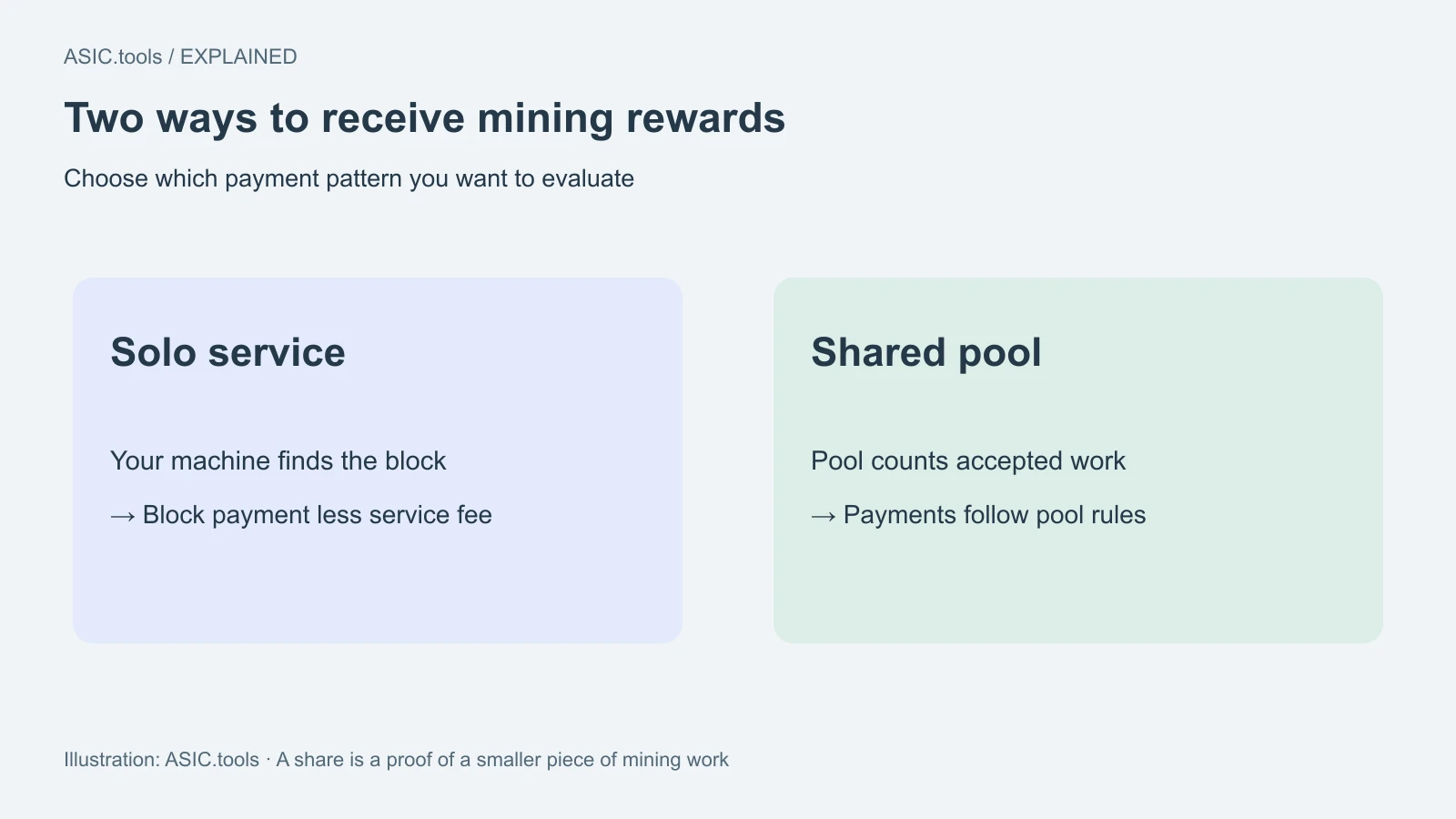
What a solo service changes
Solo CKPool gives machines work and broadcasts a valid block if one is found. In solo mode, the miners connected to the service do not split each win among themselves. The winning miner gets the block payment after the fee. A shared pool spreads rewards across participants according to the work they submit and the pool’s payment rules.
A machine can show that it is sending valid shares for days without finding a block. Shares are smaller proofs that the device is working. A solo service can use them to show whether the machine is connected and producing valid work. A share does not itself earn a portion of the next block found by another miner.
The service’s public statistics showed roughly 160 TH/s over a day for the recipient account when checked on November 13. That is a later estimate derived from shares. It is useful for scale, while the actual speed at the instant of the win and the model of the equipment remain unknown.
What you can learn from the block
Compare solo and shared mining using the same electricity price and operating hours. A solo machine can run up a steady power bill through a long stretch with no reward. A pool payout schedule answers a different question: how much a pool pays for accepted work and when it sends that payment.
Both approaches benefit from knowing how much accepted work your rig produces when it stays online. A shorter testing window can tell you whether it connects, while a longer one gives a better picture of uptime and the electricity bill. Neither window creates a schedule for finding a solo block.
The next time you see a headline about a solo win, you can open the block and inspect its first transaction. Read the total amount in bitcoin and then look at the individual outputs. That makes it possible to verify a payout without relying on a dollar conversion taken at an unknown time.
Source: Bitcoin block 975427 / Solo CKPool ↗ · Bitcoin — reward transaction ↗ · Solo CKPool — service and fee ↗ · Bitcoin developer guide — coinbase maturity ↗
Mining calculator ↗