Malaysian police seize 48 Bitcoin miners in a power theft investigation
Source report: 2026-11-10 · Editorial analysis published: 2026-11-12
Police and utility engineers raided a residential property in Seri Iskandar on November 10. The case is a reminder to check how mining power is metered and billed.
A raid at a residential property
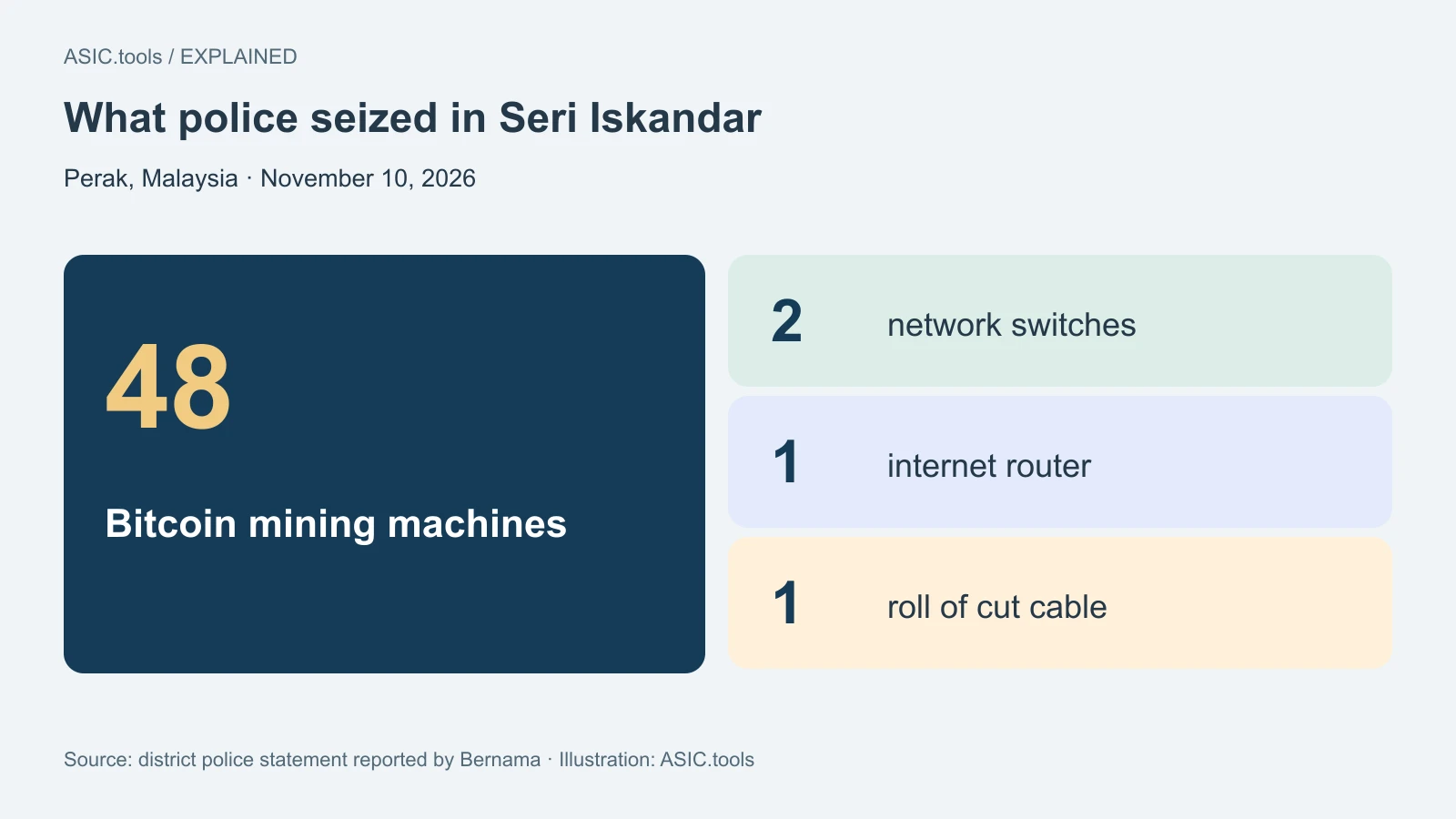
Police seized 48 Bitcoin mining machines on November 10 at a residential property in Seri Iskandar, in the Malaysian state of Perak. District police chief Hafezul Helmi Hamzah said criminal investigators worked with engineers from Tenaga Nasional Berhad (TNB), the electricity supplier. The operation concerned a suspected unauthorized power connection.
Malaysia’s national news agency Bernama reported the police statement that evening. Public broadcaster RTM followed on November 11. For a miner, the practical question raised by the raid is straightforward: who measures the machines’ electricity use, and whose name appears on the bill?
What investigators took
Along with the miners, police reported seizing two network switches, one internet router and a roll of cut electrical cable. Switches and routers connect machines to a network. They tell us that communications equipment was found at the address, but the report did not identify the mining pool, the equipment models or their running hours.
The statement also gave no confirmed amount of electricity taken or financial loss. Forty-eight machines is a count, not an energy reading. Turning it into a bill would take evidence of their power draw, how long they ran and what rates applied. The seizure itself does not establish anyone’s guilt.
Even an equipment list from a raid has limits. Seized items can be inspected later, but an inventory does not show what was switched on at any given time. That distinction matters when comparing this case with other enforcement reports.
Why the meter matters
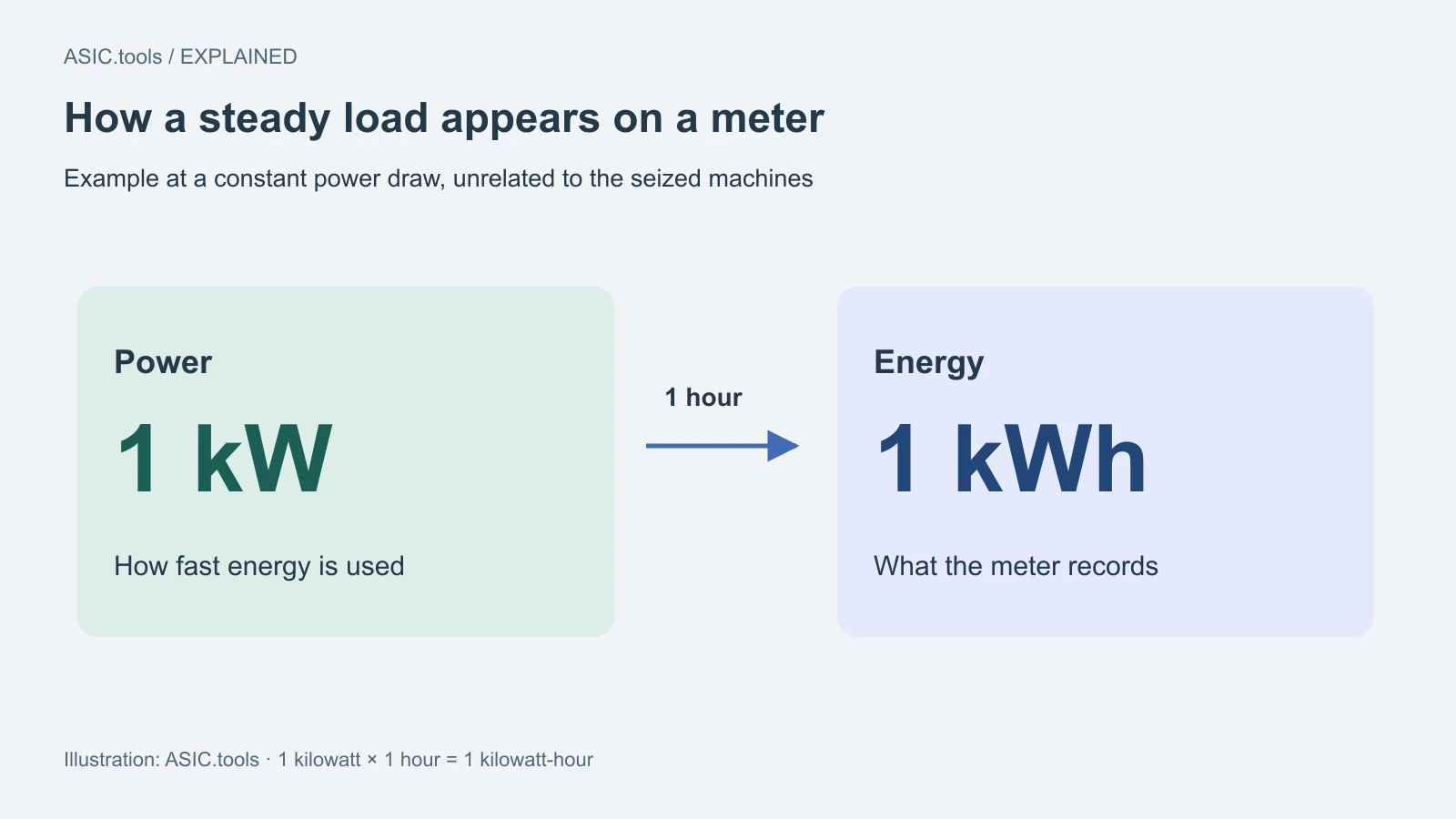
An electricity meter records energy in kilowatt-hours. A device drawing one kilowatt for an hour uses one kilowatt-hour. Measuring a steady mining load matters because even a modest device can run for far longer than a kettle or oven. A household bill may show the combined use of the miner, the rest of the home and any extra ventilation.
TNB says interference with a meter can prevent it from recording actual consumption. The utility warns that unsafe alterations can also expose people to electric shock and fire. If you suspect interference, contact the utility; have a qualified electrician look at wiring on your side of the connection. A surprisingly low bill does not establish that everything is connected correctly.
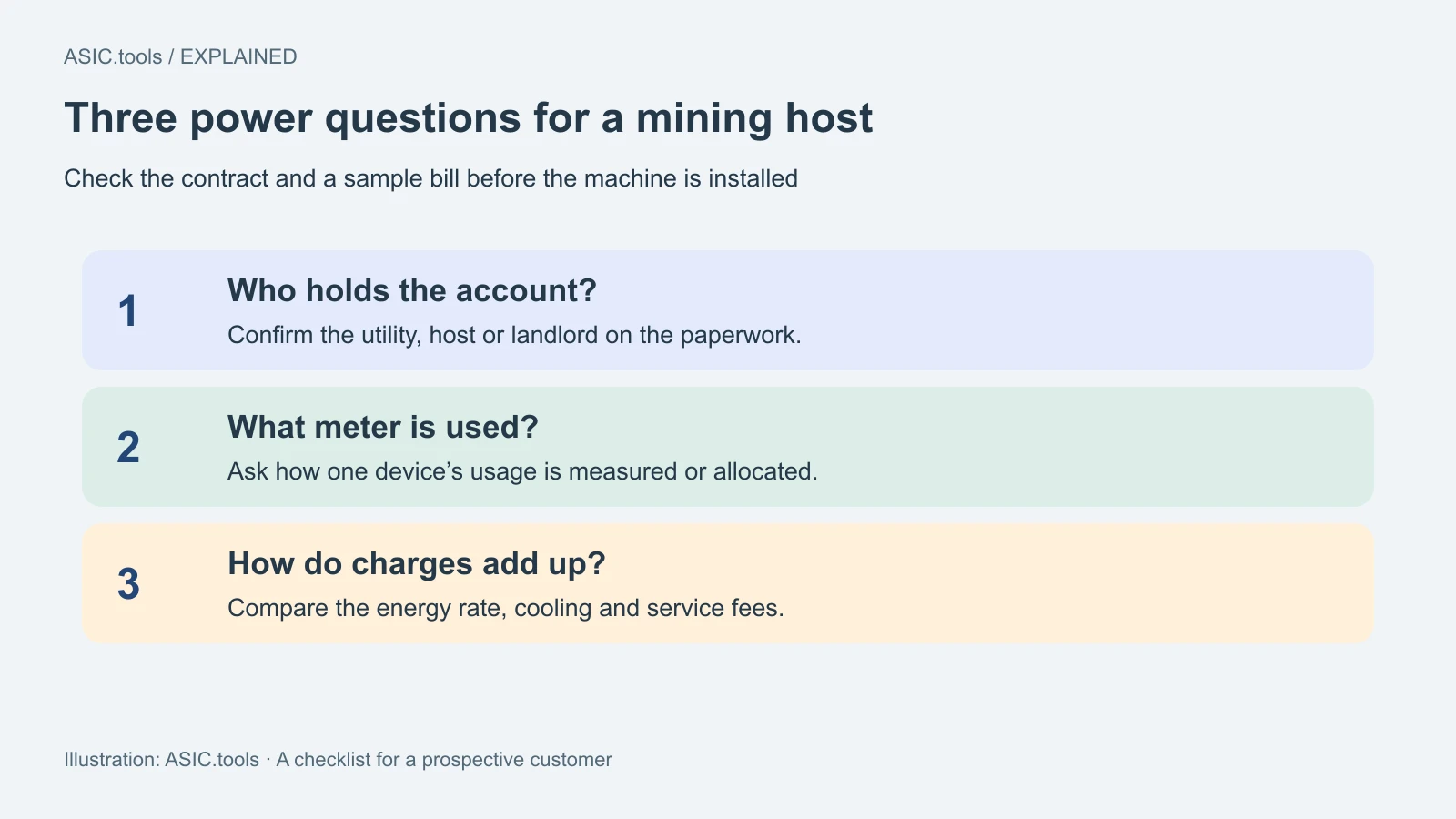
Questions to ask before renting space
If a host offers to run your miner, ask how they measure your machine’s use. Is electricity included at a fixed rate, or billed against meter readings? Ask for an example bill or statement, the rate per kilowatt-hour, and the terms for cooling and service fees. If payment goes through a landlord or host, ask how they are authorized to supply and charge for electricity.
Those questions also help when a cheap quote is legitimate. A small host may have a clear tariff and good records without a polished website. Put the answers in the contract so you can compare the actual bill with what was offered. For a rented home, check whose account covers the meter and agree on continuous equipment use before installing anything.
For a shared facility, ask how it allocates a common bill. A reading for a whole room does not show your machine’s share unless the host can explain the allocation. Keep the billing dates alongside the readings so that a shorter month or a maintenance stop does not distort a comparison.
What the case tells miners
A pool dashboard can show a machine producing valid work all day. It cannot tell you whether the power supply is authorized, safely installed or billed to the right customer. That information comes from the electricity account, the meter and the agreement for the property.
Ask who will answer if a reading and a bill disagree. The host may control a device-level meter while the account holder sees the utility bill. Having those contacts and knowing which record each one can check makes it easier to resolve a mismatch.
For home or hosted mining, keep a record of the rate, periodic readings and payments. They make an unexpected change easier to spot and give you a basis for asking the supplier or host to explain it. In Seri Iskandar, the police account identifies the equipment seized and the suspected connection; the investigation will determine what happened.
Source: Bernama ↗ · Radio Televisyen Malaysia (RTM) ↗ · Tenaga Nasional Berhad (TNB) — meter tampering FAQ ↗
Mining calculator ↗