San Diego moves toward a data-centre pause: the council vote is still ahead
Source report: 2026-10-22 · Editorial analysis published: 2026-10-23
The mayor’s October 22 order asks staff to bring a temporary moratorium to the council on October 26. Water, power costs, housing and local authority are central to the review.
An order to prepare a pause is not the pause itself
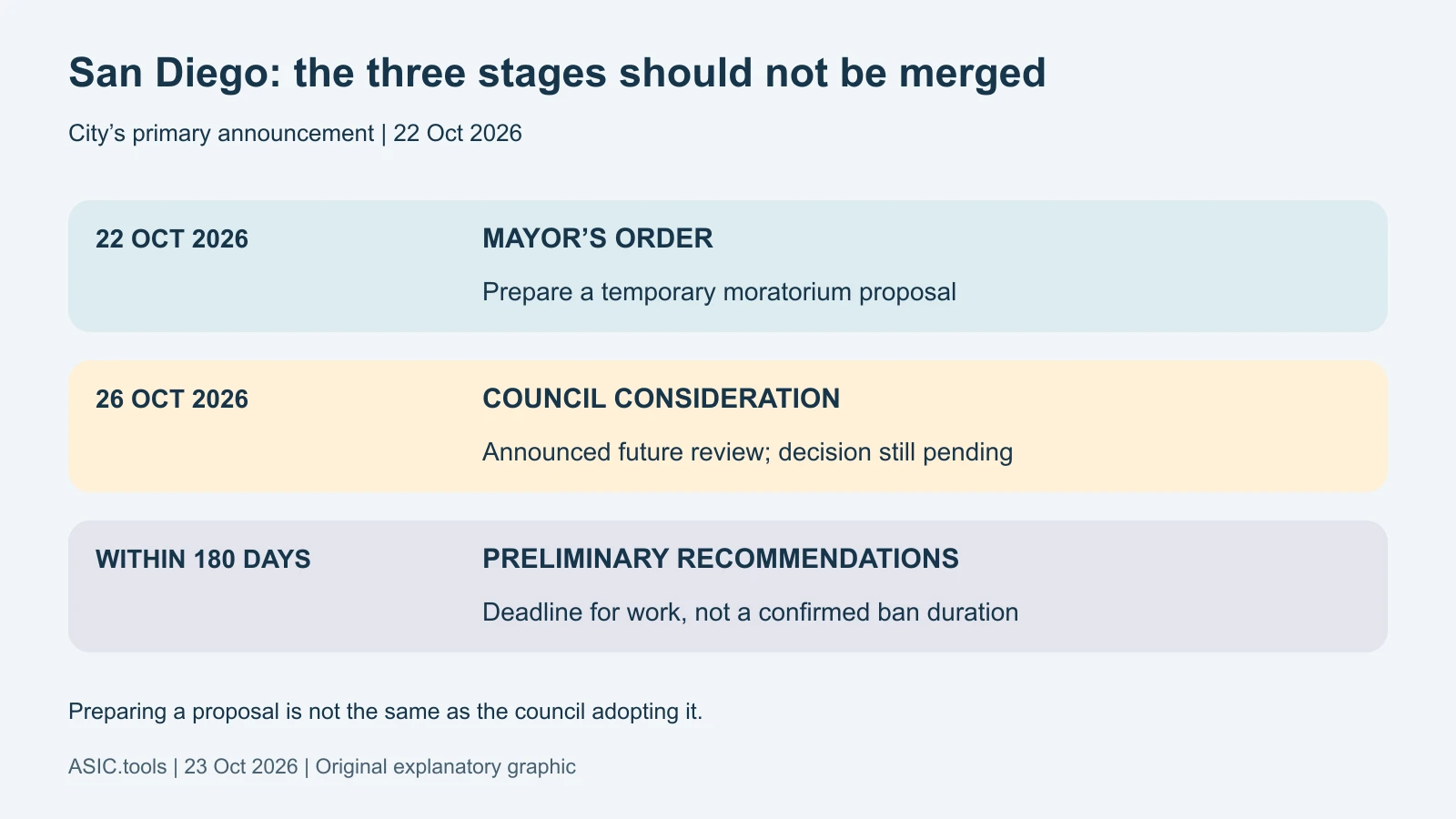
San Diego mayor Todd Gloria signed an executive order on October 22 directing city staff to bring forward a temporary moratorium on new data-centre development. The city says the proposal is due before the City Council on Monday, October 26. As of this report, that council decision is still ahead.
A moratorium is a temporary stop while rules or other questions are reviewed. Here, the mayor has launched the work and requested a proposal. Writing that San Diego has already passed the proposed development ban would skip the council’s remaining role and turn a future decision into a completed event.
Why residents’ water and electricity bills are part of it
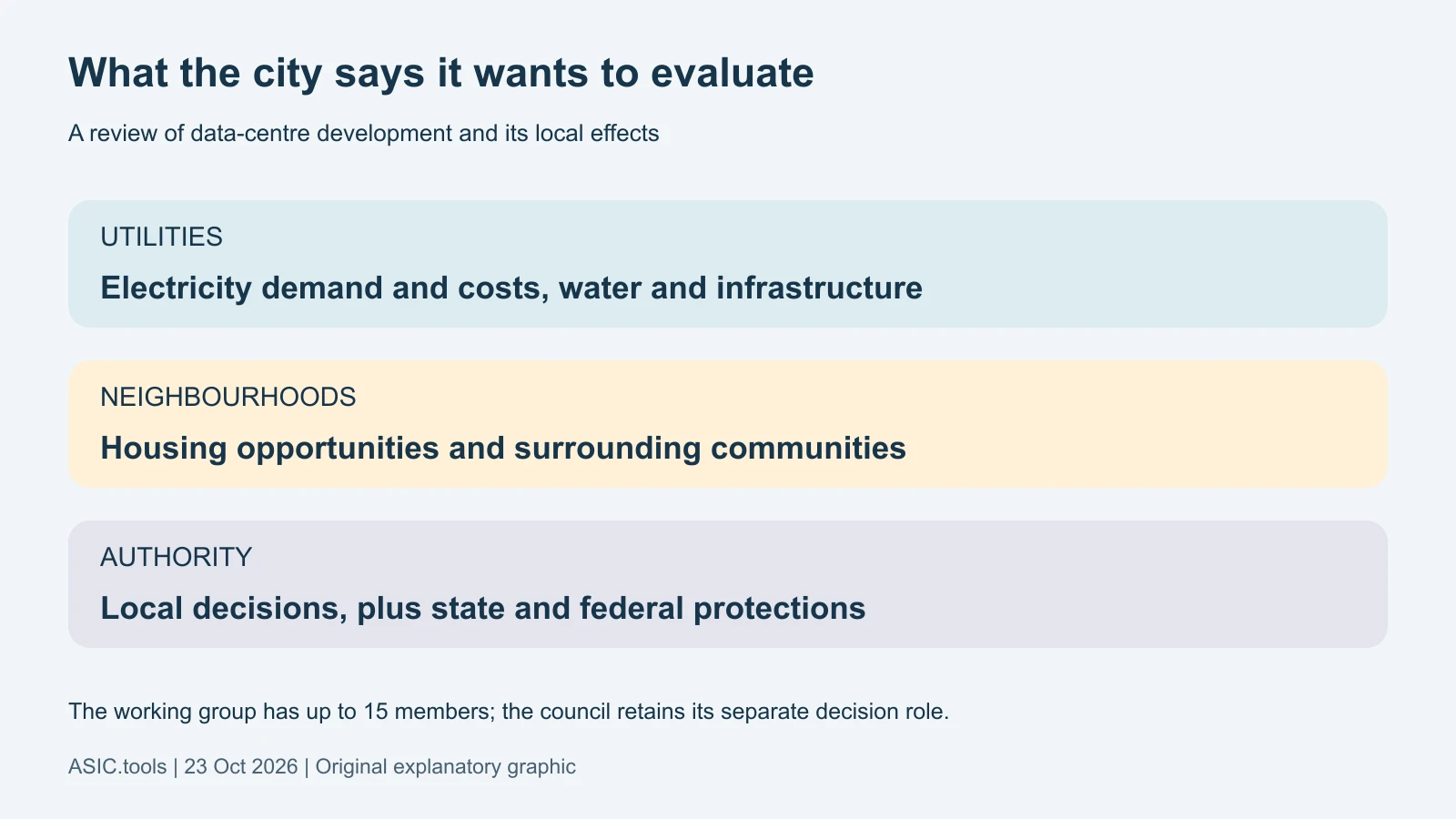
The city says it wants to assess water supplies, electricity demand and costs, infrastructure, housing opportunities and effects on nearby neighbourhoods. A data centre is a building full of computing and support equipment. Its size and cooling design can make a substantial difference to local power and water requirements.
For a household, the useful questions are concrete: what extra network works are needed, who pays for them and what land use is being displaced? The announcement identifies those concerns for review. It does not calculate a promised bill reduction or establish that every possible facility would use the same amount of water.
The review offers a practical set of questions for residents: what demand the proposed design adds, which systems would supply it and how the developer would account for those costs. Asking for those linked details is more informative than assuming every computing building has the same effect simply because it is called a data centre.

The city is asking for rules, not just one yes-or-no answer
The order directs planning and development departments to prepare recommendations for location, development, construction, operation and expansion of data centres. That wider list is important: the work is about how facilities fit into the city, not only whether a company can submit a new building proposal.
A temporary stakeholder group of up to 15 mayor-appointed members will contribute. The city describes expertise from technology, utility and water services, housing, land use and community advocacy. These are participants in the review process, not fifteen additional council votes or a substitute for the council’s own decisions.
Community input and technical analysis play different roles. Residents can describe local concerns, while utility, water and planning information helps evaluate how a design would work. A working group brings these perspectives into the process; the announcement does not say its seats are already filled or that a final set of rules has been agreed.
The 180 days refer to recommendations
The order calls for preliminary recommendations within 180 days of taking effect. That deadline describes the requested work product. It should not be reported as the confirmed duration of a moratorium that the council has not yet approved.
The October 26 consideration date, the 180-day recommendations deadline and any eventual rules are separate stages. Each answers a different question: when the council considers the proposal, when staff should report and what requirements might ultimately apply. Keeping the stages separate helps readers follow what changed on October 22 and what is still pending.
City boundaries do not answer every authority question
The announcement also directs the mayor’s government-affairs team to develop or support state and federal protections, including for facilities on state or federal property outside the city’s local land-use authority. That is an acknowledgement that different public bodies can control different decisions.
It is not evidence that the city can stop every project on every parcel within the geographic area. Nor does the press release resolve the status of a particular proposed site. Anyone comparing projects should first identify the relevant authority and the actual decision, rather than assuming a citywide headline settles all land and permitting questions.
The connection to mining and everyday electricity use
The debate belongs to the same infrastructure problem that affects large mining sites: adding intensive computing demand raises questions about grid capacity, costs and the surrounding community. An AI data centre is not automatically a Bitcoin mine, and this announcement should not be presented as a blanket prohibition on home mining.
The next concrete event to watch is the council’s announced October 26 consideration. Until then, the confirmed change is the mayor’s direction to prepare a temporary pause and a broader set of safeguards. For residents, the useful outcome of the review will be clear responsibilities for power, water and land use, rather than a promise of instant savings that the city has not quantified.
To follow the next stage, look for the council agenda, the proposal actually presented and the decision subsequently recorded. A meeting being announced does not establish its outcome. The useful change to report later will be the terms adopted or rejected, and how they differ from the preparation request made on October 22.
Source: City of San Diego ↗
Mining calculator ↗