Proxima switches mining to BLAKE2b with its November 10 upgrade
Source report: 2026-11-10 · Editorial analysis published: 2026-11-11
Upgrade 6 changes the calculation behind PROX mining. Suprnova reports the new GPU job format and requires ProxiChorizo 2.0.0 on its pool.
The calculation behind PROX mining changed
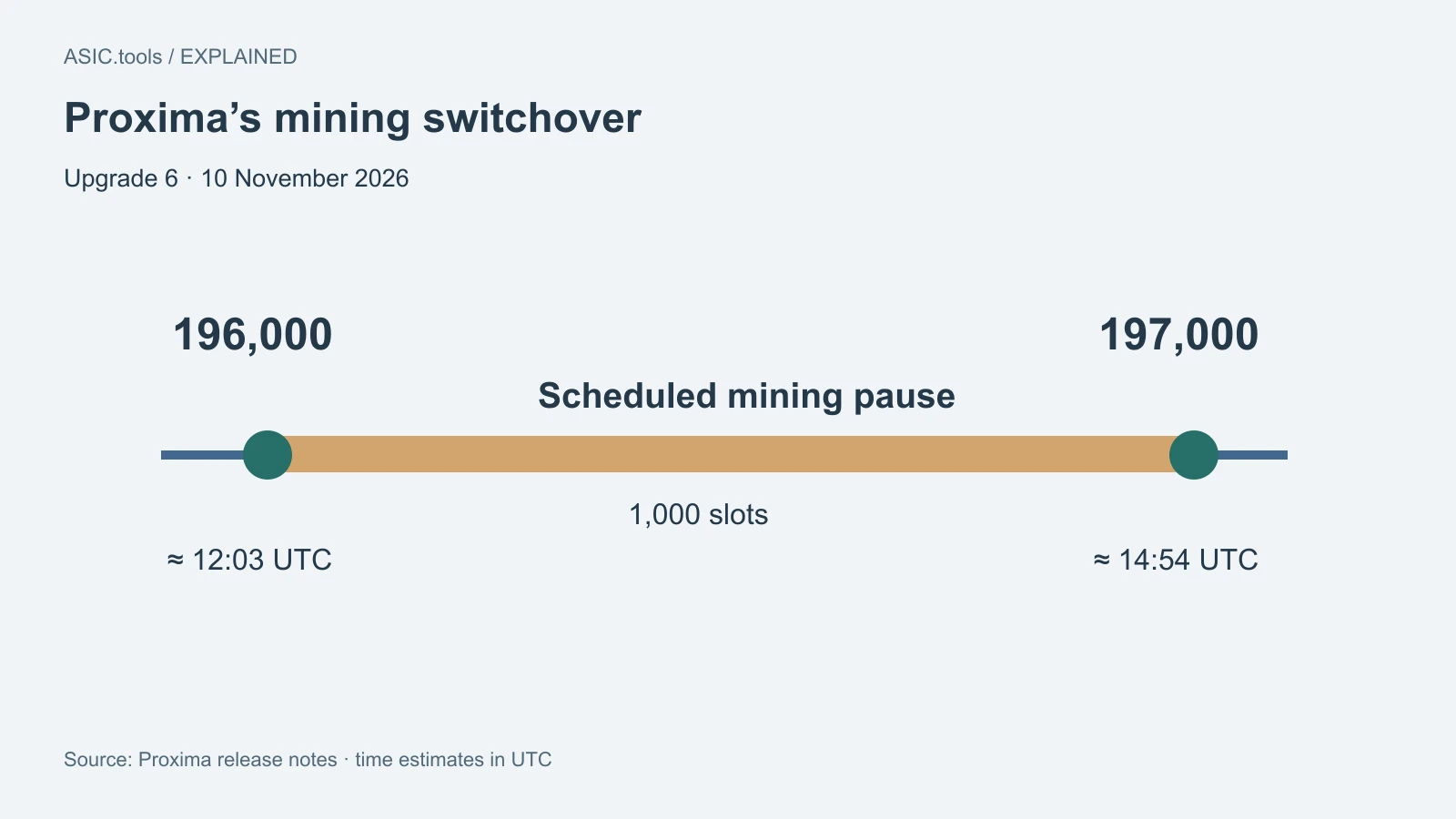
Proxima’s November 10 network upgrade switched mining to a BLAKE2b hash of the mining transaction. The project’s release notes put activation at slot 196,000, around 12:03 UTC, and the end of the scheduled 1,000-slot mining pause at slot 197,000, around 14:54 UTC. A slot is a numbered time interval in this network. Suprnova’s PROX pool subsequently described the new job format in use on its service.
Proof of work is the calculation miners repeat to look for a result that meets a network target. Proxima’s new rules use the mining transaction’s own identifier, calculated with BLAKE2b, in place of a result from a verifiable random function, or VRF. A miner varies a trial value called a nonce and looks for a qualifying hash. The project expects graphics cards to be the main hardware for this work.
What the new work looks like at a pool
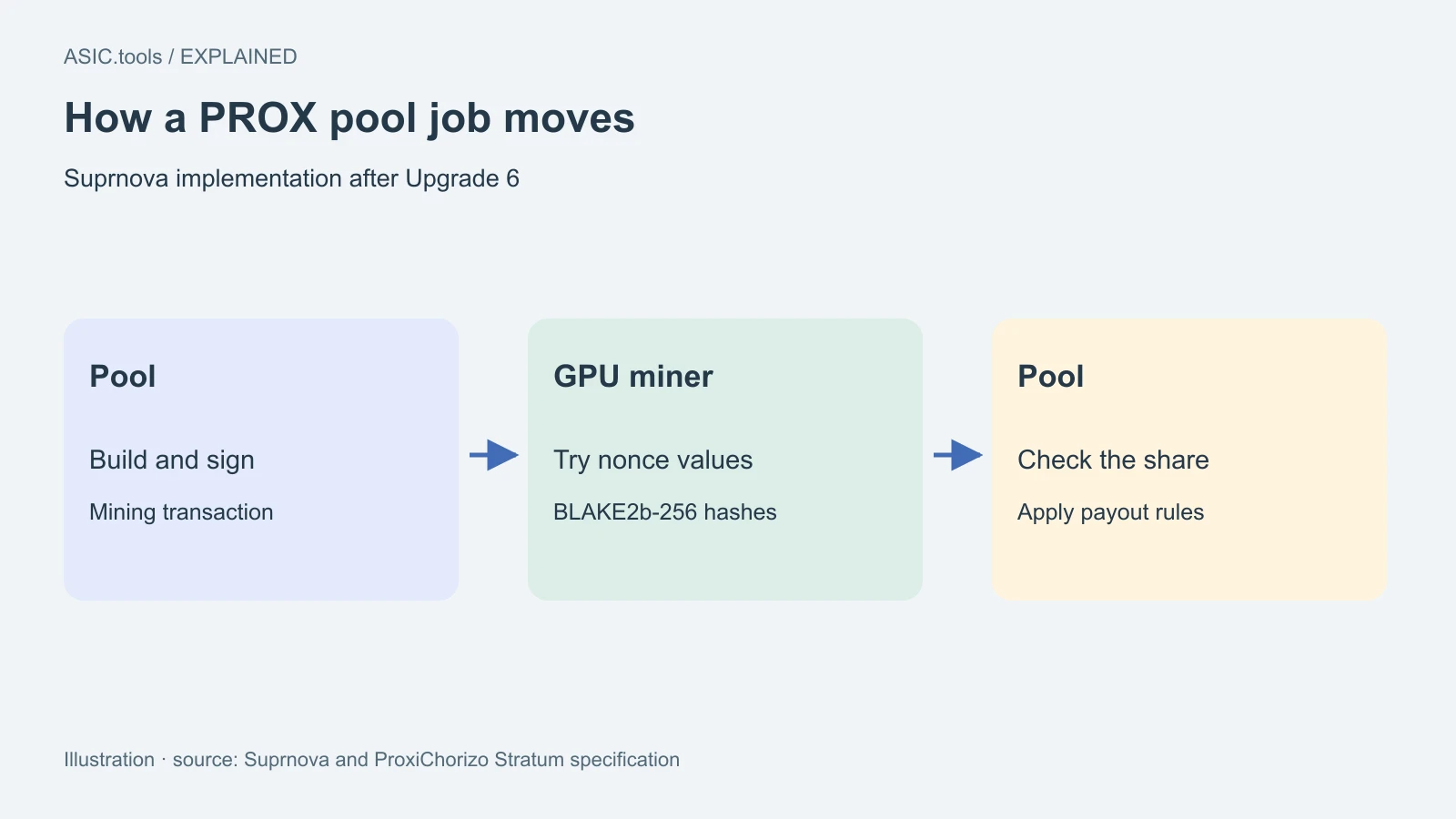
Under Suprnova’s new setup, the pool builds and signs the mining transaction. Connected miners receive work and search for nonce values on their graphics cards. The pool uses Stratum, a protocol that carries jobs to the miner and shares back to the pool. Its published specification names the 256-bit form of BLAKE2b for this job. A share is a result that meets the pool’s target and helps it measure contributed work.
Suprnova says this setup uses a pool token on the miner side. The pool’s software signs the transaction, so a wallet signing key is unnecessary for that connection. The token is a pool credential and should stay private. The operator says rewards are distributed using PPLNS, a scheme that looks at a window of recent shares when it distributes a reward. A stream of accepted shares shows work reaching the pool. The rewards depend on the pool’s results and its payment rules.
Check the software for your role
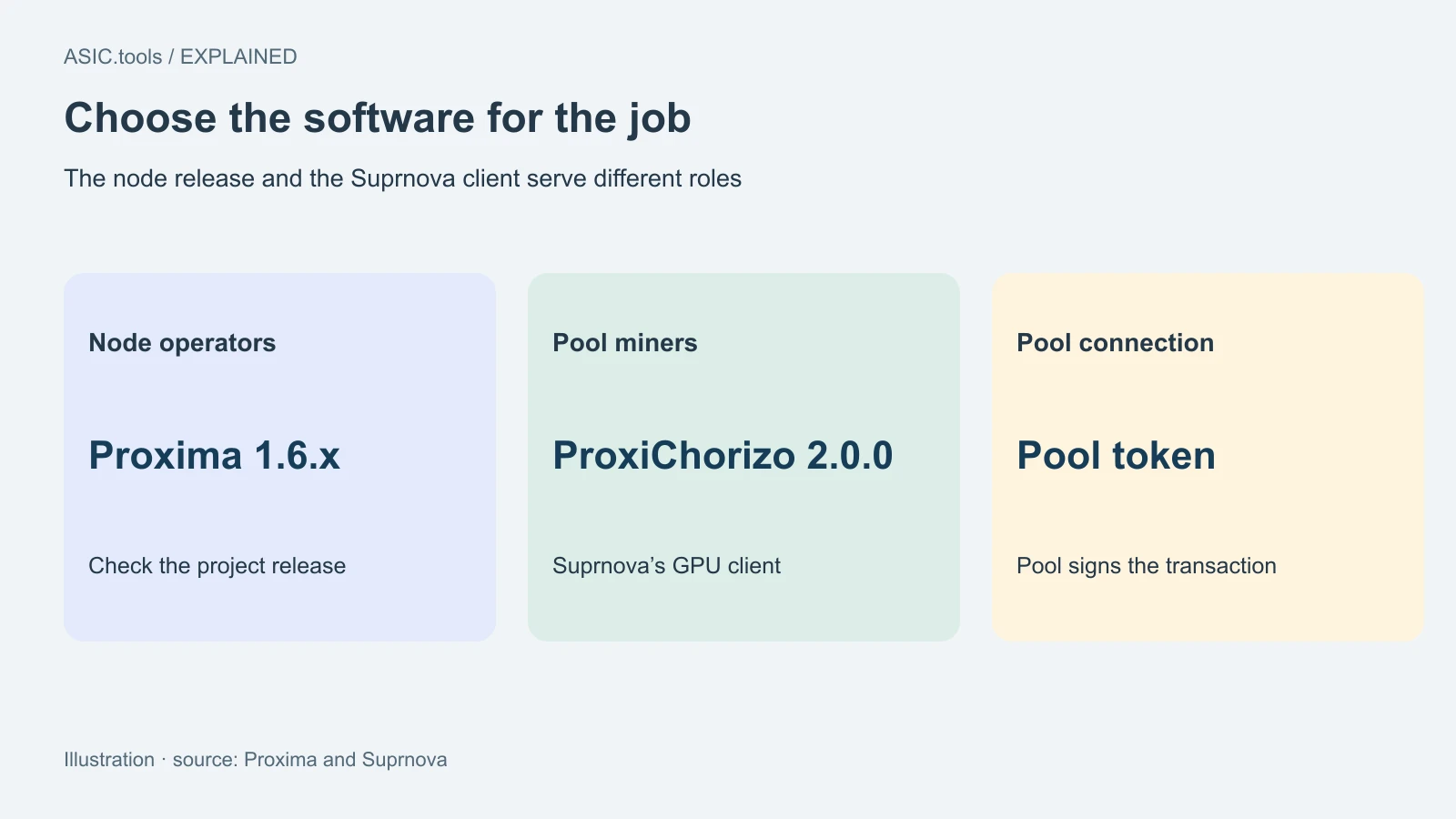
Suprnova requires ProxiChorizo 2.0.0 for this pool’s new jobs and says the 1.x branch stops working with the change. The operator lists both NVIDIA and AMD graphics cards. The version number belongs to the pool miner, while the project’s own 1.6 series covers node, wallet and mining tools. An operator changing software can verify the release name and the source used for that particular role.
The project’s v1.6.1 amendment required node operators to update before slot 196,000. It kept the mining schedule and allowed the v1.6.0 project wallet and miner tools to continue. A further node patch, v1.6.3, arrived on November 10 at 12:48 UTC. It helps nodes remember rejected branches so they do less repeated validation. The release lists no new wallet or miner requirement for that patch.
Read the new hashrate in its own units
Suprnova reports the new work in GH/s, or billions of hashes per second. The figure counts BLAKE2b trials on this transaction format. The older work measured a different computation. Even if both dashboards use a rate per second, moving a number across the upgrade gives no clean before-and-after measure of what the same computer can earn.
The name of a hash function is only one part of hardware compatibility. The miner must construct the work expected by the pool, search the right part of the transaction and send back a share in the format the pool accepts. The documented pool route uses GPU software. A Bitcoin SHA-256 ASIC performs a different computation. Similar-looking hashrate figures across coins do not make them interchangeable.
The reference miner and the pool client
The project’s own release also describes a reference nonce search tool for NVIDIA cards and a Rust tool that no longer needs the wallet key. These are project tools. Suprnova’s requirements come from its separate pool implementation. The route chosen determines who builds and signs the mining transaction.
For operators running the project’s reference miner, the project asks them to run its wallet consolidator. That tool combines small outputs that would otherwise sit idle. On the Suprnova route, the pool’s payout policy determines when earnings appear in a wallet. These are different points to check after the switch.
Follow the scheduled switch on the dashboard
The activation and restart times are the project’s approximate UTC schedule. The slots are the network thresholds. For someone who left a rig connected through the pause, the practical checks are the pool’s current job type, the miner’s version and whether fresh shares are accepted after work resumes. A local display showing the GPU at work cannot by itself tell whether the pool accepts that work.
The reported change applies to Proxima, whose coin is PROX. The upgrade documents and the pool’s own implementation describe where the older setup needs changing. They offer no single estimate of daily earnings. Measuring the power at the wall and comparing actual accepted shares and eventual pool credits gives an operator evidence about their particular rig.
Source: Proxima / November 10 network update ↗ · Proxima v1.6.0 original upgrade schedule and mining rules ↗ · Proxima v1.6.1 amendment ↗ · Suprnova PROX pool ↗ · ProxiChorizo Stratum specification ↗
Mining calculator ↗