LuxxPool reports 520 workers and 2.1 TH/s from outside miners
Source report: 2026-11-12 · Editorial analysis published: 2026-11-14
The Scrypt pool reported about 7.7 TH/s across regular and solo modes on November 11. How to read the figures and compare payouts on a home miner.
What the November snapshot measures
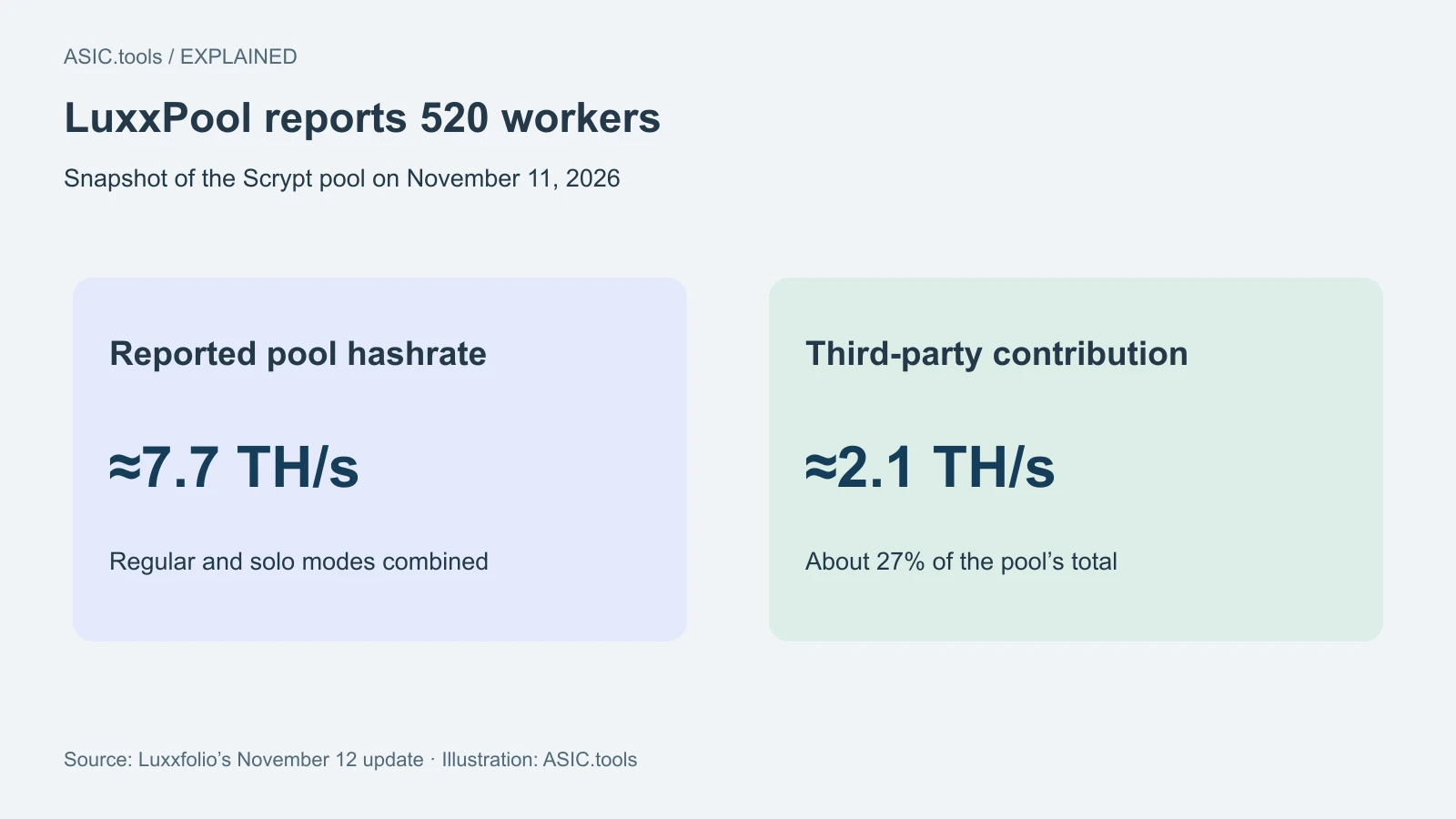
Luxxfolio said on November 12 that its pool for the Scrypt mining algorithm had reached about 7.7 terahashes per second across 520 workers on November 11, including about 2.1 TH/s supplied by miners outside the company. The figure covers its regular and solo modes. A worker is an identity used to track submitted mining work. The company did not say that these were 520 distinct people or that every connection was a separate physical machine.
The pool opened its public beta on October 20. This update gives a clearer picture of the contributions beyond the company’s fleet: the outside figure is roughly 27% of reported pool hashrate at that point. It is a share of the pool’s computing work, not a share of all Litecoin mining. Both numbers were rounded by the operator, and the mix can change as devices connect and disconnect.
The worker count and the outside hashrate answer different questions. A small miner can add one worker identity with little effect on the total; a large operator can contribute considerable work under a small number of names. The announcement lists both so readers can see the size of the beta without treating worker count as the same thing as computing power.
Treat the November 11 values as a dated snapshot. A miner choosing where to connect should check the service’s latest rules and readings separately. The release lets readers compare future reports against this baseline without assuming that the same capacity is available at every moment.
Operating miners and pool readings
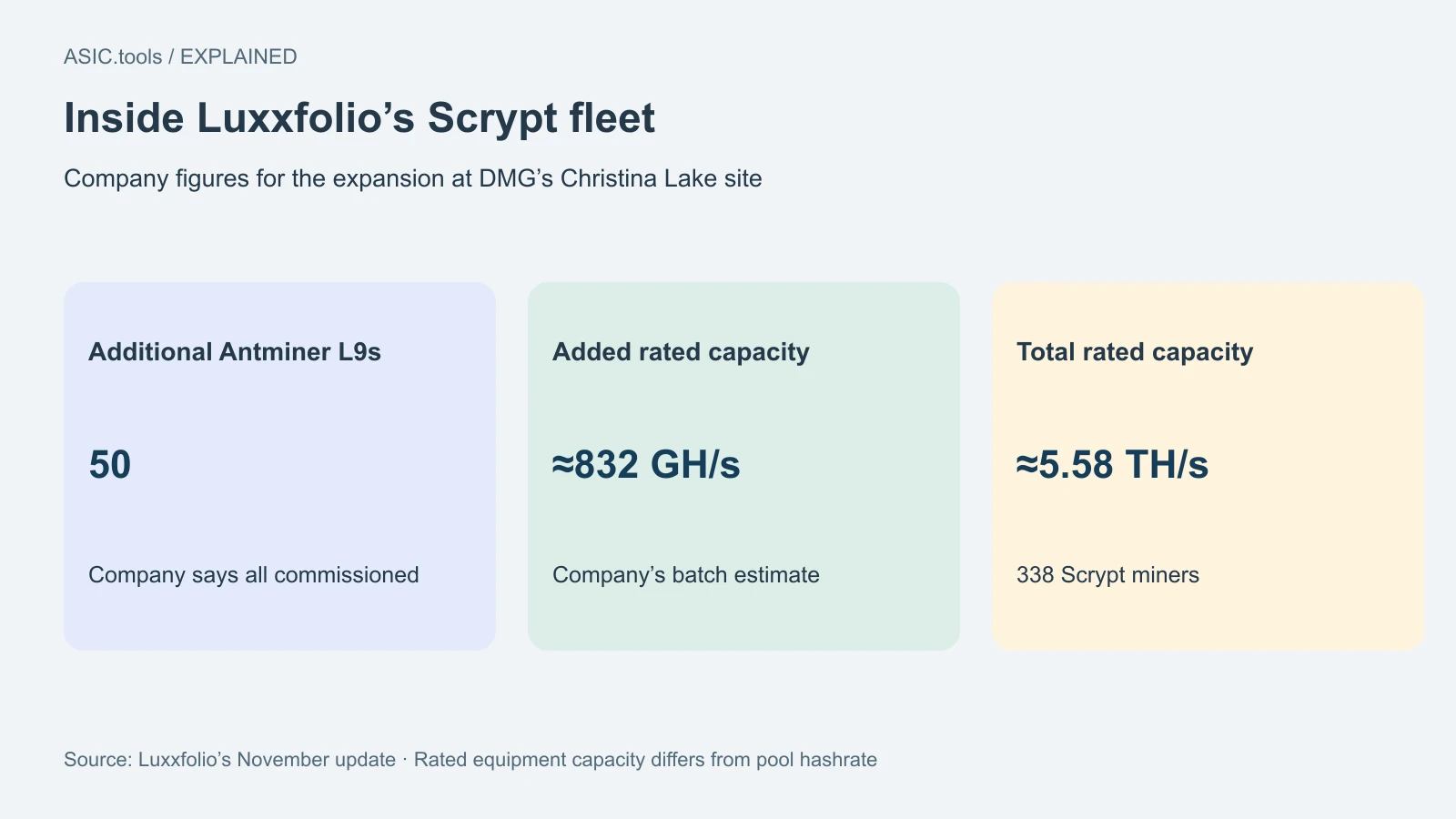
Luxxfolio also said all 50 additional Bitmain Antminer L9 units were commissioned at DMG’s Christina Lake facility in British Columbia. It gives about 832 GH/s of added rated capacity, taking the company fleet to 338 Scrypt miners and about 5.58 TH/s on paper. One terahash per second is 1,000 gigahashes per second. The sum of machine ratings measures something different from a pool statistic based on work reaching the service.
If your own miner contributes less than the box advertises, check the time window and accepted work before assuming a fault. A machine that turns off at expensive hours or during maintenance cannot contribute its rated speed all day. Short readings also fluctuate. Compare a longer period with actual uptime and the device log. This puts a fleet specification and a pool reading on terms you can use.
The company reports commissioned machines at Christina Lake, not a new Antminer model. The 832 GH/s was the rated addition it reported for the batch, not a number to derive by multiplying a reseller’s sample specification. Keep that fleet figure distinct from any hourly reading on the pool.
The fleet and pool figures are close to each other after adding the external reading, but all were reported approximately. Do not use that near match to infer how many of the company’s machines were online. If your own result matters, measure it from the worker records for the hours you actually ran.
One connection, several payout rules
The company says its pool supports merged mining across 11 Scrypt networks, including Litecoin, Dogecoin and Soqucoin. Merged mining lets compatible chains accept proofs tied to the same work. A supported auxiliary coin therefore does not need its own extra miner. The coins still have separate wallets and may follow different confirmation or payment schedules. Check the balances and payout details for each network you plan to use.
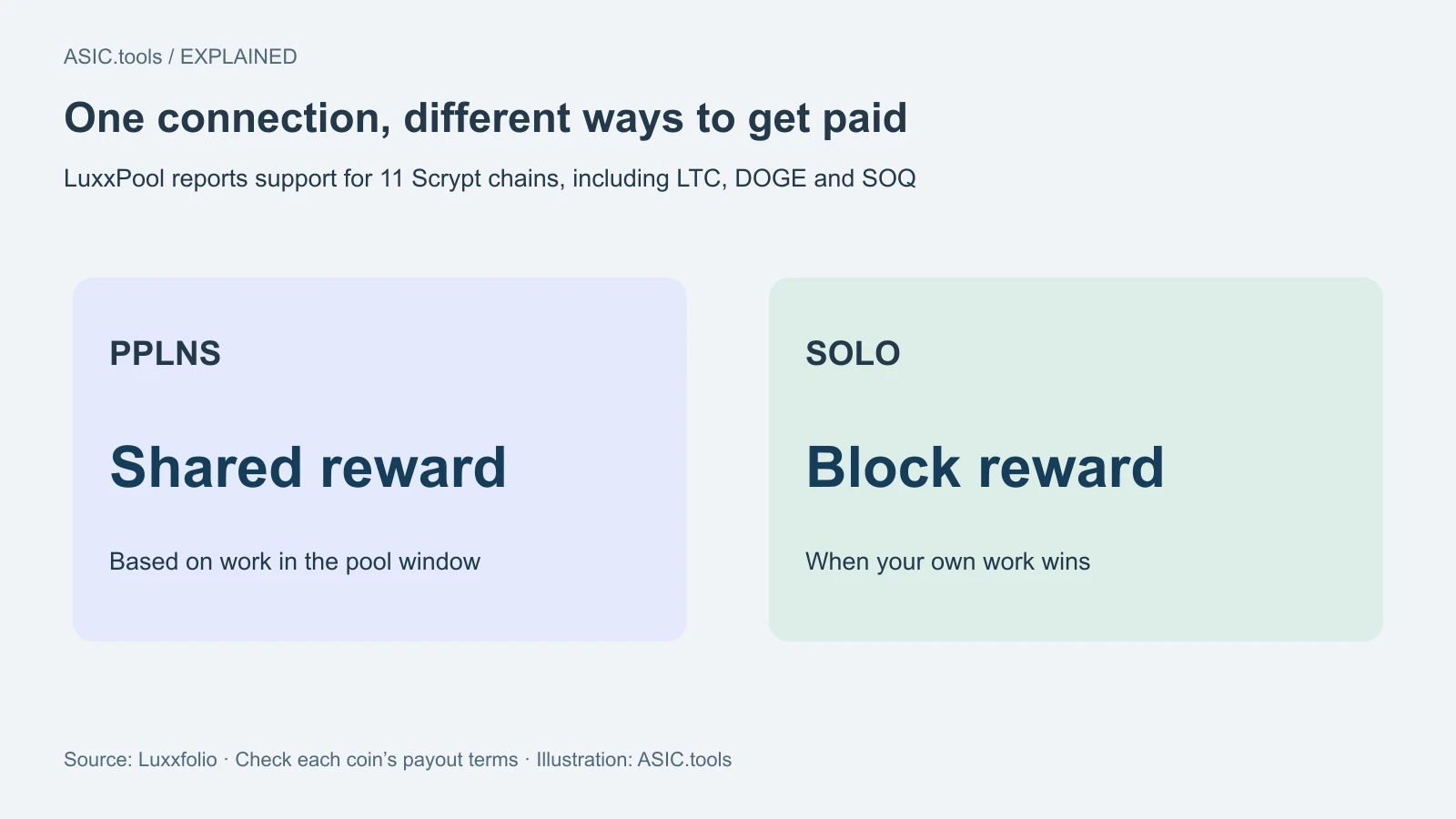
Luxxfolio lists a 0.75% standard pool fee and says it covers payout network fees. It offers PPLNS and SOLO. PPLNS shares rewards in proportion to qualifying work within a pool window; SOLO pays a block reward when your work wins under the pool’s rules. Compare the mode as well as the fee. A lower percentage tells you little if the payout threshold or the time between payments is a poor fit.
For a coin that you intend to collect, also check that the receiving wallet supports its own network. An address that works for Litecoin is not evidence that the same destination can receive Dogecoin. Record the balance for each coin and the transaction that paid it. That makes it possible to tell a pending credit from a payment you can verify.
A useful home test
Test with one miner and note its running hours, accepted shares and credits for the coins you can actually receive. Compare the same machine over a similar period before changing the whole farm. If a small balance has not reached a payout threshold, keep it separate from amounts that appeared in your wallet. The reported 520 workers show how the beta had grown by November 11; your own payout history shows how the service fits your setup.
When comparing two pools, choose the same operating mode and time window. Network difficulty and block luck can shift during the test. A solo result that includes one lucky block is not a useful straight comparison with an ordinary payout window. Use both the accepted work and the rules for earning and receiving each coin.
One more detail matters for a small miner: whether enough value accumulates in the currencies you can actually use. Review where the coins are sent and how often the balances clear. Reporting eleven supported networks shows the menu; it does not promise equal earnings or identical payout schedules for all eleven.
Source: Luxxfolio ↗ · Luxxfolio — November fleet presentation ↗ · LuxxPool — pool service ↗
Mining calculator ↗