Who controls your mined Bitcoin? Lopp calls for a rethink of wallet protection
Source report: 2026-10-22 · Editorial analysis published: 2026-10-23
In an October 22 letter, Casa’s security chief argues that moving coins to a custodian shifts risk. We explain multisig, separated keys and planning for lost access in plain language.

A fresh letter asks a familiar question
Jameson Lopp, Casa’s chief security officer, published an open letter to Bitcoin users on October 22. His argument is that recent wallet-security scares should lead people to improve how they hold their keys, rather than assume another custodian makes every risk disappear. For someone receiving mining payouts, the immediate question is who can actually authorize spending those coins.
The three-page letter discusses compromised devices and supply chains, increasingly convincing scams and the fear of managing keys personally. These are the author’s reasons for the appeal, not a new forensic report proving a particular brand-wide breach. Casa also sells services around self-custody, so the letter comes from a participant in that business, not a neutral product comparison.
A receiving address is not the key to spending
Self-custody means retaining the private keys used to authorize spending Bitcoin. A receiving address tells a miner or pool where to send a payment; it is not the secret that allows someone to spend the payment afterward. That distinction lets you separate mining setup from control of the rewards already received.
Lopp argues that handing keys to another institution shifts the point of trust. An exchange balance or an investment fund holding Bitcoin is a different relationship from directly controlling on-chain coins. His preference is self-custody; the practical lesson is to understand which party can sign, what happens if it becomes unavailable and what evidence of access you actually have.
A hardware wallet is a signing device, while the key is what gives spending authority. Replacing a broken device and losing the key material are therefore different problems. The useful question for a recovery plan is whether the same wallet can be restored, not merely whether another piece of hardware can be purchased.
What several signatures change
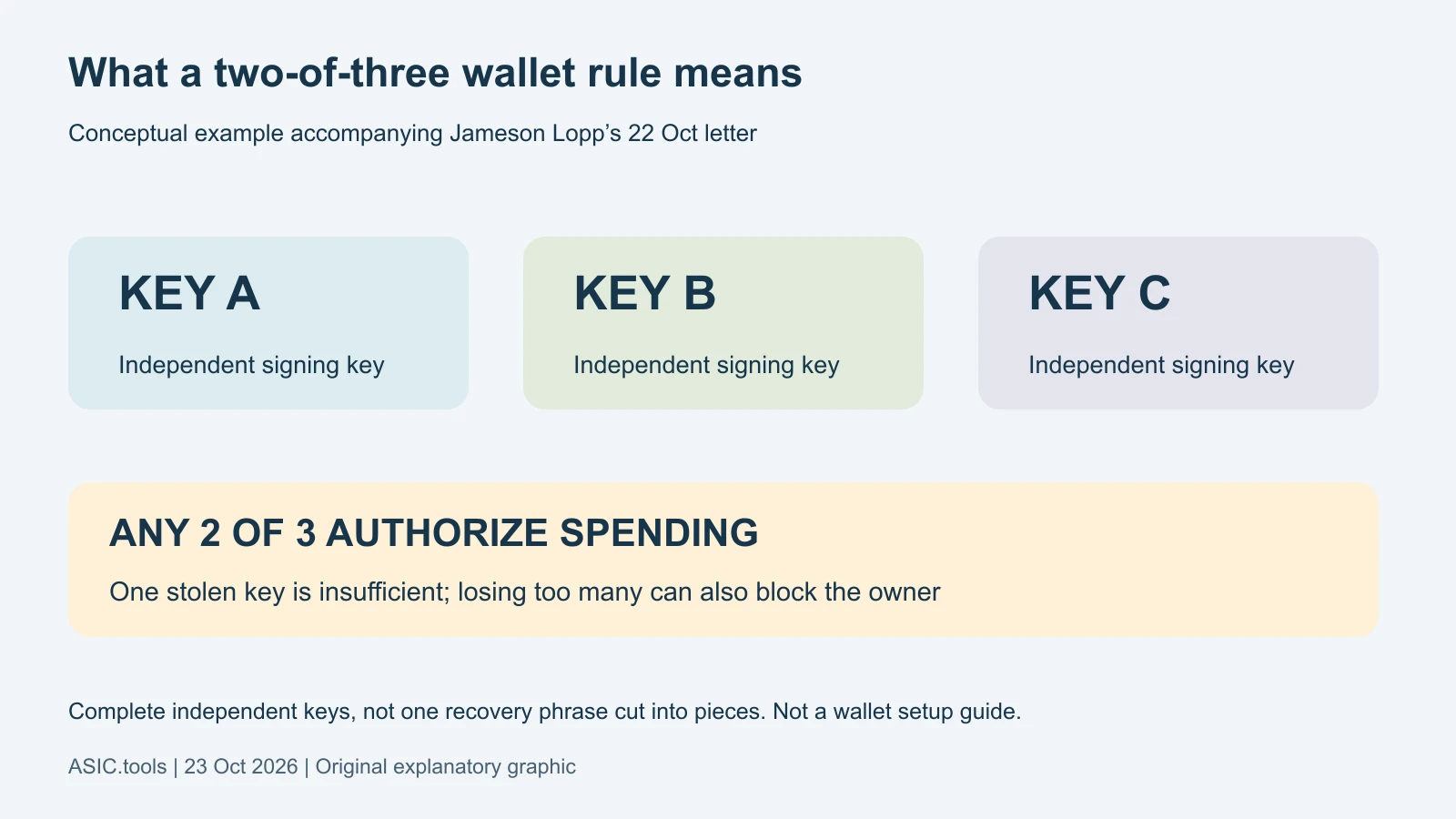
Multisig is a wallet arrangement requiring a chosen number of independent key signatures. In a simple two-of-three example, any two of three authorized keys can approve a transaction. One stolen key alone is insufficient, and losing one key can still leave the required two. This is an explanation of the rule, not a recommendation that every reader immediately rebuild a wallet.
Lopp stresses that multisig is not a cure for every problem. If an attacker gets enough keys, the threshold no longer protects the coins. If the owner loses enough keys or cannot reconstruct the setup, the same threshold can block legitimate access. More devices without a clear recovery process can create more confusion rather than more usable security.
The two-of-three example refers to complete independent signing keys. It is not an instruction to cut one recovery phrase into three pieces. These are different designs with different recovery requirements; a reader should understand the actual wallet policy before treating a label such as multisig as a complete backup plan.
Separate failure points, not just objects
The letter asks readers to spread keys across geographical locations and supply chains. The idea is to avoid one fire, theft, compromised supplier or other common failure taking every required signing method at once. Several devices in the same drawer do not provide the same independence as the number of boxes might suggest.
Separating locations also creates a practical task: the owner must know how to reach the required signing tools when a legitimate payment is needed. Backups, the wallet’s configuration information and clear records of the signing rule belong in the recovery plan. Knowing where a device sits is not enough if nobody can restore the wallet it was intended to protect.
Plan for being unable to operate the wallet
Lopp also raises inheritance and what happens if the owner can no longer manage the Bitcoin. This is not only a theft problem. A family can lose access because instructions are missing, necessary material cannot be found or nobody knows which combination of keys is required.
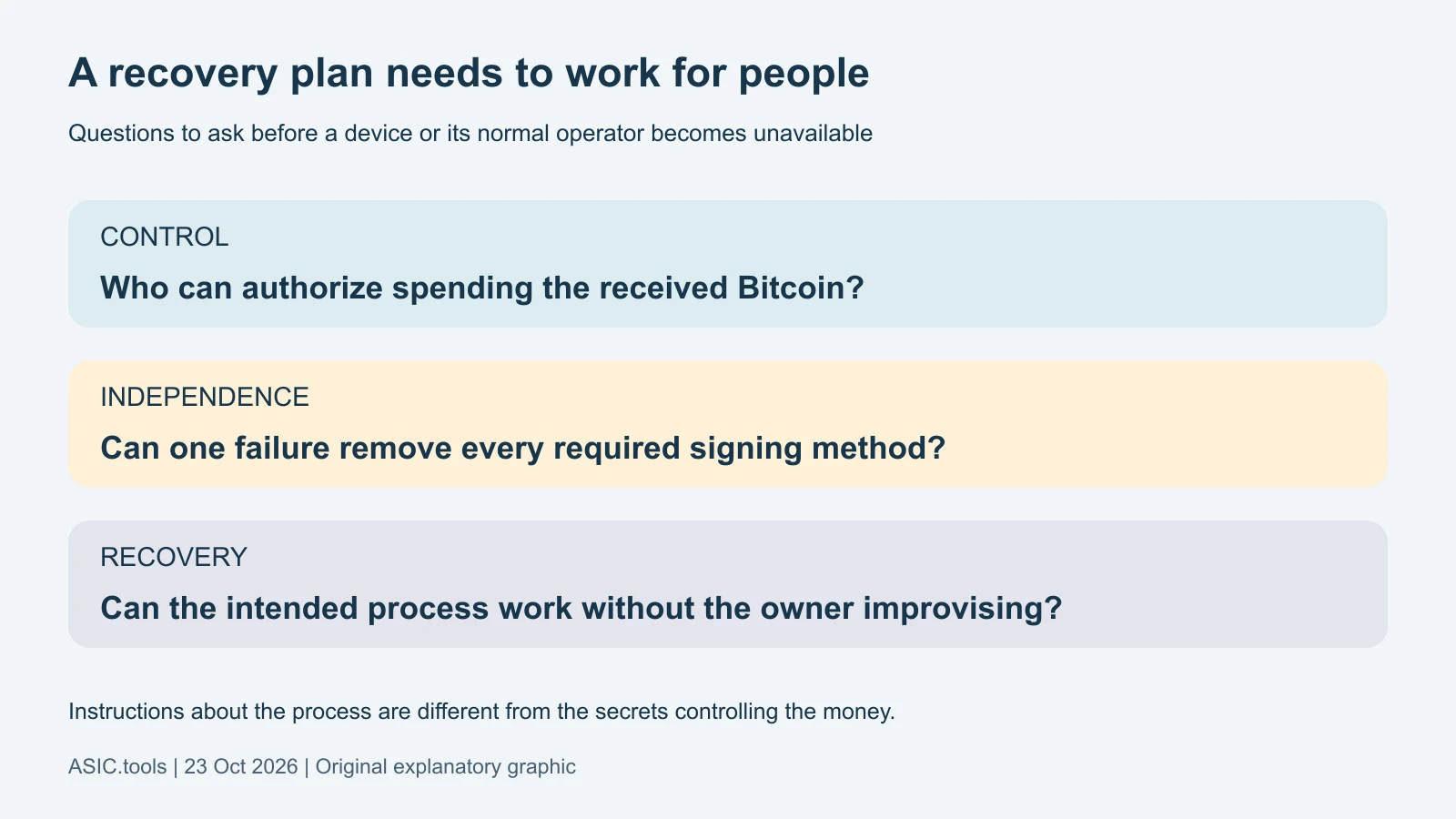
A useful review asks whether a trusted recovery process can work without the owner improvising every step. That does not mean posting recovery phrases or private keys in a shared message. It means distinguishing instructions about the process from the secrets that control the money, and making sure any assisted arrangement has a clearly understood role.
One practical thought experiment is a broken everyday signing device. Another is the normal operator becoming unavailable. The first checks the backup path; the second checks whether the process can be understood by the intended successor. They test different parts of the plan without requiring anyone to publish secrets or move a real mining balance merely to prove a point.
What a home miner can take from the appeal
Check the destination used for payouts, whether you control the resulting coins and whether the chosen wallet’s recovery process is understood. A pool’s unpaid balance and a payment already received by a wallet are different stages. Strong storage after payment also does not repair an incorrect payout destination.
The letter is a call to review an arrangement, not evidence that every hardware wallet is broken or that any paid service guarantees safety. A sensible outcome is being able to explain who can spend the coins, which failures the arrangement tolerates and how access can be recovered. Those questions remain useful whether mining rewards arrive often or only occasionally.
Source: Jameson Lopp / Casa ↗ · Bitcoin wallet functions and signing ↗ · Bitcoin two-of-three multisignature example ↗
Mining calculator ↗