Kraken drops Monero spending questions, but withdrawal limits still matter
Source report: 2026-10-24 · Editorial analysis published: 2026-10-25
Arjun Sethi says Kraken withdrew intrusive questions sent to XMR buyers. Its support page still lists rolling 30-day Monero limits, while availability depends on the customer’s region.
A reversal over questions about withdrawn coins
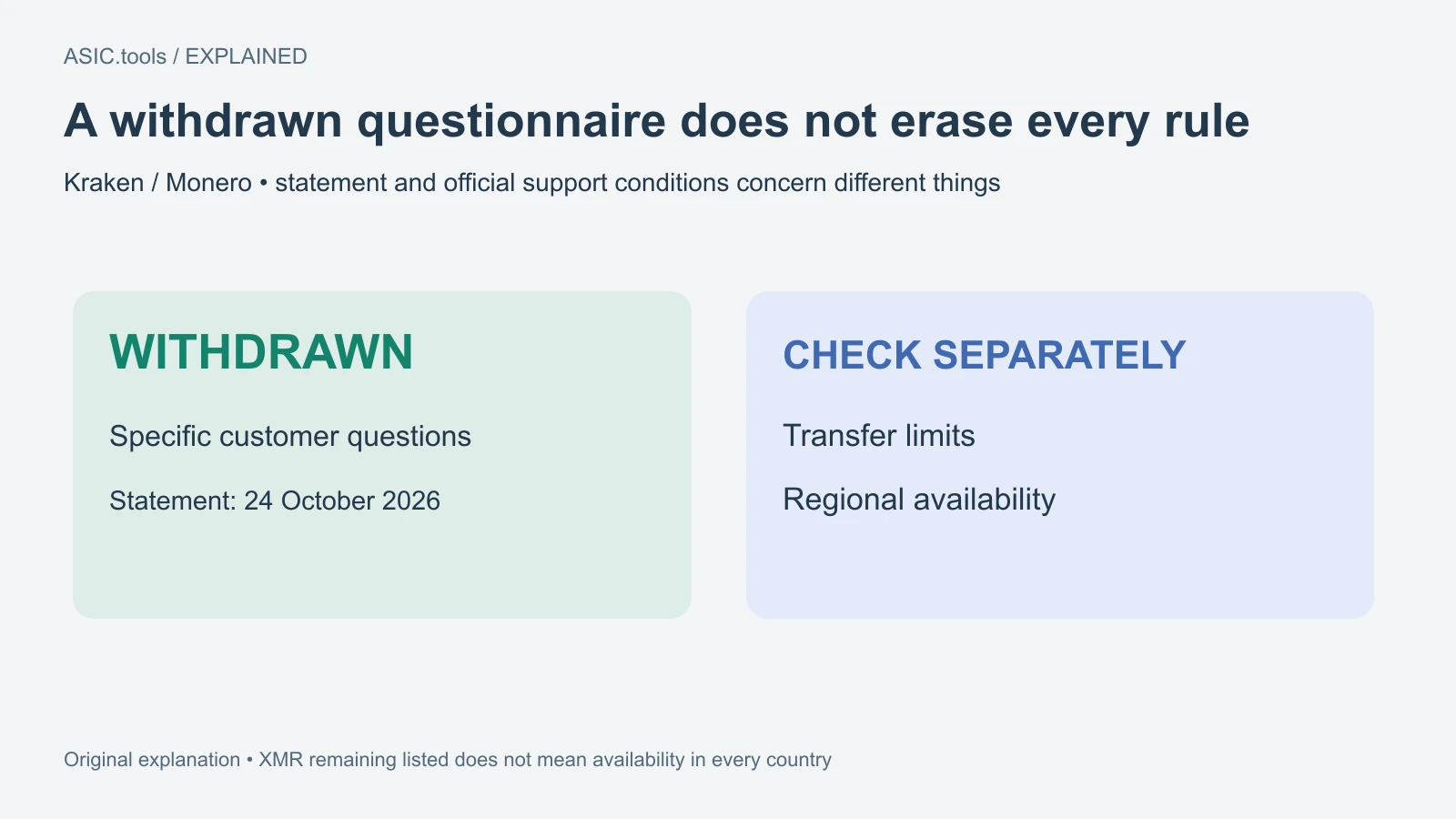
Kraken co-CEO Arjun Sethi said in an October 24 post that emails sent to some Monero buyers were a mistake. Customers who bought XMR with their own money and withdrew it had been asked about their employer, source of funds and plans for the coins. Sethi said those requests were withdrawn and affected clients had been told nothing was required of them.
He also said XMR would remain listed. For people who mine or receive Monero, that addresses an immediate worry about how one exchange handles the coin. It does not mean every account can use Monero in every country, or that existing transfer limits have disappeared.
The useful distinction is between a withdrawn questionnaire and the other rules of an exchange account. Kraken’s public support pages still describe Monero-specific funding limits and regional restrictions. Those pages need to be read alongside the statement, rather than replaced by a short social-media headline.
What was withdrawn, and what was not
Sethi drew a line between asking where funds came from and asking what a customer would do with coins after withdrawal. He described the intended-use question as unacceptable and said no rule required the particular requests. That is the company leader’s account of this episode, not a general legal opinion covering every information request.
Source-of-funds checks remain a separate matter. In ordinary language, they ask for evidence of how money or coins were obtained. A miner might need records that explain a payout, but the acceptable documents and actual requirement depend on the exchange’s request and the account.
The announcement does not say that every compliance email can now be ignored. If an account receives a question, check it inside the official service and establish whether it is the withdrawn request or another review. An unsolicited direct message is not proof that the sender represents Kraken.
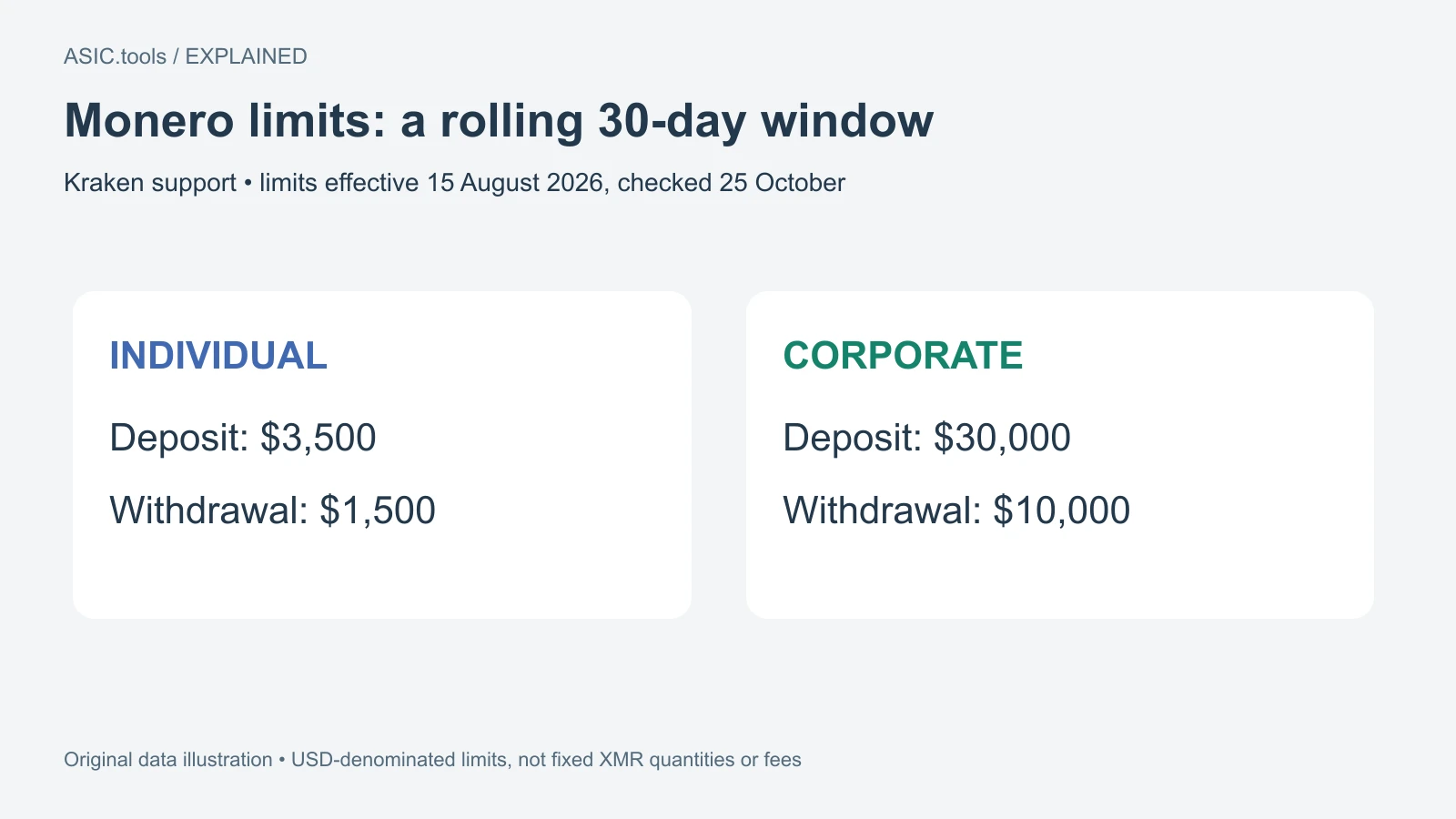
Monero still has its own transfer limits
Kraken’s support page says XMR limits took effect on August 15, 2026. On a rolling 30-day basis, an individual account has a $3,500 deposit limit and a $1,500 withdrawal limit. Corporate figures are $30,000 for deposits and $10,000 for withdrawals.
Rolling means the window moves with time instead of starting again on the first day of a calendar month. A user who has used part of a limit needs to consult the remaining allowance in the account. Waiting for a new month on the wall calendar does not automatically clear every earlier transaction from that window.
These are dollar-denominated limits on Monero transfers, not a fixed number of XMR, a mining fee or a promise of an exchange rate. An individual’s actual available allowance should be checked before moving funds. The support page does not announce that Sethi’s questionnaire reversal raises these limits.
Listed does not mean available everywhere
Kraken’s regional support page lists XMR among assets clients in the European Economic Area and the United Kingdom cannot deposit or trade. Canada has a restriction on depositing, holding or trading XMR. The general statement that the asset stays listed does not remove those country-specific conditions.
This is why two users can read the same headline and see different options in their accounts. Verified residence, account eligibility and the asset all affect what the exchange offers. A feature visible to someone in another country is not confirmation that it is enabled for you.
For a miner planning a pool payout, confirm that the destination account actually accepts the coin and that there is room under its applicable limit. A valid Monero address on its own does not establish that a particular exchange account is eligible to credit every incoming transfer.
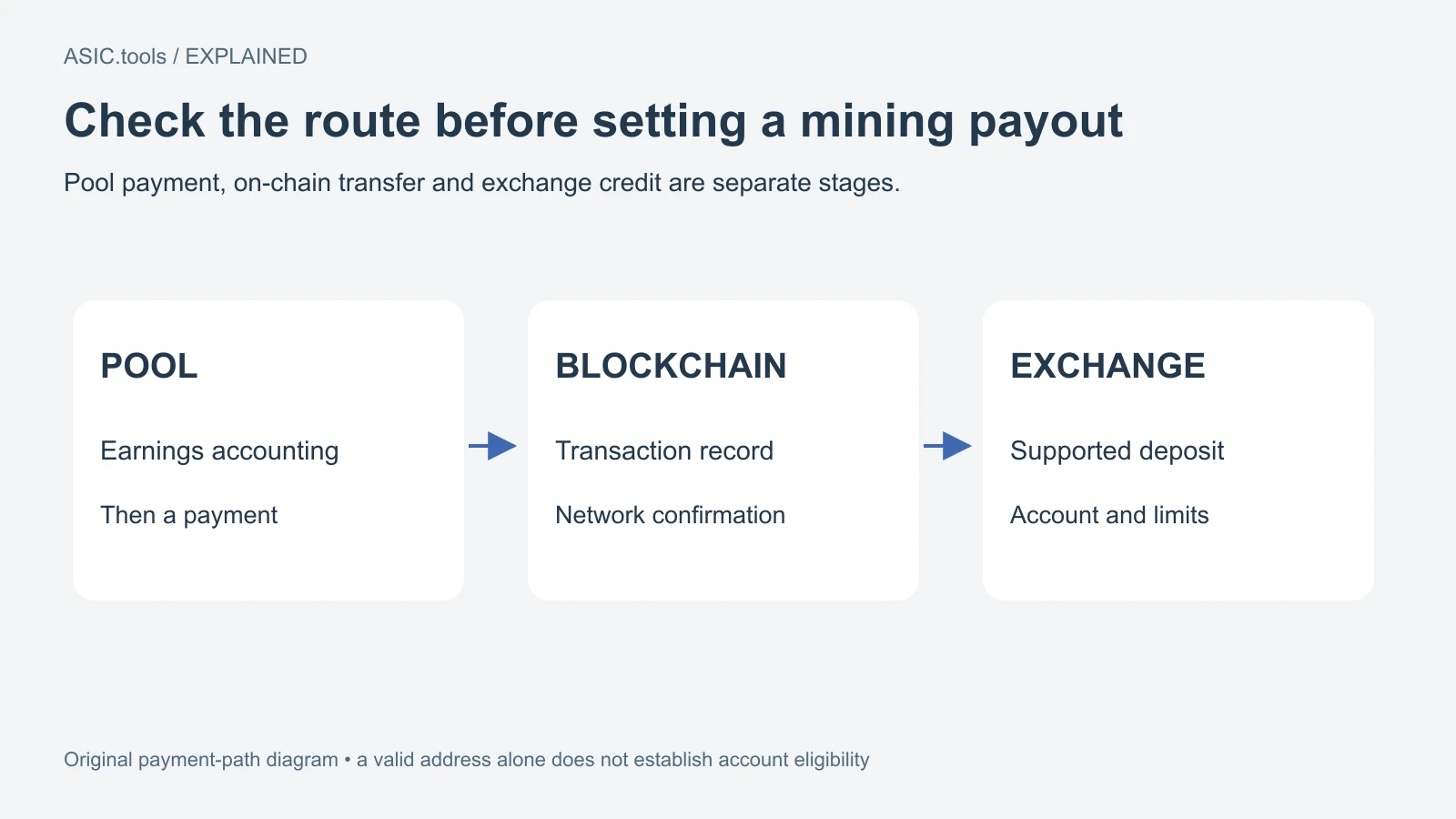
A pool payout and an exchange withdrawal are different steps
Monero is a proof-of-work cryptocurrency: miners perform calculations to help secure its blockchain. XMR is its ticker. Unlike Bitcoin’s SHA-256 ASIC mining, Monero uses RandomX, an algorithm designed around general-purpose processors. This exchange announcement does not change that mining process or the network reward rules.
A pool first accounts for the miner’s earnings, then sends a payment; an exchange separately decides when and how to credit a supported deposit. Later withdrawing from that exchange is another action. A limit or review at one stage does not mean the blockchain itself has stopped operating.
Keeping payout records helps distinguish these stages. A pool statement, transaction identifier, exchange deposit entry and withdrawal record answer different questions. None should be treated as interchangeable proof of a final spendable balance in every service.
The practical change is narrower than the headline
The reversal removes the specific questions Sethi described and keeps XMR supported where Kraken makes it available. It is meaningful for affected customers, while falling short of a worldwide reopening or unrestricted movement of Monero.
Before your next transfer, use the official account and support pages to check three things: whether XMR is available for your residence, what your remaining transfer allowance is and whether the account has an unresolved request. That turns a broad announcement into a decision about your own payment route.
Do not change a pool address in response to a stranger claiming to arrange a Kraken migration. The statement is about how the exchange questioned some clients, not an instruction to surrender wallet secrets, buy new mining hardware or move through an unofficial service.
Source: Kraken / Arjun Sethi ↗ · Kraken deposit and withdrawal limits ↗ · Kraken regional restrictions ↗ · Monero mining explained ↗ · Statement reported by TronWeekly ↗
Mining calculator ↗