Heatbit puts Bitcoin mining inside a water-heater element: what Bitwater promises
Source checked: 2026-10-23 · Editorial analysis published: 2026-10-23
Bitwater is open for preorder with first shipments planned for Q1 2027. It reuses mining heat in an existing tank, but the advertised limits are not a guaranteed income or one tested operating mode.
A familiar household job, with a different source of heat
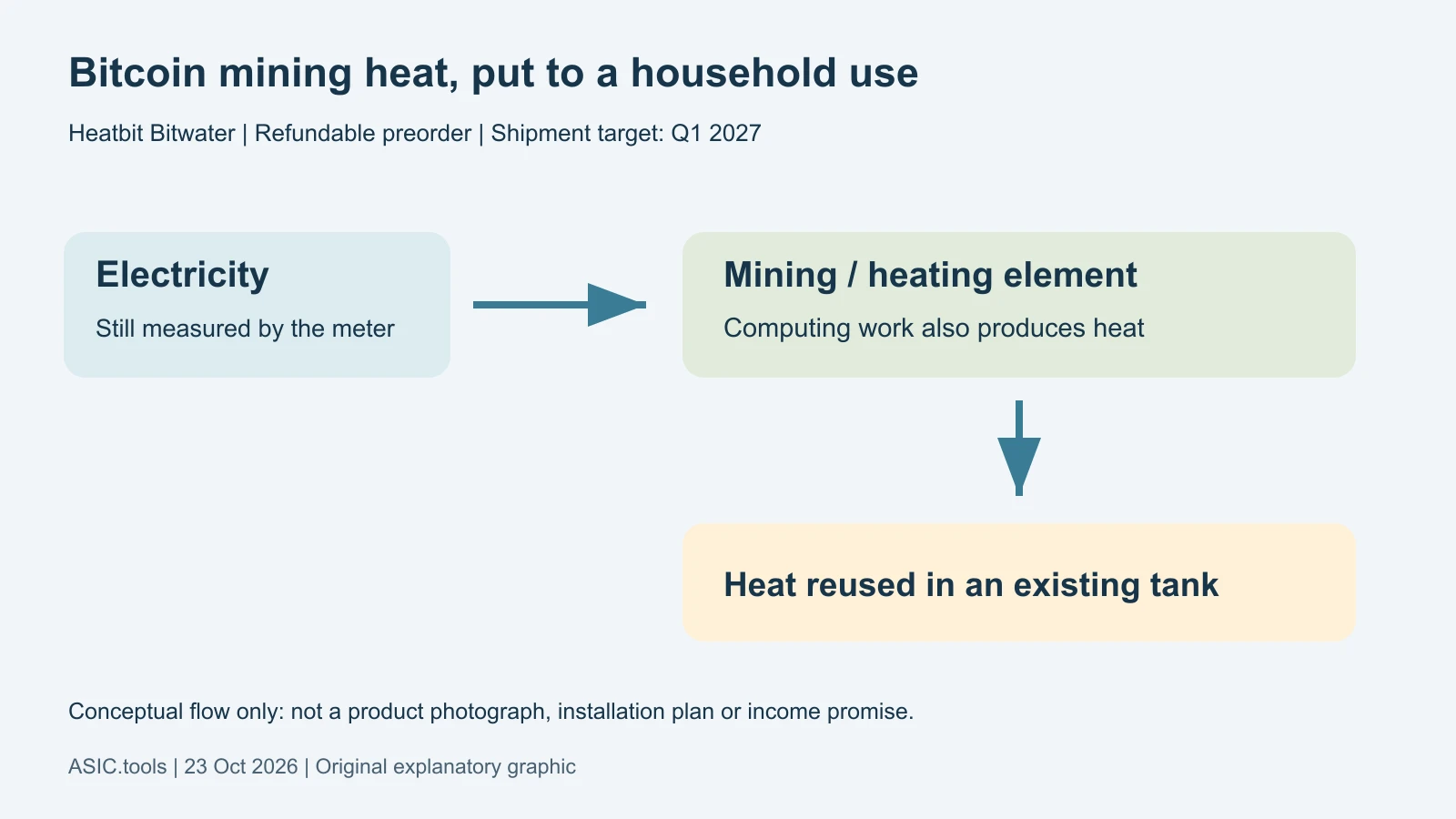
Heatbit is taking refundable preorders for Bitwater, a Bitcoin miner built into a replacement water-heater element. Its current product page, checked on October 23, targets first deliveries in the first quarter of 2027. The idea is straightforward: use the heat from mining to warm water in a tank the household already owns.
This is a new product offer, rather than evidence that customers have already received working units. For a home miner, the attraction is having a useful destination for heat instead of treating it only as something a fan must remove. Whether that makes sense depends on the household’s water demand and existing heating system.
What an ASIC is doing in the tank
An ASIC is a chip designed for a particular computing job. Here, twenty BM1370 chips perform the calculations used to mine Bitcoin. Heatbit places the mining assembly inside an element with Eco Brass heatsinks; heat passes to the surrounding tank water. A separate controller supplies it and connects to Wi-Fi and the Heatbit app.
The manufacturer says Bitwater replaces the lower element in a compatible tank. The existing upper element and thermostat remain available for heavier hot-water demand. That matters when reading the power figures: the mining element is not the household’s entire water-heating installation, and the other heater can still consume electricity.
Three advertised numbers, not one measured mode
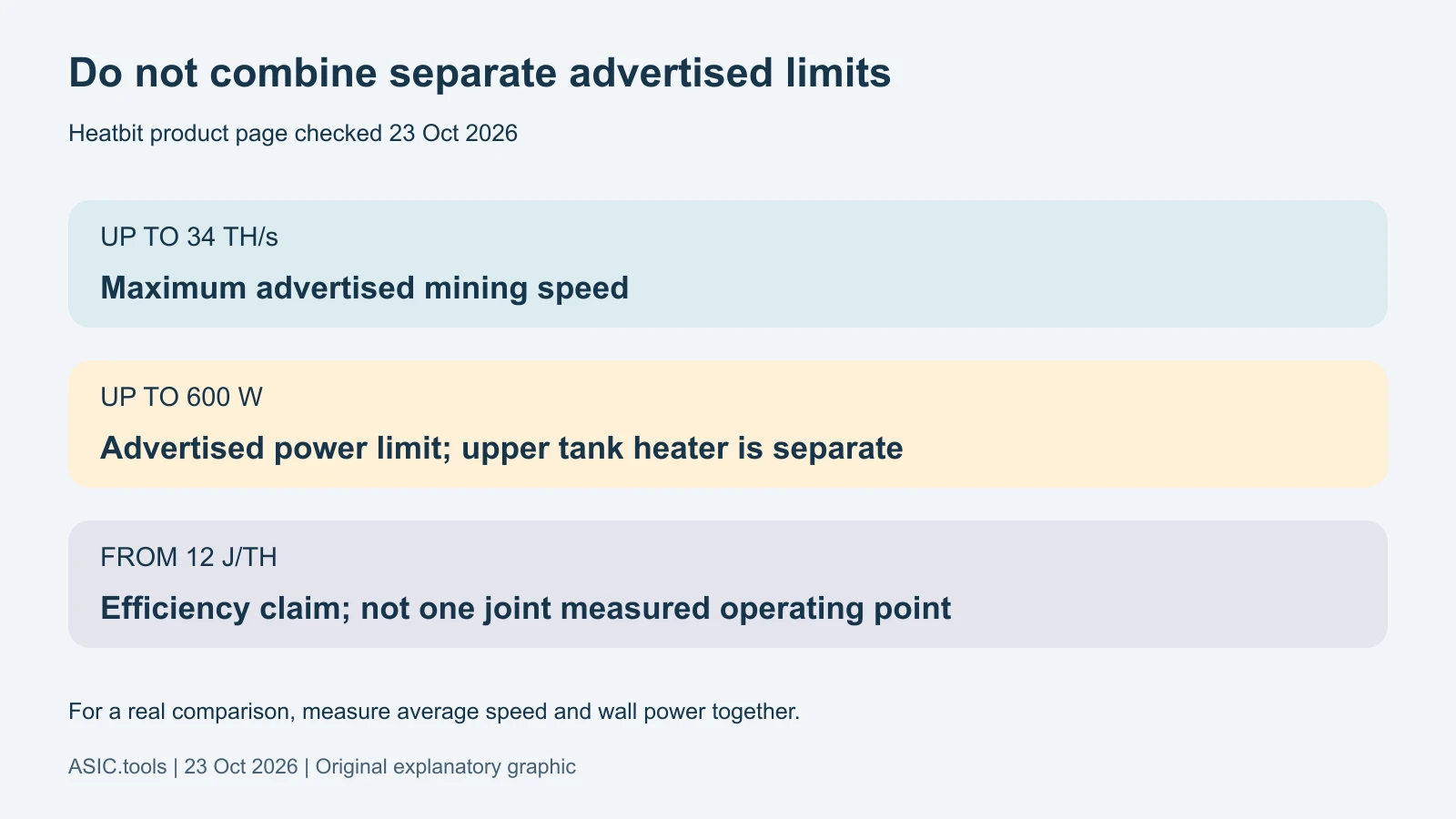
The page advertises up to 34 TH/s, up to 600 W and efficiency starting from 12 J/TH. TH/s means trillions of mining calculations each second; watts describe the rate of electricity use. Joules per terahash describe energy per unit of work, so a lower number can indicate better mining efficiency when measured on comparable terms.
Those are separate limits under automatic tuning, not a published joint test point. Multiplying the highest speed by the lowest energy figure does not establish the device’s actual input power. A useful performance test would record average speed and wall consumption together, at the same water temperature and settings. The page’s promise of high utilization is also a design claim, not a household usage log.
Useful heat still needs electricity
Mining converts electrical energy into heat while doing computing work. Reusing that heat can replace some heating that would otherwise be required; it does not turn the electricity meter off. Savings depend on how much of the heat the home needs, when it needs it and the price of that electricity.
The relevant comparison is the existing heater. An electric resistance element and a heat-pump water heater use different methods, so the same economic claim should not be copied between them. Heatbit currently targets conventional electric storage tanks; it says options for gas and heat-pump systems will come later. Extra hot water that nobody needs is not automatically a saving.
Compatibility comes before mining income
Heatbit describes compatibility with 30–80 US-gallon electric tanks using a 1-inch NPSM screw-in port in the United States and Canada. It offers to check a tank’s model label. That is more specific than “fits every water heater,” and the company’s planned listing at shipment should not be confused with a verified certification already issued for this new model.
The kit includes the element, controller and leak sensor. The app is intended to show operation and allow schedules and temperature control. These are manufacturer descriptions, not our installation test. The useful next evidence is a complete model-specific manual, final certification details and performance readings from delivered devices.
Heatbit states a one-year warranty from shipment and says heating continues without an internet connection, while mining needs one. These are separate promises: network independence does not mean independence from electricity. A tank may still provide heat when mining connectivity fails, so the app’s mining state and the water-heating function should be read separately.
Bitcoin earnings are a separate question
The company says the default is solo mining on its Heatbit pool, with alternative pools selectable in the app. A pool coordinates mining work; in solo mining, a small participant can wait a very long time for a block. A large headline payout is a possible outcome, not a regular salary. Shared-pool arrangements distribute rewards differently.
Compare the preorder with your actual tank, heating needs and tolerance for waiting, rather than a promised daily income. Bitcoin price, network competition, pool terms and delivery timing can all change the result. Bitwater is an interesting way to reuse mining heat; today’s verified status is a preorder with a Q1 2027 shipment target, not a proven return from a device already in your home.
A useful home record would keep delivered hot-water use, electricity use and received Bitcoin as three separate observations. A pool balance is not the same as a payment received in a wallet, just as a maximum speed on a product page is not a day-long average. Keeping those categories clear makes a later household comparison possible without assuming a fixed return.
Source: Heatbit ↗
Mining calculator ↗