German day-ahead power reaches €351.48/MWh: what it means for a running ASIC
Source checked: 2026-11-10 · Editorial analysis published: 2026-11-10
SMARD’s November 10 delivery schedule averages €351.48/MWh. That is a wholesale energy price, not a new household tariff or an all-in hosting quote.
Another expensive delivery day
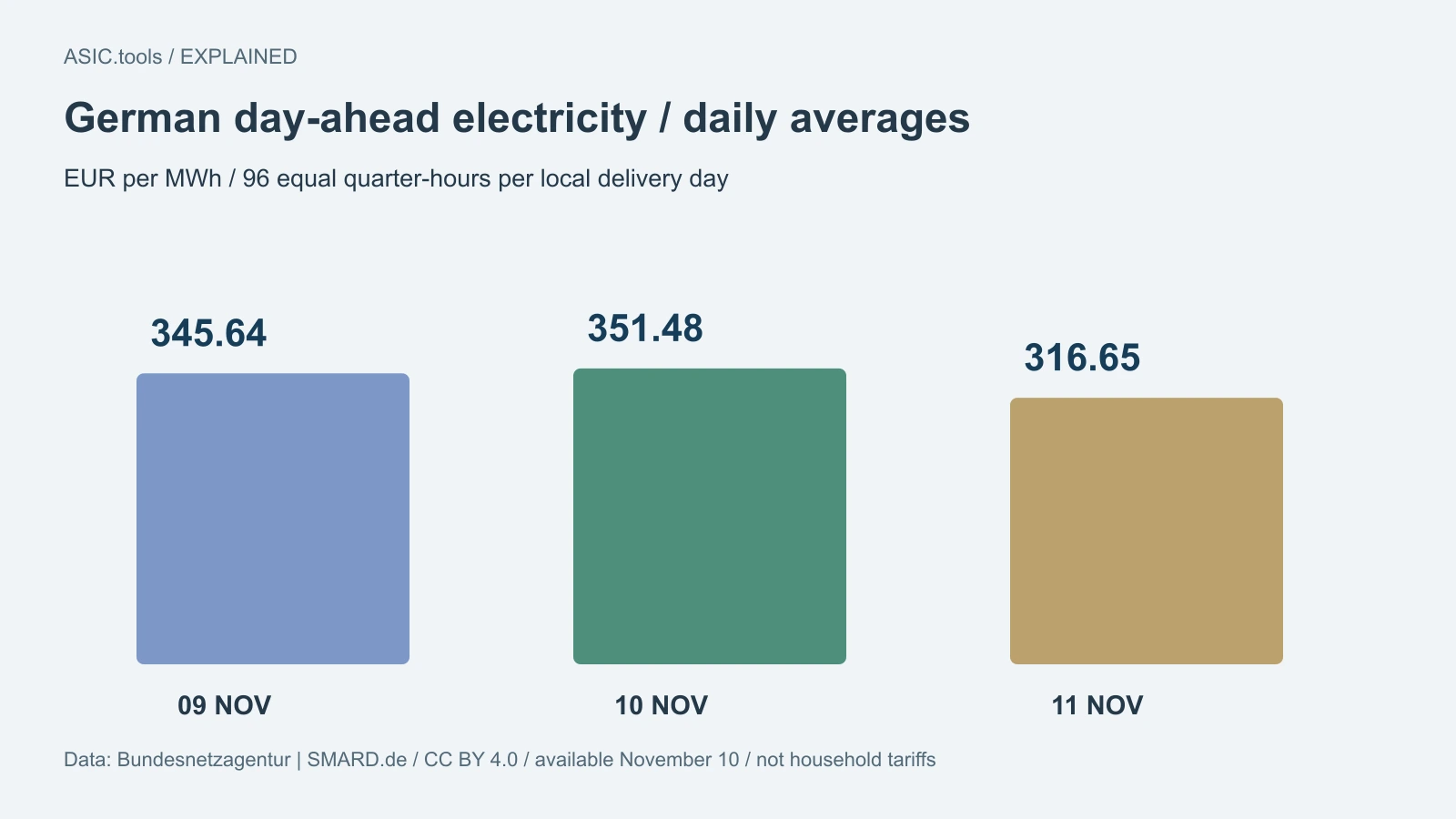
Electricity for November 10 delivery in Germany’s day-ahead market averages €351.48 per MWh in the Bundesnetzagentur’s SMARD data. Our calculation uses all 96 equal-length quarter-hour prices for the local calendar day. It follows €345.64/MWh on November 9. For a miner whose electricity contract follows these market prices, energy remains a large operating expense even before network charges and other bill items.
Day-ahead means the prices are agreed for specified delivery intervals ahead of consumption. They are not a live reading of what every household is paying. A fixed-price customer does not automatically receive a new tariff when an auction price rises. The effect on an ASIC owner depends on the electricity contract, the hours the machine runs and the complete price that actually reaches the bill.
Put MWh and kWh on the same scale
One megawatt-hour is 1,000 kilowatt-hours, so €351.48/MWh is approximately €0.35148/kWh for the wholesale energy component. It is easy to lose a factor of a thousand when copying a market headline into a mining calculator. Neither number yet includes every possible charge a retail customer pays. Taxes, network fees and supplier charges depend on the actual contract and location.
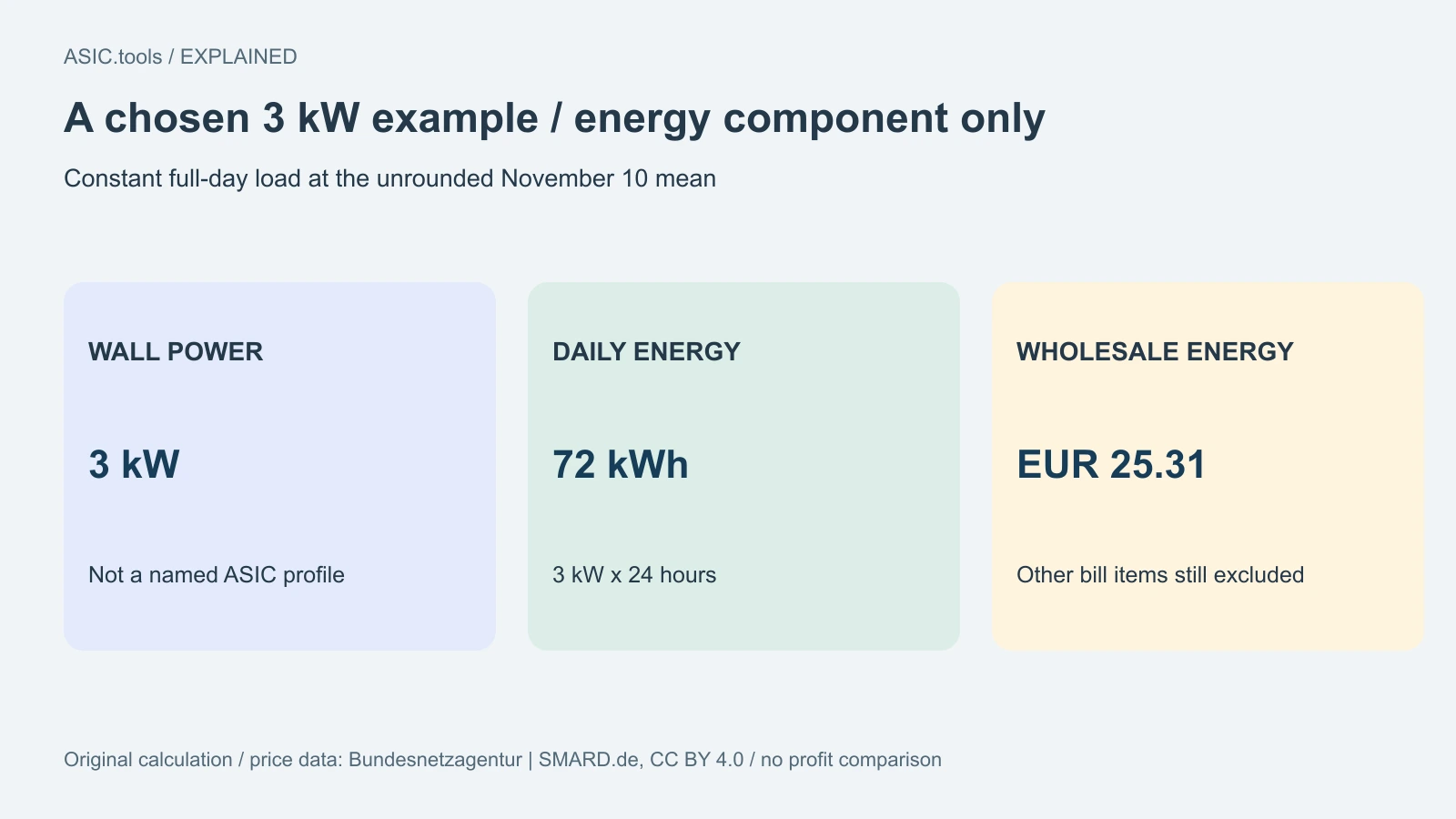
For an illustrative machine drawing 3 kW at the wall continuously, 24 hours means 72 kWh. Applying the unrounded SMARD daily mean gives about €25.31 for that day’s wholesale energy component. This is a chosen power example, not the specification of a named ASIC or a household electricity quotation. A real setup’s meter should also capture pumps, cooling and other equipment outside the miner’s own reported power.
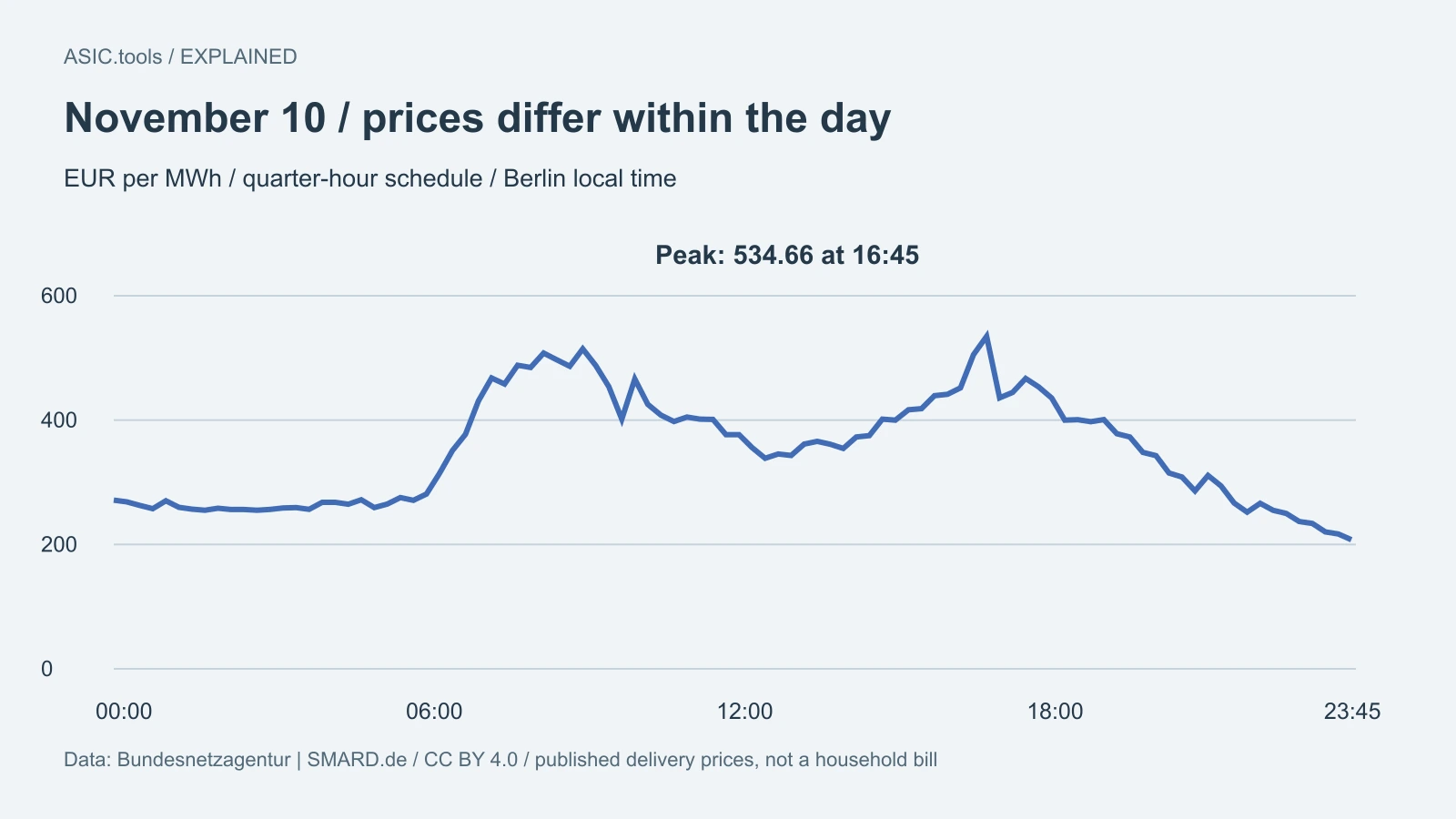
The daily mean hides expensive intervals
The November 10 schedule ranges from €207.71/MWh at 23:45 to €534.66/MWh at 16:45, in Berlin local time. These are quarter-hour delivery prices, not a claim that each value lasts an hour. On November 9, the highest interval was €653.38/MWh at 17:15; four of that day’s quarter-hours were above €600/MWh. Yesterday’s peak should not be mistaken for today’s schedule.
A daily arithmetic average is appropriate for comparing the energy component of a constant load across the full day. A miner that changes power or stops for selected intervals needs a consumption-weighted calculation instead: energy used in each interval multiplied by that interval’s applicable price, then added together. Using the daily average after operating only at particular times can hide the difference that the schedule was meant to capture.
A published tomorrow is not a forecast model
At our November 10 check, SMARD also contained all 96 day-ahead intervals for November 11. Their arithmetic mean was €316.65/MWh. These are published market prices for the following delivery day, rather than our prediction of future auction results. The lower next-day mean still does not become a universal all-in tariff or a guarantee of profitable mining.
Keep delivery dates with the figures when comparing them. A chart may show yesterday’s completed delivery, today’s already published schedule and tomorrow’s auction result beside one another. All three can be valid, but they answer different timing questions. In this report, dates follow the Europe/Berlin calendar; the market’s local time should be checked before copying a schedule into equipment operated in another timezone.
What a flexible miner can compare
An owner on an applicable dynamic contract can compare expected net mining receipts during an interval with the avoidable electricity cost of running through it. That decision should use the contract’s complete marginal charge, not only the wholesale number in a news headline. A hosting customer may instead be paying a fixed contractual rate, so the same market movement can reach that customer differently or later.
If stopping is part of an operating plan, count the equipment that continues to consume power and the time needed to resume useful work. A machine cannot always move instantly from full earning speed to zero consumption and back. The useful comparison is the money kept after the actual energy used, alongside any operating restrictions, rather than a screenshot of the lowest interval price.
Recheck the bill, then the calculator
The SMARD series gives a transparent source for the market component: we retained the raw quarter-hour data, the timezone and the averaging method. The data are attributed to Bundesnetzagentur | SMARD.de under CC BY 4.0. No weather explanation or claim about why individual miners switched off is inferred from the price series alone; those would need their own evidence.
For a personal budget in the ASIC.tools calculator or My farm, use the tariff that actually applies to your machine and the same currency for costs and revenue. This report’s euro calculation is not a comparison with a dollar Bitcoin revenue figure or a Ukrainian supply offer. The immediate news is the expensive delivery schedule; the practical response is to check how that schedule enters your own bill before changing the mining plan.
Source: Bundesnetzagentur | SMARD.de ↗ · SMARD market data ↗ · SMARD data use and CC BY 4.0 ↗
Mining calculator ↗