Home mining has a different power bill: new EIA figures show the gap
Source report: 2026-10-23 · Editorial analysis published: 2026-10-24
The October 23 release puts August U.S. residential electricity at 18.16 cents/kWh, versus 9.64 cents for industry. We explain what these averages can—and cannot—tell a home miner.
New figures, older bills
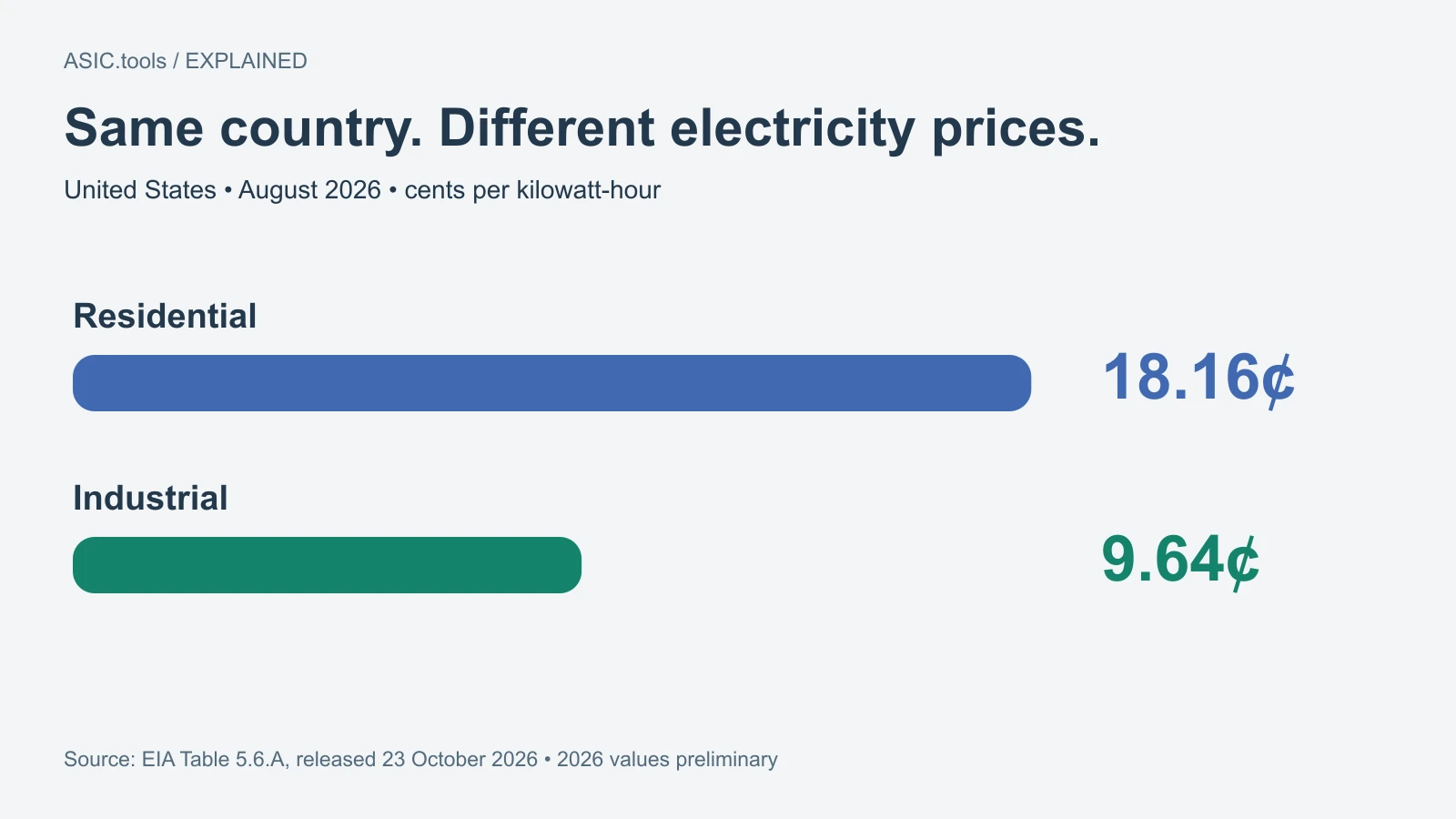
The U.S. Energy Information Administration published a fresh electricity report on October 23. Its national average residential price for August 2026 was 18.16 U.S. cents per kilowatt-hour, compared with 17.57 cents a year earlier. For anyone trying a miner at home, the useful message is simple: cheap industrial electricity in a mining-farm presentation is not automatically the price at your socket.
The same table puts industrial electricity at 9.64 cents/kWh, up from 8.98 cents in August 2025. Residential electricity therefore cost about 1.88 times the industrial average in this comparison. These are U.S. sector averages for August, not a new October tariff, a worldwide price or a retail offer available to every customer.
The report compares the same month in two different years. That avoids treating an August figure as if it were an October reading, but it still does not explain the causes of each price change. The table does not isolate data-centre demand, mining demand, fuel costs or network spending. Blaming one of them from this comparison alone would go beyond the evidence.
What a kilowatt-hour buys
A kilowatt-hour is a quantity of energy: a device drawing one kilowatt for one hour uses one kWh. Watts describe how fast electricity is being used. That is why a miner's power rating needs a running time before you can estimate its bill.
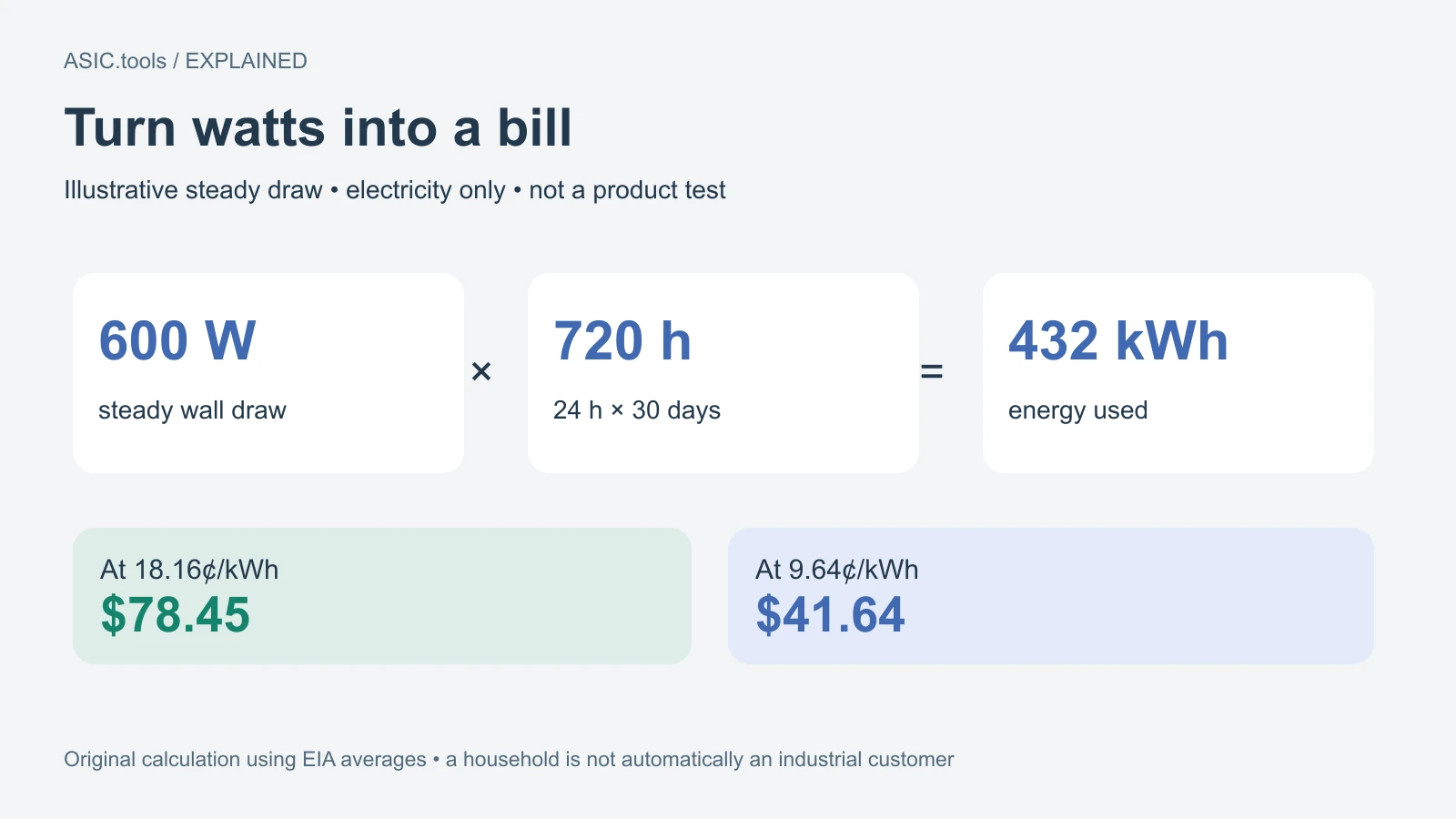
Take an illustrative device drawing a steady 600 W from the wall. At 24 hours a day for 30 days it uses 432 kWh. Applying the residential average gives about $78.45; using the industrial average gives about $41.64. The roughly $36.81 difference is electricity alone. This is a calculation, not a measurement of any named product or a claim that a household qualifies for industrial service.
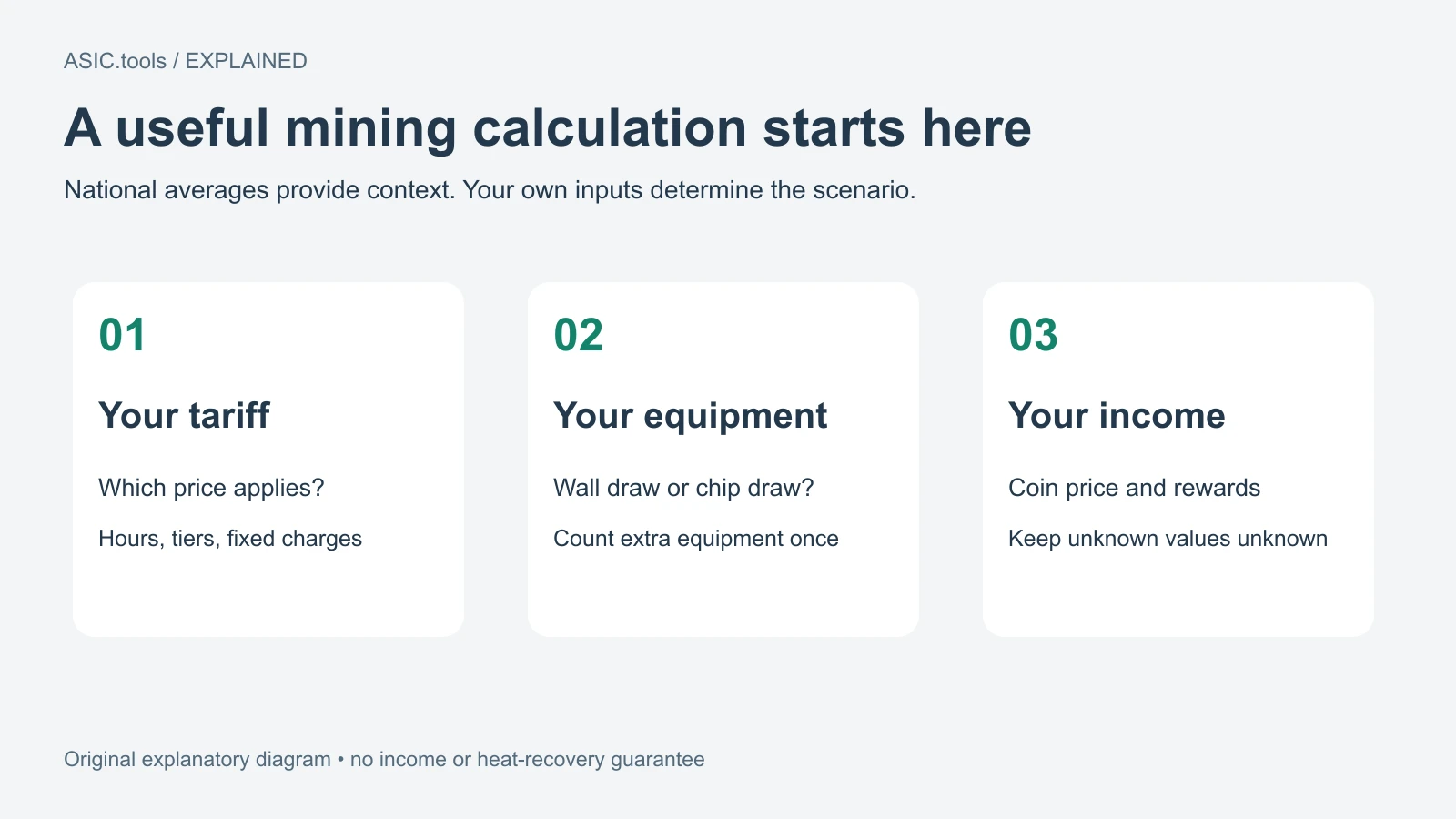
Keep the measurement boundary consistent. If your input already describes total power at the socket, do not add the same built-in fan or power-supply losses a second time. If a specification describes chips alone, it is not necessarily the whole device. Separate cooling or other equipment still needs its own allowance when it draws additional electricity.
Why your own result will differ
EIA marks 2026 figures as preliminary estimates and 2025 figures as final. The national average does not describe every state, utility or contract. Customer classification also matters: a small miner in a spare room does not become an industrial account merely because its owner uses it for work.
Start with the applicable price on your own bill. Time-of-use rates charge different amounts at different hours; a tiered plan changes the price after a consumption threshold. Fixed charges and other bill components also need checking, especially when comparing a proposed new service with an existing one. A national average is useful context, but it cannot replace that tariff.
An average is a summary of customers who already bought electricity under many different arrangements. It is not the marginal price of the next kWh in your home. Adding a continuously running miner may change your bill differently from simply dividing a previous bill by consumption, especially under a tiered or time-dependent plan.
A power bill is only half of mining income
Mining revenue is separate from electricity cost. Hashrate means the computing work a machine attempts each second; it does not fix the value of its rewards. The coin price, network competition, pool terms and actual running time all affect what remains after expenses. This electricity table alone cannot establish whether a particular miner is profitable.
The new release is a good reason to revisit assumptions rather than copy someone else's cheap-power scenario. In the ASIC.tools calculator, use the device's relevant wall-power figure and your own tariff. For a farm, include the machines that actually run together. If income is unknown, leave it unknown instead of turning a low electricity estimate into a promise of profit.
A heater that mines adds another comparison: how much useful heat replaces heating you would otherwise pay for? All its electricity still has to be paid for. If the room does not need that heat, calling it free heating does not remove the consumption. EIA reports electricity prices, not a test of heat recovery or a guarantee that mining rewards cover a household bill.
Put the units next to the inputs
If a calculator asks for dollars per kWh,18.16 cents becomes $0.1816, not $18.16. Likewise,600 W becomes 0.6 kW before multiplying by hours. A misplaced unit can overwhelm every other assumption even when the device specification itself is correct. Keep the currency and energy unit visible when comparing someone else’s calculation with your own.
The example’s 600 W is a deliberately stated steady wall draw, not an assignment to Heatbit Bitwater or another named miner. A product’s separately advertised maximum power and maximum hashrate do not automatically describe one operating mode. Select a matching profile or retain what is unknown; a price table supplies neither a device test nor the missing income figure.
Source: U.S. Energy Information Administration ↗
Mining calculator ↗