Bitcoin ETFs show another day of withdrawals, but the week still has a positive balance
Source checked: 2026-10-24 · Editorial analysis published: 2026-10-24
Farside’s available October 23 row shows $137.9 million in net outflows, with one fund still unreported. Across October 19–23, the reported figures total a provisional $301.2 million inflow.
Friday is negative; the available week is not
U.S. spot Bitcoin exchange-traded funds recorded another negative day in Farside Investors' available October 23 data. The table checked on October 24 shows net outflows of $137.9 million. One important detail remains visible: VanEck's HODL entry is a dash, not a reported zero, so the daily result is still provisional.
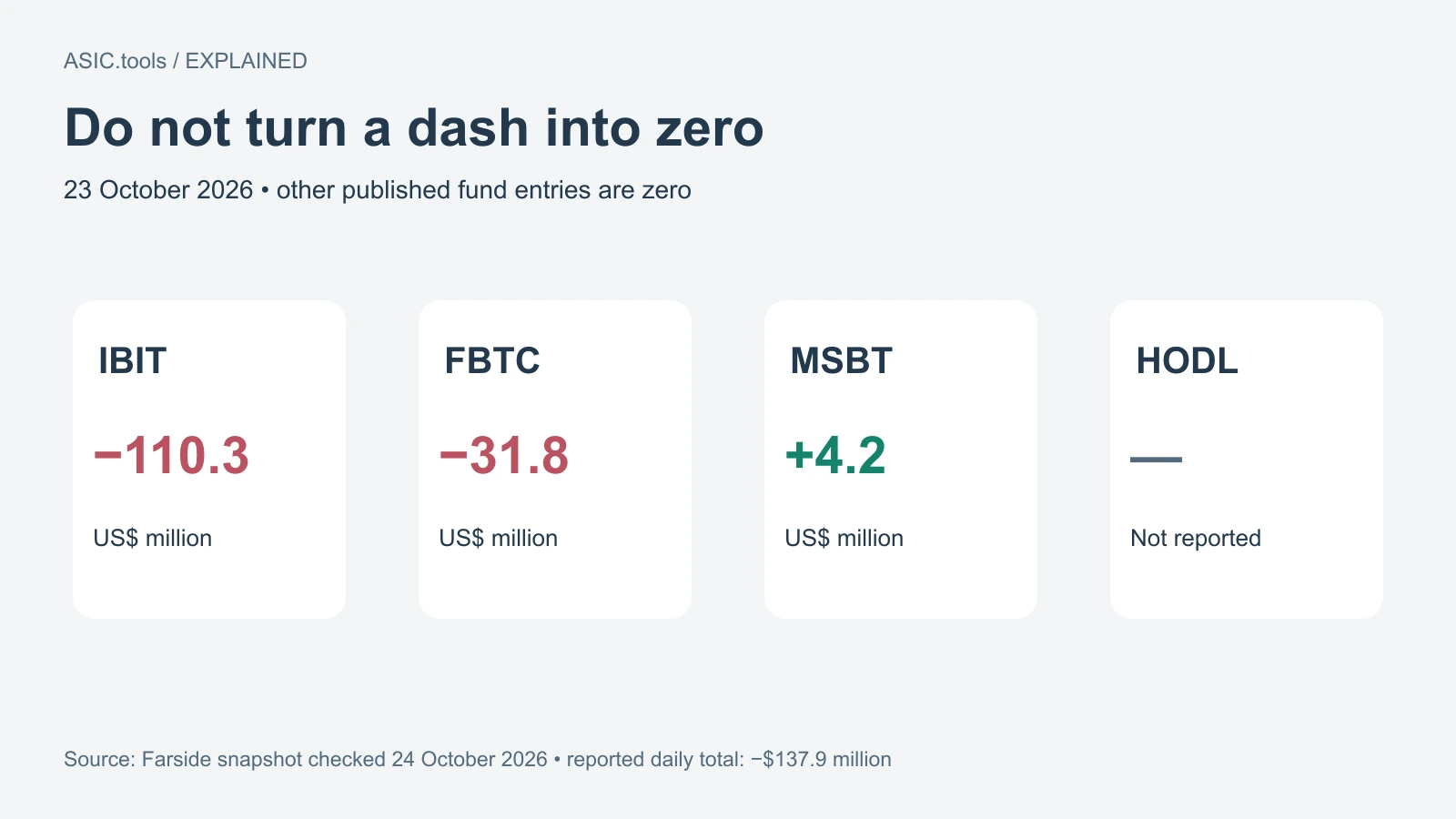
The same snapshot shows $110.3 million leaving BlackRock's IBIT and $31.8 million leaving Fidelity's FBTC, partly offset by a $4.2 million inflow into Morgan Stanley's MSBT. The other published entries are zero. These are flows into and out of fund products, not money leaving the Bitcoin network or coins being destroyed.
Read a dash as missing information, not as a very small number. In this table, zero and unreported are different states. The snapshot is dated so a reader can understand both the event day and when the data were checked. If the missing fund later reports a nonzero flow, the daily subtotal and the weekly addition both need updating.
The week changes the picture
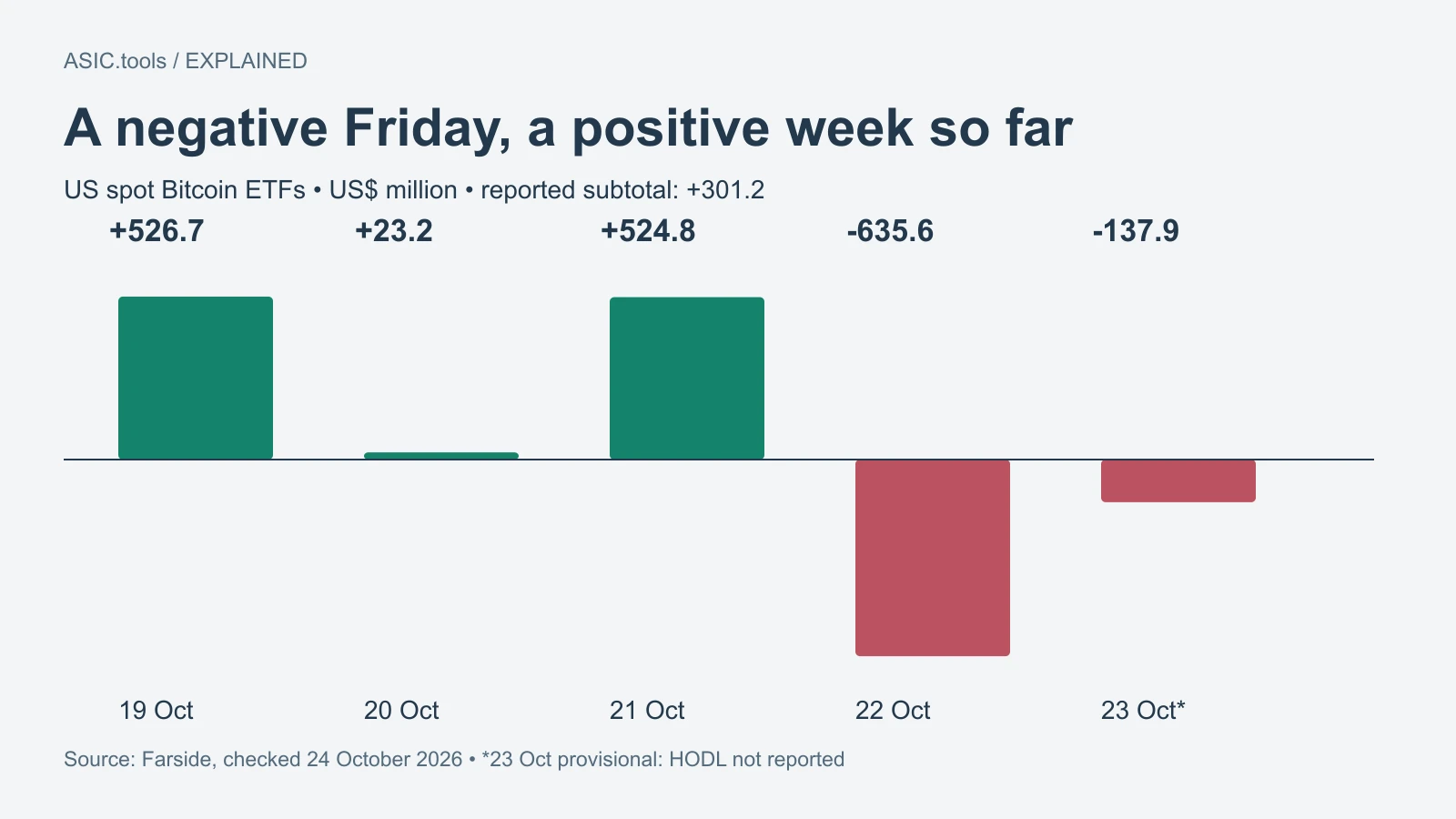
Farside's totals for October 19, 20 and 21 are positive $526.7 million, $23.2 million and $524.8 million. October 22 then records a $635.6 million outflow, followed by the provisional $137.9 million outflow on October 23. Adding those reported daily totals produces a positive $301.2 million for October 19–23.
That is an arithmetic subtotal from the available snapshot, not a final weekly figure while a fund is unreported. It also explains why a headline about a bad day can coexist with a positive week. The answer depends on the dates being compared, and late reports or revisions can change the total.
The subtotal uses Farside throughout, including its $524.8 million October 21 total. Mixing that with another provider’s rounded or differently timed Wednesday figure would create a different answer without any real new market event. Comparing sources is useful; silently combining their series is not a clean calculation.
What an ETF flow actually measures
An ETF is a fund whose shares trade on an exchange. A spot Bitcoin ETF provides exposure to Bitcoin through a fund rather than through coins held in the buyer's own wallet. Net flow tracks new fund-share creations minus redemptions. It is different from the dollar value of all shares changing hands between investors during the day.
A fall in the market value of a fund's Bitcoin is also different from a withdrawal. Prices can move without a matching change in fund shares. The flow table therefore tells one part of the demand story; it does not reveal every investor's motive or prove which single event moved Bitcoin's price.
Think of the difference between people trading existing concert tickets and the organizer issuing or taking back tickets. Trading activity and the number of tickets outstanding answer different questions. The analogy explains the accounting distinction only: a Bitcoin fund also has custody, operating rules and fees that a ticket example does not describe.
What this means for mining
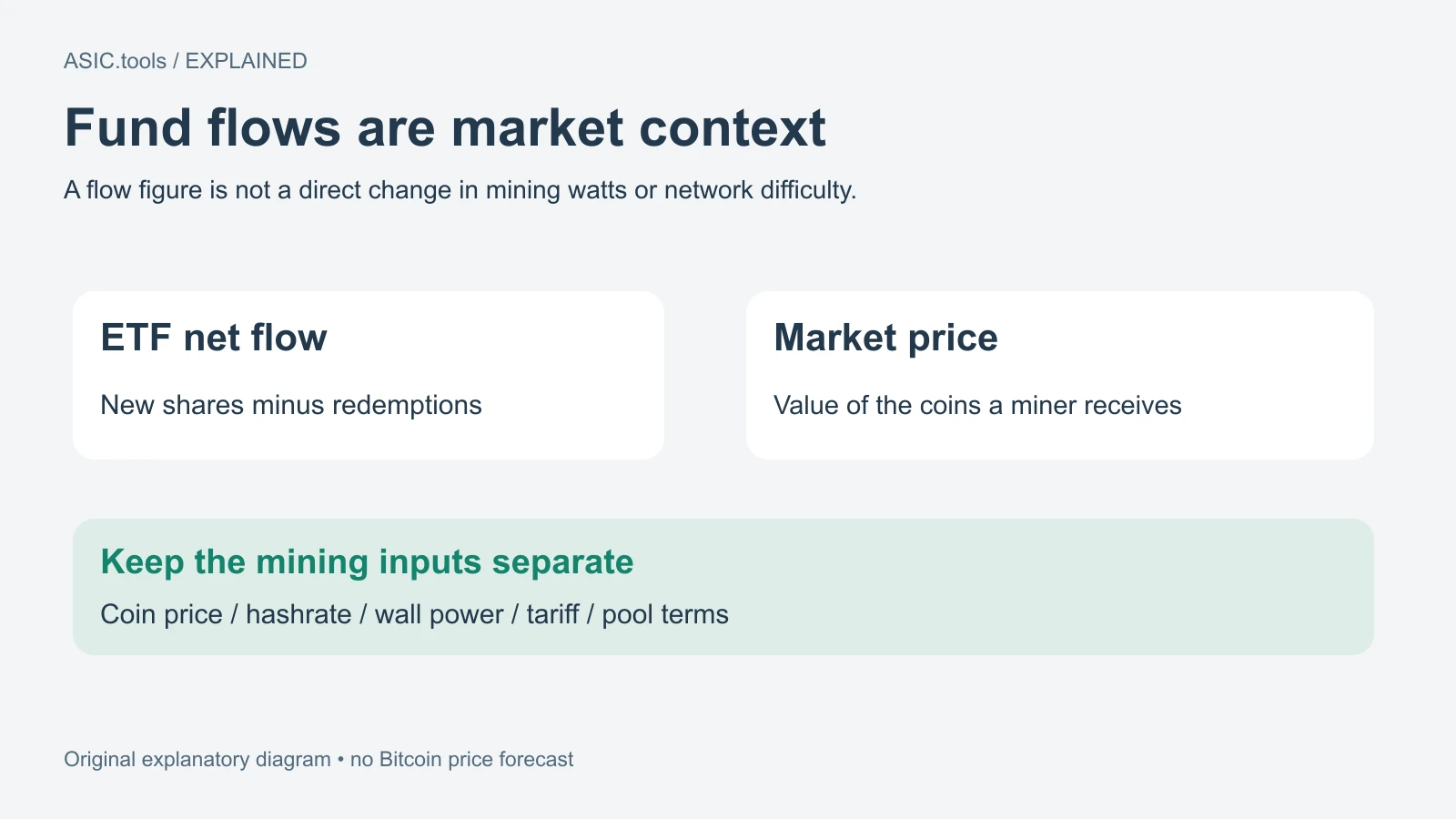
For miners, the connection is the value of the coins they receive. Changes in Bitcoin's market price can alter revenue measured in dollars or another currency even when a device's hashrate stays the same. ETF flows are useful market context, but they do not directly change a miner's watts, pool fee or the network's difficulty setting.
Do not put the $137.9 million outflow into a mining calculator as lost mining revenue. A useful comparison keeps the coin price, device performance, electricity tariff and reward assumptions separate. This snapshot is a report on fund flows, not a forecast of the next Bitcoin price or a reason by itself to buy a device, sell coins or change a pool.
Mining rewards are received in coins, while many expenses arrive in ordinary money. That makes a dollar-denominated revenue estimate sensitive to the price used at the time of calculation. A fund-flow headline cannot replace that price input, and a positive weekly flow cannot promise the sale price of next week’s mining rewards.
Keep the record reproducible
Save the provider, session dates and check date together. Dollar figures in this table are millions of U.S. dollars; they are not numbers of Bitcoin. The snapshot’s negative Friday and positive week are statements about different intervals, not competing claims about the same total.
A later complete table can legitimately differ from this provisional snapshot. That should be explained by newly reported or revised entries, rather than quietly presenting the old subtotal as a final number. A visible missing-data marker is part of the news, not a detail to erase for a tidier headline.
Source: Farside Investors ↗
Mining calculator ↗